How communities are putting a spotlight on anti-Asian racism
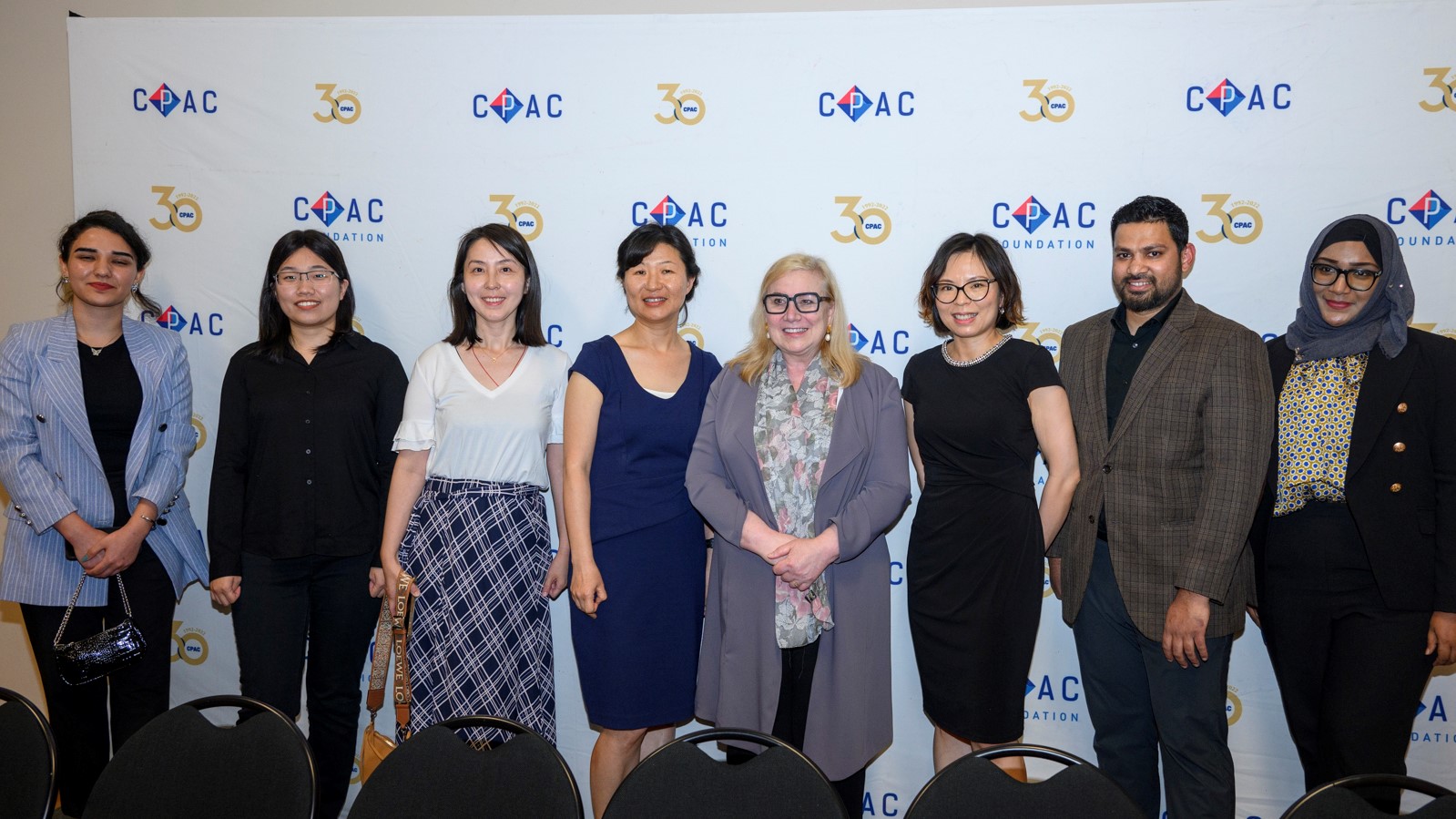
At an event hosted by CPAC to honour EDI trailblazers and the centennial of the Chinese Exclusion Act, Wendy Cukier, fifth from right, received an award and celebrated with other members of the Diversity Institute team.
On June 17, 2023, in Toronto, CPAC (external link) , formerly known as the Chinese Professionals Association of Canada, organized a public forum ahead of the 100th anniversary of the Chinese Exclusion Act to remember its significance and honour those who have fought for equity, diversity and inclusion (EDI) and the eradication of racism.
About 100 academic, community and corporate leaders attended the event. The keynote speech was delivered by Timothy Stanley, a professor at the University of Ottawa specializing in anti-racism. Stanley presented his research, which focuses on the history of Chinese immigrants in Canada and the relationship between racist exclusion, historical representation and contemporary racism. He discussed the resilience and the contributions made by Chinese Canadians throughout a century of systemic anti-Chinese and anti-Asian racism that persists today.
The event took place ahead of the centennial memorial of the Chinese Exclusion Act as a way to celebrate the path forward and included an award ceremony. Teresa Woo-Paw and Dr. Wendy Cukier were awarded the CPAC EDI award, which recognizes outstanding Canadians who have made significant contributions to the advancement of human rights, equal access and EDI.
“We aim to raise public awareness about the history and ongoing struggle against racism,” said Ti Wang, president of CPAC. “We also want to acknowledge the contributions of some exceptional leaders who have led the fight against racism, exclusion and inequity, so that their influence can be amplified and their work emulated and expanded.”
Woo-Paw is a former member of the Legislative Assembly of Alberta and a consultant at Teresa Woo-Paw & Associates Ltd. She has been an advocate for EDI for over 45 years and has built eight non-profit organizations to serve and advocate for marginalized communities. Woo served on the boards of numerous organizations and consistently tries to raise awareness, increase capacity and effect systemic changes toward a more equitable and inclusive society. She is the driver behind the National Remembrance Event of the 100th anniversary of the Chinese Exclusion Act (external link) and the designation of the Exclusion of Chinese Immigrants as an event of national historic significance.
Upon receiving the award Cukier, academic director and founder of the Diversity Institute (DI), said, “I want to express my gratitude for all this work and for being such a great partner over the last decade.” She highlighted the important impact CPAC has made on the lives of Chinese Canadians and Canada’s economy through their dedication and advocacy to support immigrant professionals with their credential recognition, social integration, skills upgrading, employment and leadership development.
Cukier echoed some of the themes discussed by Stanley during his presentation, emphasizing the extensive evidence of systemic discrimination, and anti-Chinese and anti-Asian racism at every stage of DI's work. She noted that the COVID-19 pandemic brought attention to the historical neglect of discrimination against the Asian community. During this period, DI and its partners drew attention to the disproportionate impact of the pandemic on equity-deserving groups, such as Chinese Canadians, in terms of employment, entrepreneurship, and physical and mental health. Cukier highlighted research in partnership with the Environics Institute (external link) and the Future Skills Centre (external link) , where DI showed that Chinese Canadians were among the hardest hit, in part because of the explosion of anti-Asian racism.
While the COVID-19 pandemic brought anti-Asian racism to the spotlight, one of the reasons it may get overlooked is because in general, people of Chinese background do well economically, Cukier said.
“But when you start to look at leadership, stereotypes and the representation of this very well-educated segment of the population in leadership roles, it tells you something about how decisions happen and how racism is baked into the processes,” she said.
Cukier pointed to (PDF file) CPAC research (external link) published in 2021 showing that Chinese Canadians are strongly underrepresented in leadership across all eight sectors observed. She said that while they represent 11.1% of the GTA population, they occupy 2.17% of leadership positions.
Cukier concluded by highlighting the federal government's 50 – 30 Challenge (external link) , which promotes the creation of diverse leadership teams. The challenge encourages organizations to achieve gender parity (50% women and/or non-binary people) and significant representation (30%) of members from other equity-deserving groups on Canadian boards and/or in senior management.
“We need tools like the 50 – 30 Challenge; we need strategies, and we need action,” she said.
Cukier highlighted that while there is a lot of work ahead, progress is being made, adding that “With our partnership with CPAC, we see lots of opportunities to move forward.”