Canadian Equity Diversity and Inclusion Summit analyzes allyship and embedding lasting change
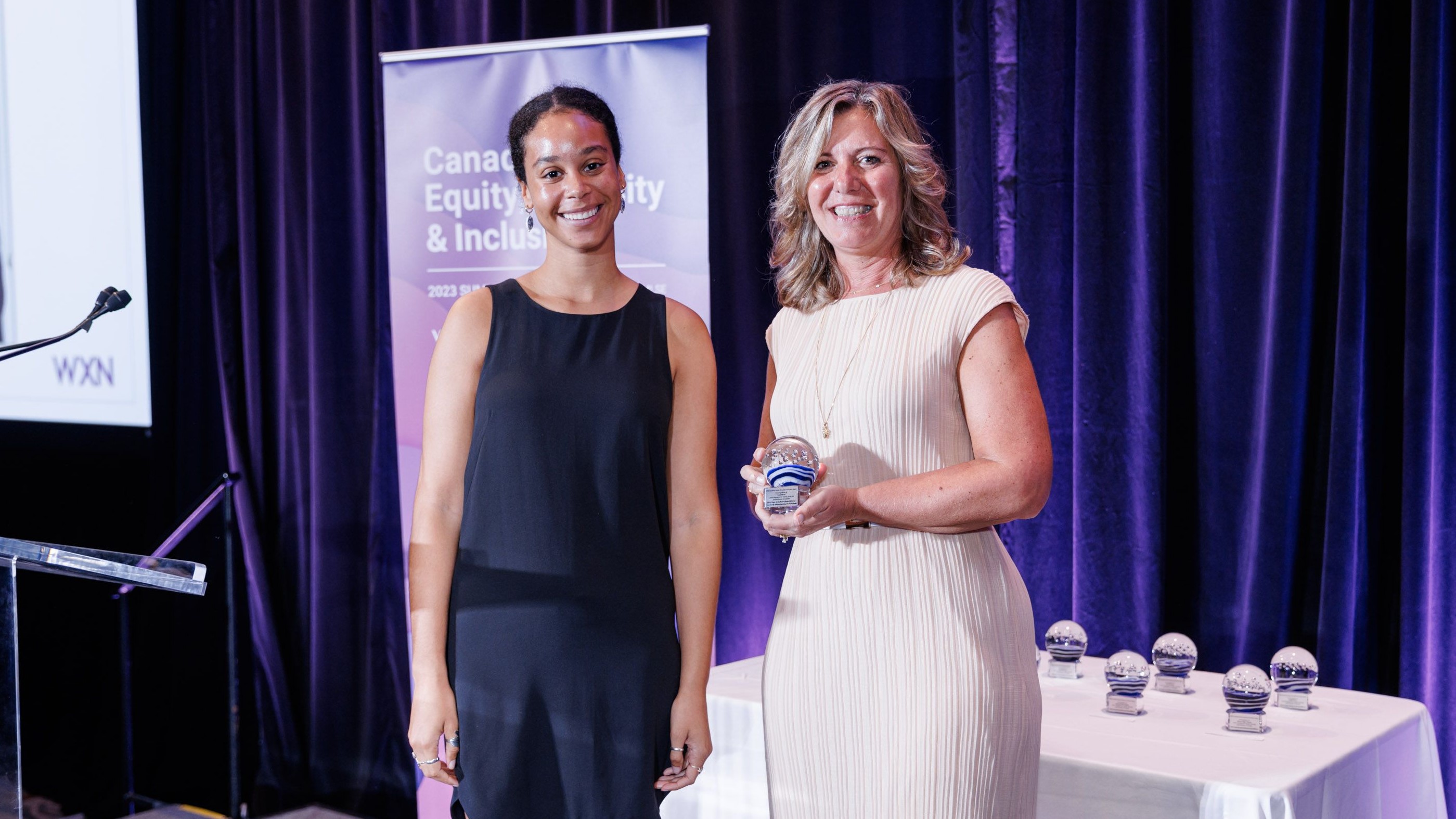
At the 2023 Women’s Executive Network Canadian Equity, Diversity and Inclusion awards, Nancy Mitchell, senior program manager at DI, presents the Chair of the Board 50 – 30 Challenge award to Joan Hertz, chair of the board of directors at ATB Financial and Edmonton International Airport, lawyer and strategic consultant. (Photo credit: Josh Fee/Portmanteau Media Inc.)
Hundreds of equity, diversity and inclusion (EDI) professionals gathered on June 1, 2023, to participate in the Canadian Equity, Diversity and Inclusion (CEDI) Summit and Awards, organized by the Women's Executive Network (external link) (WXN). The event provided a platform for individuals to share their experiences and explore ways to drive change within their organizations.
It was followed by the WXN CEDI Awards, which celebrated EDI change makers. Nancy Mitchell, senior program manager at the Diversity Institute (DI), presented the Chair of the Board 50 – 30 Challenge award to Joan Hertz, chair of the board of directors at ATB Financial and Edmonton International Airport, lawyer and strategic consultant. Chairs drive change, Mitchell said. She added that when they put EDI on the agenda, the rest of the organization is better equipped to deliver a supportive environment that outperforms. And it encourages leaders to lead by example, creating environments that are inclusive to all.
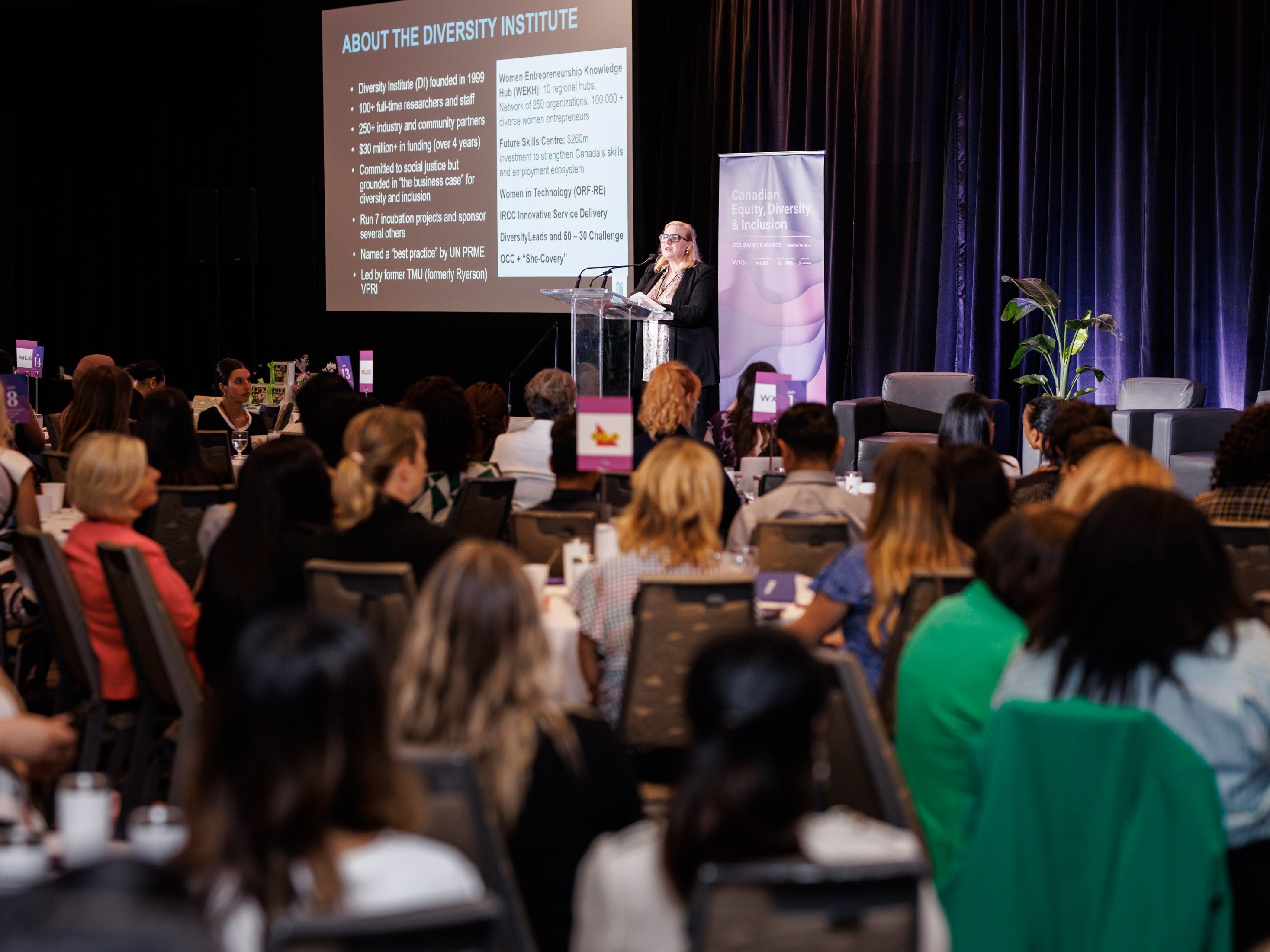
Hundreds of people attended the WXN CEDI Summit, where Wendy Cukier, founder and academic director of the Diversity Institute, presented data on women in leadership. (Photo credit: Josh Fee/Portmanteau Media Inc.)
Earlier that day, Wendy Cukier, the founder and academic director of DI led an interactive workshop, Diversity in Leadership. The presentation included insights from DI research about women in leadership that looked at eight Canadian cities. The report found that while women make up about one-half of the population, they represent 41% of people on boards. For non-white women, that difference is even larger, with racialized women representing 23% of the population but only 10% of people on boards. She cited a (PDF file) 2023 report by the Canadian Centre for Policy Alternatives, which discovered that among the 100 highest-earning CEOs in Canada, there were more men named Mark (four) than women (three).
To gauge attendees' priorities, Cukier conducted a live poll, asking, "What's your organization's top EDI priority?" The results identified governance, leadership and strategy, and values and culture as the primary concerns. Cukier acknowledged the significance of tone at the top and leadership in effecting change, while also stressing the need to address diversity from the outset of the hiring process. She highlighted the importance of human resources, despite it receiving only 9% of the audience’s votes. She advocated for treating EDI like other business functions which have clear targets and accountabilities.
Cukier emphasized the continued challenges faced by women in leadership positions and that there has been lots of progress but at a glacial pace. She highlighted competing gender and leadership stereotypes, noting that men are never called “bossy” because it is assumed they are leaders. Women who exercise strong leadership, on the other hand, are called “bossy” or worse, she said. She added that while the research shows men do not like working for women, it also shows most women also do not like working for women. “The stereotypes and biases run deep,” she said.
Cukier highlighted microaggressions as one reason many women are reevaluating their priorities and leaving the workforce. Microaggressions are just as debilitating as overt discrimination and maybe even worse, Cukier said, likening them to “death by 1,000 cuts.”
“Because they are so dependent on contact and may or may not be intentional, victims begin to second-guess themselves, asking themselves, ‘Am I just too sensitive?’ which adds to the stress,” she said. Cukier referenced the award-winning Micropedia project (external link) , a resource developed by DI, creative agency Zulu Alpha Kilo (external link) and other partners, including the Black Business and Professional Association (external link) . The project collects everyday microaggressions experienced by individuals and is a tool for unlearning biases.
What’s lacking in many organizations, Cukier said, is that while there are good intentions, a strategy, targets and accountability are often lacking.

Attendees use their smartphones to participate in a live poll during Wendy Cukier’s presentation at the WXN CEDI summit. (Photo credit: Josh Fee/Portmanteau Media Inc.)
Cukier concluded by highlighting the federal government's 50 – 30 Challenge (external link) , which promotes the creation of diverse leadership teams. The challenge encourages organizations to achieve gender parity (50% women and/or non-binary people) and significant representation (30%) of members from other equity-deserving groups on Canadian boards and/or in senior management. “It is a really good way for organizations to both signal their commitment and also to be held accountable,” she said, adding, “Because what gets measured gets done.”
The 50 – 30 Challenge has more than 2,000 signatories. The Diversity Institute, along with other organizations, has been tasked with providing support to organizations that want to advance their EDI strategy. The Diversity Assessment Tool (external link) proves an in-depth view of an organization's practices, processes and policies benchmarked against global best practices. Using a data-driven approach like this one helps to give context to where each organization is in its inclusion journey and focuses on continuous improvement.
The session attracted lots of interaction as participants discussed barriers and strategies for action. After the event, the conversation continued online, where people shared on LinkedIn (external link) that they joined the challenge.