Commemorating George Floyd's legacy and advocating for racial equity
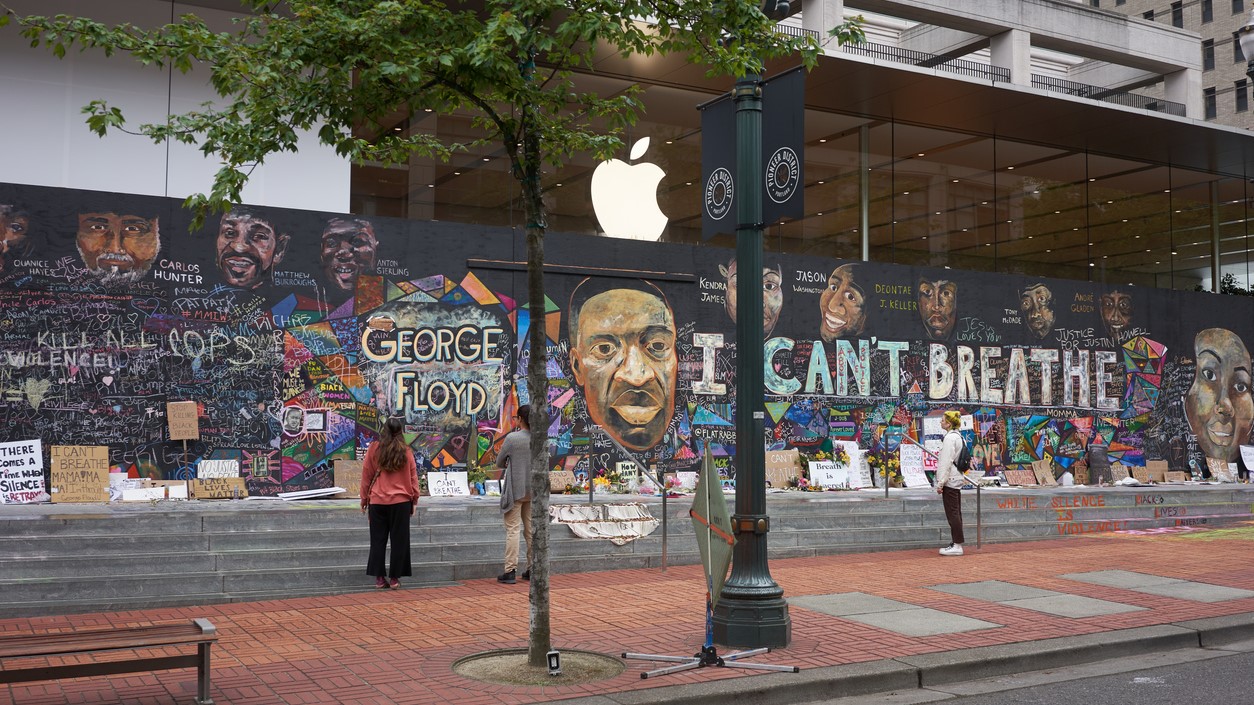
Portland, OR, USA - Jun 12, 2020: Passersby stop and take a look at the boarded-up Apple Store in downtown Portland's Pioneer Place, which has become an unofficial canvas for peaceful protest. Artists have also joined to promote peace over violence. (Photo credit:iStockPhoto)
The third anniversary of George Floyd's tragic death was commemorated by the Canadian Congress on Inclusive Diversity & Workplace Equity (external link) , which organized a memorial event in Toronto on May 25, 2023. The gathering brought together leaders from academia, government, community organizations and the private sector to advocate for the protection of Black lives and discuss the progress of social justice and economic empowerment for people of African descent.
The virtual event, co-hosted by Alex Ihama, executive director of the Canadian Congress on Inclusive Diversity and Workplace Equity, and Moy Fung, executive director of Solid Rock Family Services (external link) , addressed the progress and challenges in combating anti-Black racism. With more than 20 speakers, Ihama and Fung introduced the speakers and shared their lived experiences to connect the topics. Ihama emphasized the importance of collaboration: “If you get to the top of the mountain alone, you have lost. Let’s get to the mountaintop together.”
Ransford Jones, pastor and CEO of Destiny Gospel Centre in Markham, Ont., spoke about the spiritual implications of Floyd’s death. He opened his speech by offering prayers and thoughts to the friends and family of Floyd and all those who have lost loved ones due to anti-Black systemic racism.
Jones highlighted how Floyd’s death became a catalyst for change because it further exposed anti-Black racism and white supremacy in this modern era. “Many protested, prayed and advocated,” he said. “There was some political action taken, corporate commitments and policy changes were made.”
But more needs to be done, Jones added. “We want to move from intention to intentional actions, from articulation to substantial action. I believe that there is a generational opportunity to collaborate and to do what is right,” he said.
“It's important for us to understand and recognize that racism does persist in Canada, both on the individual level as well as the systemic level,” Fung said. “And we need to do what we're doing now—have conversations and take meaningful actions to promote change.”
Dr. Wendy Cukier, founder and academic director of the Diversity Institute (DI), was invited to present the available data on what has changed since George Floyd's murder. She noted that the discussions of anti-Black racism have entered the mainstream and highlighted Canadian data that reinforced the inequities shared by other speakers of their lived experiences.
The presentation addressed the underrepresentation of Black individuals in leadership positions. Cukier pointed to research DI conducted with TD that revealed significant disparities among boards of directors across eight Canadian cities. The (PDF file) Diversity Leads report found that among 1,639 Canadian corporate board members, only 13 (0.8%) were Black. This lack of representation hinders progress toward equal opportunities and perpetuates poverty, she said.
Turning to the school system, Cukier said it is one of the most striking reflections of anti-Black racism. She pointed to TDSB data (external link) that found Black students are four times more likely to be expelled from a Toronto high school than white students. “Education is the strongest pathway to social mobility and prosperity,” she said. But she also highlighted that 50% of Black students reported they feel like they do not belong, and the dropout rate is 20% for Black students compared to 11% for non-racialized students.
“We cannot change what happens in the boardroom if we do not change what happens in the classroom,” Cukier said, quoting DI’s executive director, Mohamed Elmi.
Cukier also highlighted the challenges Black business owners face, referencing Statistics Canada data (external link) that found the incomes of Black business owners are lower on average than the incomes of white or other racialized business owners.
“There are huge gaps in how we support Black businesses,” Cukier said, pointing to the State of Women’s Entrepreneurship 2023 research (external link) that found the proportion of small and medium-sized enterprises majority owned by racialized women entrepreneurs fell to 18.8% in 2020 from 23.5% in 2017.
Reflecting on the impact of George Floyd's murder, Cukier noted the establishment of the Centre of Excellence for Black Student Achievement within the TDSB (external link) and the creation of a federal Anti-racism secretariat (external link) , accompanied by a $30 million investment from the government. She noted that many companies and organizations have also announced initiatives to address anti-Black racism in Canada, including the BlackNorth Initiative (external link) , which encourages companies to increase the representation of Black board members to 3.5%.
Despite some progress, Cukier stressed the importance of using measurable targets and data-driven approaches to assess progress. Addressing anti-Black racism requires transformative changes in organizations, encompassing hiring practices, promotions and product delivery, Cukier said. She added that the workforce continues to show discrimination in hiring practices, citing Statistics Canada data (external link) that found 16% of Black workers are overqualified for their jobs, the highest rate among any Canadian-educated racialized group.
Cukier pointed to the federal government's 50 – 30 Challenge (external link) as a way to create change by creating a diverse leadership team. The challenge encourages organizations to reach two goals; gender parity (50% women and/or non-binary people) and significant representation (30%) of members of other equity-deserving groups on Canadian boards and/or in senior management.
"Diversity and inclusion skills are now core skills and must be integrated into performance measurement," Cukier said. Merely showing up for work is insufficient; individuals must actively contribute to advancing the diversity and inclusion agenda, she added.
To conclude the presentation Cukier, Ihama and Fung agreed that data is important to make progress in addressing anti-Black racism, a point that Henry Luyombya, a social worker for PEERS Alliance Inc., emphasized in the speech that followed. We can't make decisions without data, Luyombya said.
“The data is critical,” he said.
Lyombya urged attendees to continue to combat anti-Black racism by asking them to remember why this work is important: “The young people—those are the ones that we're doing this work for.”