Generous Futures: Supporting Refugee Resettlement
Canada is often touted as a welcoming new home for scores of people seeking asylum from various forms of oppression and persecution. What are the hard realities of resettlement? How are leaders mobilizing their resources, networks and efforts? What have we learned from recent events?
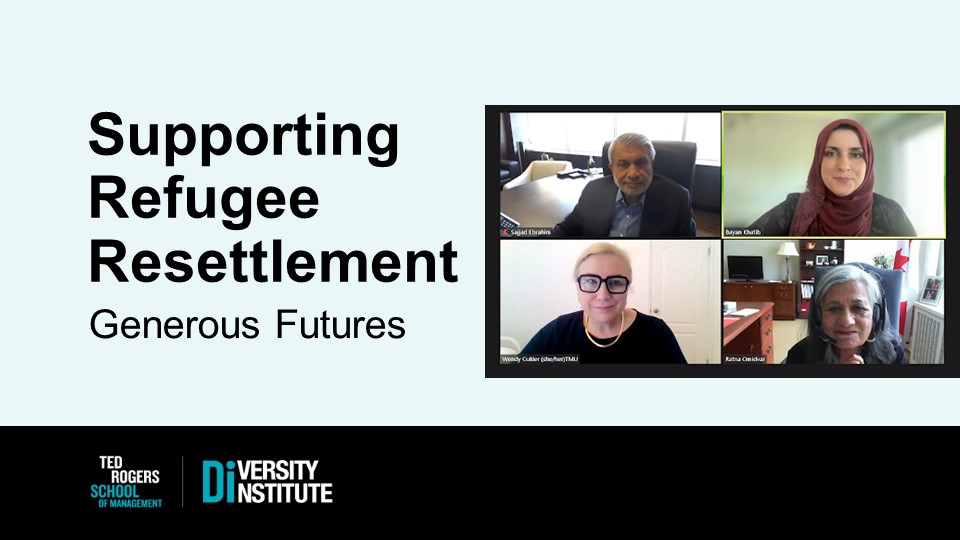
As global humanitarian crises continue to rise at an alarming pace, Wendy Cukier, Founder and Academic Director of the Diversity Institute, recounted her experience as the child of a refugee, a sponsor with Operation Lifeline (1979) founder of the Ryerson University Lifeline Syria Challenge [RU Lifeline Syria Challenge: Year in Review (external link) ] (2015), and more recently co-founder of Lifeline Afghanistan (external link) . She led a discussion with community leaders on the ways in which philanthropy impacts refugee resettlement as part of the Generous Futures: Driving Change for Good webinar series at Toronto Metropolitan University.
Each panelist weighed in on why, among many worthy causes, refugee resettlement is an important focus of their work and how to balance commitments to evacuations, humanitarian aid, pathways to Canada and support once refugees arrive.
Senator Ratna Omidvar is a co-founder of Lifeline Afghanistan with decades of experience supporting newcomers. She emphasized that while Canada is geographically distant from conflict, it does not exist in a vacuum: “We might be far removed from countries of conflict, but we know from history that if we don’t address displacement, that displacement will have an impact on our lives and how secure and prosperous we are…. I know we talk about compassion, but ultimately being responsive to what’s happening in other parts of the world is in the interest of Canadians.”
Dr. Sajjad Ebrahim, president of Sajjadiyya Trust and CEO of Lark Investments Inc, shared a similar perspective of enlightened self interest, noting that Canadians “have an obligation to the Afghan people that worked with the Canadian embassy. It’s a humanitarian thing, but it’s also nation-building. Canada needs more immigrants. We have one million vacant jobs. It’s a win-win situation for everybody, and I think it’s a good thing for Canada to do.”
Drawing on her experience as the co-founder of the Syrian Canadian Foundation, Bayan Khatib, Impact Manager at the Northpine Foundation, noted that “any one of us can become a refugee. We’re all vulnerable: war, insurrection, climate change. Being a refugee is a hardship that nobody sees coming, and nobody chooses. We need to be there for each other. While Canada brings refugees here for humanitarian reasons, we need these newcomers for Canada to thrive.” She also described some of the innovative programs the Northpine Foundation has supported, including one focused specifically on helping refugees settle in smaller communities.
Refugees make significant contributions to Canada, particularly through entrepreneurship. Refugees are more likely to start businesses than their Canadian-born counterparts, and are more charitable than those born in Canada. The panel celebrated Canadian refugee success stories and their impact on their local communities.
Panelists remarked on the role that refugee resettlement has in nation-building. “3 million Canadians were involved in some way or another with Syrian refugees. Private Sponsorship of Refugees was one of the most powerful antidotes to Islamophobia that we could have had, because those personal connections are so important,” Cukier noted.
Meaningful employment not only helps refugees to become financially independent and integrated in their communities, but it also has a positive impact on their overall wellbeing. Bayan Khatib noted that the recognition of foreign credentials and professional licensing remains a barrier to refugees seeking Canadian employment in their fields.
Lifeline Afghanistan and many community and industry partners, as well as organizations like the Diversity Institute and Future Skills Centre, are working to create pathways to employment by leveraging technology to match refugees and their skills with opportunities. Magnet (external link) , which was a key player in the RULSC, has launched a portal with the Diversity Institute to bridge the gap between refugee job seekers and employment opportunities by sharing information, services, and opportunities. The Future Skills Centre is also testing a range of innovative approaches to supporting the transition, including technology-enabled language training and tutoring, trauma-informed approaches to career pathing, and employer-centered programs.
Senator Omidvar spoke to how the government can better harness philanthropic dollars to benefit refugees, noting that charitable tax deductions offer a path: “Instead of making [private sponsorship] accidentally possible, we need to make it systemically possible. Private sponsorship releases not just money - it releases social capital and bonds the community together.” Dr. Ebrahim agreed, noting that businesses and philanthropists could be more easily mobilized to support Afghan refugees if red tape were reduced.
The discussion affirmed that we each have a role to play in advocating for the government to expedite action, and as individuals in the effort to support settlement and integration to sustain a prosperous and pluralist Canada. “Regardless of faith, philanthropy and volunteerism is a core value in Canada. Many of us are newcomers and refugees or the children of newcomers and refugees and want to “pay it forward,” Cukier concluded.
Watch the session (external link)
This session was generously supported by TD Bank Group (external link) and promotional partners: Association of Fundraising Professionals (Greater Toronto Chapter) (external link) , Canadian Association of Gift Planners (external link) , CanadaHelps (external link) , Community Foundations of Canada (external link) and Imagine Canada (external link) .
Resources
- Lifeline Afghanistan (external link)
- RU Lifeline Syria Challenge: Year in Review (external link)
- Diversity Institute at Toronto Metropolitan University (external link)
- Magnet at Toronto Metropolitan University (external link)
- Future Skills Centre (external link)
- Government of Canada Refugee and Asylum Services (external link)
- Immigration program for Afghans who assisted the Government of Canada (external link)
- Special measures for Afghanistan (external link)
- Ukraine immigration measures: Financial assistance (external link)
About Lifeline Afghanistan
Lifeline Afghanistan (external link) is an initiative of the Diversity Institute at the Ted Rogers School of Management. Founded in August 2021, Lifeline Afghanistan is mobilizing resources to support Afghan refugee resettlement with a focus on a range of pathways including private sponsorship to help with successful integration into Canadian society. The initiative builds on the experiences and lessons learned during the Lifeline Syria Challenge.
About Generous Futures
Generous Futures: Driving Change for Good is a series of virtual discussions exploring the triumphs and struggles of leaders as they address societal problems. Drawing on the voices of non-profit and charity leaders, corporate sector champions, community advocates and influencers, Generous Futures aims to shed light on topics of national and global significance.