The Big Shift: Changes in Canadian Manufacturing

There is a big shift underway in Canada’s manufacturing sector. This is especially true in Canada’s aerospace industry.
Prior to the COVID-19 pandemic, Canada’s aerospace industry consisted of 700 firms employing roughly 90,000 people. Demand for labour outstripped supply in the industry, and many jobs remained empty. Despite the catastrophic impacts of the COVID-19 pandemic on the aerospace industry, a new generation of workers is needed to fill gaps left by skills shortages and an aging workforce, and drive future innovations.
Industry 4.0 (I4.0) is often presented as one way to increase the competitiveness of the industry and improve the quality of work by reducing repetitive, routine tasks through technological solutions.
Industry 4.0, the Future of Work & Skills: Building Collective Resources for the Canadian Aerospace Industry, a new report from the Diversity Institute, examines the adoption of I4.0 in Canada’s aerospace industry, and emphasizes the need for a collective approach and a long-term strategy for the sector. The report was published in collaboration with the Future Skills Centre (FSC), the Interuniversity Research Centre on Globalization and Work (CRIMT), HEC Montréal, and the International Observatory on the Societal Impacts of AI and Digital Technology.
We recently joined the Ontario Chamber of Commerce (external link) (OCC) to launch the research with an in-depth discussion featuring industry experts during an online event hosted by Tricia Williams (external link) , the Director of Research Evaluation and Knowledge Mobilization at FSC.
Cassandra Bowkett (external link) , Postdoctoral researcher at HEC Montréal introduced the report and presented some of its key findings. Bowkett noted that while some firms have been able to take advantage of Industry 4.0 to operate almost entirely virtual factories, while others do not have the resources or capacity to keep-up. While the report finds continued demand for traditional occupations like machinists, it identifies the emergence of new jobs driven by I4.0—including data analysts and data scientists.
The authors ask: What will work look like under I4.0 in the Canadian aerospace industry? Traditionally, many supervisors have been former skilled machinists, and their role required a deep understanding of the machining process. Under I4.0, supervisors will need to know how to extract and analyze data, and use statistics effectively.
In order to extract the largest benefits from I4.0, Bowkett explained, a collective approach is necessary. Currently, resource distribution is uneven, with very few programs targeted to small- and medium-sized enterprises in the industry. While researchers found many collective resources at the cluster level for both small and large firms to access in Montreal, fewer existed in Toronto. Greater collaboration and stronger collective resources are needed to propel the industry forward.
“The time is now to decide the future of the Canadian aerospace industry under I4.0,” Bowkett explained.
A Collaborative Way Forward
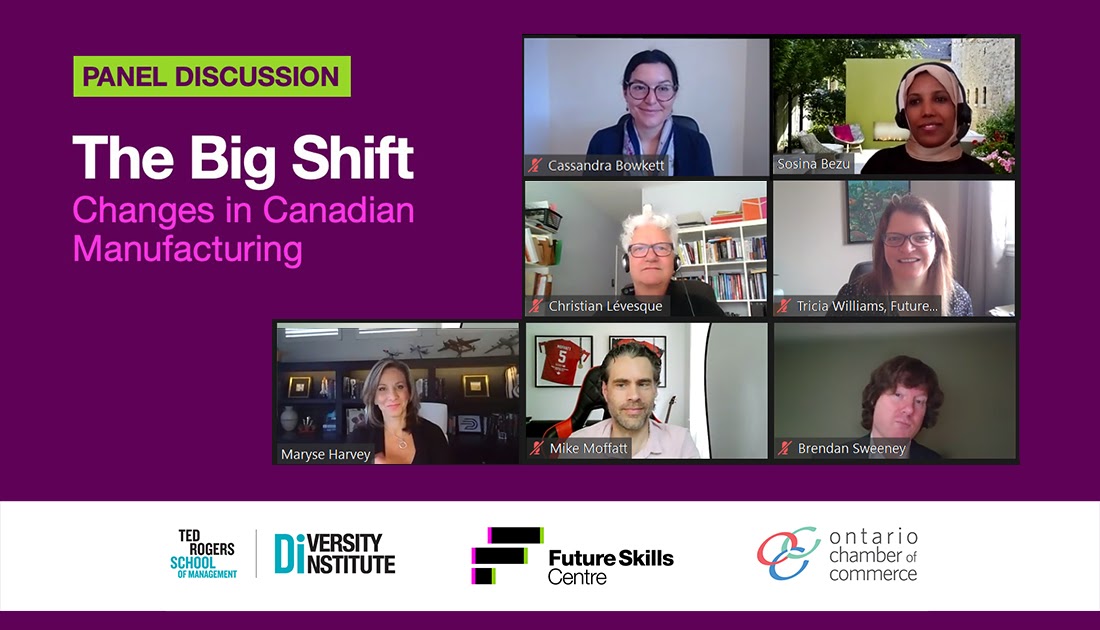
Following the research presentation, Sosina Bezu (external link) , Senior Research Associate at the Diversity Institute, invited experts from the aerospace industry and the broader manufacturing ecosystem to join the conversation.
Brendan Sweeney (external link) , Managing Director, Trillium Network for Advanced Manufacturing, emphasized an urgent need to overhaul how we recruit and train young people for the skilled trades. “It’s not working. And it’s especially not working for women,” Sweeney explained. Sweeney suggested that Canada is swaying over a “demographic cliff” with an aging workforce and increasingly smaller numbers of young people moving through the talent pipeline. If the manufacturing industry is unable to attract and retain more young talent today, the labour gaps will continue to grow.
For Mike Moffatt (external link) , Senior Director, Policy and Innovation at the Smart Prosperity Institute, the changing nature of the manufacturing industry is also resulting in a skills mismatch. The skills required by the industry are changing, yet the available labour pool is not growing and evolving at the same rate of the need. There is also a geographic mismatch, Moffatt argued, making it even more difficult for the industry to recruit young talent. In Toronto in particular, manufacturers struggle to find workers who can afford to live in the city. When we consider solutions to the challenges facing Canadian manufacturing, Moffatt explained, we have to cast a wider net to also include crucial elements like housing policy.
Christian Lévesque (external link) , Professor at HEC Montréal and the co-Director of the CRIMT research network, spoke about how I4.0 can create better work that is more meaningful and empowering. However, Lévesque stressed that it is necessary to form a collective response to gaps in the talent pipeline. Lévesque underlined the role of intermediary organizations to bring the various stakeholders in the aerospace industry to create resources that meet the needs of its different parts. It is crucial to also involve workers and their representatives in this process, Lévesque explained.
“The most important thing for the industry is a collaborative mindset”
“The most important thing for the industry is a collaborative mindset,” said Maryse Harvey (external link) , Executive Director of Downsview Aerospace Innovation & Research (DAIR). Harvey sees significant opportunity in industry collaborations with academia, as well as more collaborations and supportive relationships between larger firms and smaller firms. It is critical to recognize that the competition threatening the Canadian aerospace industry is largely not within Canada, but on a global scale. Efforts to strengthen the industry as a whole can thus enable Canadian firms to better compete around the world. To do so effectively, a diverse talent pipeline is also needed.
Join our Network
Be among the first to know about new research, events, and opportunities from the Diversity Institute by subscribing (external link) to our mailing list and by following us on Twitter (external link) and LinkedIn (external link) .