Job Polarization in Canada

High-skilled jobs that usually require university education, like those in finance or in the sciences, drive economic growth and innovation. But mid-skilled jobs that require college education or apprenticeship training—like those found around a manufacturing assembly line, in a sales office, or on a construction site—are also essential for providing employment for Canadians across the skills spectrum.
“Job Polarization in Canada,” a new study by Sean Speer (external link) and Sosina Bezu, shows that over the last 30 years, Canadian jobs have become increasingly polarized with steady growth in high-skilled jobs offset by continuous declines in the share of mid-skilled jobs and a slight drop in the share of low-skilled jobs (i.e., those that do not require post-secondary qualifications).
From 1989 to 2019, the share of high-skilled jobs in Canada has grown 7.5 percentage points, while the share of mid-skilled jobs shrank by nearly 6 percentage points. Unlike other advanced economies facing job polarization, the share of low-skilled jobs in Canada did not increase during this period, instead falling 1.6 percentage points.
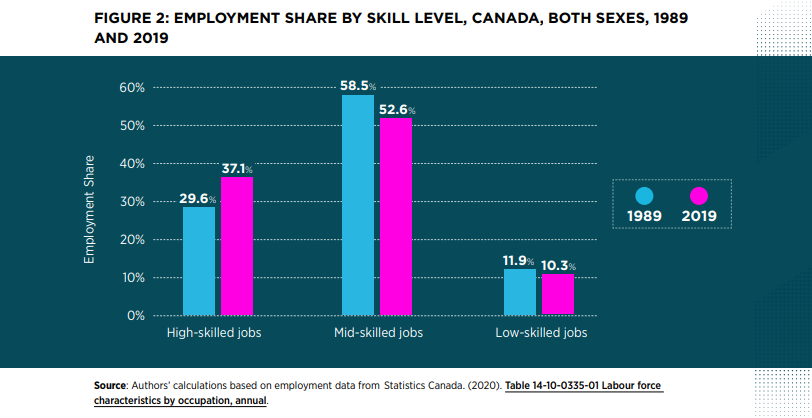
These effects vary across the country and across sectors. In Ontario and Quebec, for instance, the share of mid-skilled jobs fell by more than 7.5 percentage points. Manitoba, Saskatchewan and Prince Edward Island have seen mid-skilled jobs grow slightly over the same period. The manufacturing sector has felt the effects of these trends most acutely, shedding 15 percent of its mid-skilled jobs since 1989. Other mid-skilled occupations including office and administrative support, construction, maintenance and repair, transportation and material moving are highly susceptible to disruption in the coming years due to the risk of automation.
Speer and Bezu find that as a general rule, job polarization is primarily shaped by the labour market’s growing demand for cognitive and technological skills that tend to be seen as tied to post-secondary qualifications. Significant earnings gaps between high-skilled jobs that typically require post-secondary qualifications, and those in lower skilled occupations—on average, high-skilled jobs pay four times what low-skilled jobs pay—support this argument.
And while there is limited disaggregated data, job polarization appears to affect different segments of the population in different ways, with women, younger workers, and new immigrants overrepresented among those experiencing the negative effects. Developing deeper understandings of these different experiences is crucial to develop proper responses.
Although the report draws on historical data, it also suggests the direction of things to come and underlines the need for action. “This is not a backwards-looking trend...There is reason to believe that it is likely to continue in the future as industries and firms adopt new labour-substituting technologies,” write Speer and Bezu.
As policymakers look to build back from the devastation of the COVID-19 pandemic, these long-term employment shifts are critical to understand. A comprehensive policy agenda that considers the relationship between job polarization and income inequality that goes beyond post-market redistribution to address root causes in these labour-market trends is necessary.
Critically, job polarization will not be solved by restoring the old types of mid-skilled occupations. Speer and Bezu suggest that policymakers instead think about creating a new generation of middle-class opportunities.
This agenda can be organized into two streams: The first focuses on helping people obtain employment that is commensurate with their credentials and skills. The second concentrates on pulling low-skilled occupations and workers up the skills distribution to build a new middle-class economy. Such an effort will involve transforming today’s low-skilled jobs into tomorrow’s mid-skilled occupations. This might include support for productivity-enhancing technologies, investments in digital skills, new labour standards and forms of professionalization to upgrade low-skilled occupations, and wage subsidies to boost the market incomes of low-skilled workers.
Such an agenda will also need to build a better policy framework around those who do not pursue conventional post-secondary education, and support alternative pathways (external link) to good jobs. It might consist of expanded high school-based vocational education, innovative models for demand-side training, and different forms of micro-credentialing to help workers better meet evolving labour-market demands.
The loss of good jobs with wages that could provide financial security for less educated workers raises the spectre of an increasingly unequal society.
The changes to the distribution of jobs represent a major economic, political and social development, and need for action is high. The modern economy appears to have less demand for the mid-skilled worker, and in Canada, no greater share of low-skilled jobs either. Economists David Green and Benjamin Sand have warned that (external link) : “The loss of good jobs with wages that could provide financial security for less educated workers raises the spectre of an increasingly unequal society.” The result could be higher rates of inequality, particularly among equity-seeking groups. And an unequal society can create unrest—as it has in the U.S., where it seems to have contributed to the rise of political populism.
Skills for the Post-Pandemic World
![PPS Feature Image [Converted] [Recovered]](/content/dam/diversity/research-projects/Skills-for-the-post-pandemic-world.jpg)
“Job Polarization in Canada” is the first report in the Skills for the Post-Pandemic World (opens in new window) series. This project tackles key questions facing policymakers, employers, training providers and workers. It is critical that society turn to face the fundamental changes in the labour market precipitated by the COVID-19 pandemic, and stakeholders from across the skills training and development ecosystem need to rise to meet the new conditions of a post-pandemic world.
Building on the collaborative success of the Skills Next series (opens in new window) , the Diversity Institute, the Public Policy Forum (external link) , and the Future Skills Centre (external link) , with new support from Microsoft, join once more to face these rapid societal shifts head-on, with research looking at the future of skills, training and retraining in ways that will chart a path forward as the pandemic continues to unfold.