Tech-Enabled Innovations in the Skills and Employment Ecosystem
While much has been written about the disruptive and destructive impacts of technology in the workforce, we read less about the positive roles technology can play in the future of work. “Technology can be a really important part of the solution when we look at bridging the skills gap and creating an inclusive innovation ecosystem,” said Dr. Wendy Cukier, Founder and Academic Director of the Diversity Institute and Research Lead at the Future Skills Centre and the co-author of a new report in the Skills Next Series.
We recently launched Tech-Enabled Innovations in the Skills and Employment Ecosystem with an insightful presentation and panel discussion featuring experts in Canada’s skills and employment ecosystem alongside the Public Policy Forum (external link) and the Future Skills Centre (external link) . The new report examines how technology can enable innovative approaches to addressing the skills gap, upskilling and reskilling workers, and help foster inclusive workplace environments.
The report builds upon research published earlier this year entitled Return on Investment: Industry Leadership on Upskilling and Reskilling their Workforce, which showed that companies including AT&T, Scotiabank, TD Bank, Accenture and Walmart have already begun investing hundreds of million of dollars to retrain their workforces, and are reaping considerable benefits.
Session moderator Elaine Lam, Executive Director of the G. Raymond Chang School of Continuing Education, opened the floor and introduced report authors Dr. Cukier and Stephen Harrington (external link) , National Lead - Workforce strategy at Deloitte, to introduce the report and illuminate the skills and employment landscape in Canada.
Harrington began with a telling paradox: Despite investments in technology hitting record highs, research shows a decline in productivity in most major economies around the world. Harrington suggested that one reason is that technologies are failing to fundamentally impact the ways that jobs themselves are being done. This can be attributed, in part, to skills failing to keep pace with technological advancements, Harrington explained. In the future “operating system” of work, skills will be central, Harrington suggested.
There is an important distinction to draw between technical skills and capabilities. Technical skills, Harrington explained, are those that encompass the practical abilities a worker needs to complete their daily work. He referred to these as “brittle skills” since they have a relatively short halflife between two-and-a-half and five years. Capabilities, on the other hand, are far more enduring. These refer to observable human attributes, like the ability to learn, influence or collaborate. “Once we build them, they stay with you throughout your career,” said Harrington.
When discussing technical skills, many may think of the ability to code or develop complex technological solutions. These deep digital skills, Dr. Cukier explained, are not the dominant demand among employers looking for new talent. In fact, the ability to use basic digital applications like Microsoft Office and Excel, and match technologies to organizational needs, is often more important. Dr. Cukier underlined that these skills are teachable. For instance, work-integrated learning programs like ADaPT (Advanced Digital and Professional Training), facilitated by the Diversity Institute, are successfully helping new graduates build digital skills—regardless of their academic backgrounds—and narrow the skills gap.
The potential benefits of technology across the skills and employment ecosystem in preparing Canadians for the future of work should not be undersold. “Technology can provide innovative solutions to the assessment, the identification, the development, and the utilization of skills,” said Dr. Cukier.
“The challenge and the solution are in the same bucket right now. The solution is utilizing these technologies...But the challenge is building the skill and capability to be able to identify these sorts of solutions, build them into a digital architecture that connects, and really start to utilize them,” Harrington explained.
Towards a Connected and Inclusive Skills Training and Employment Ecosystem
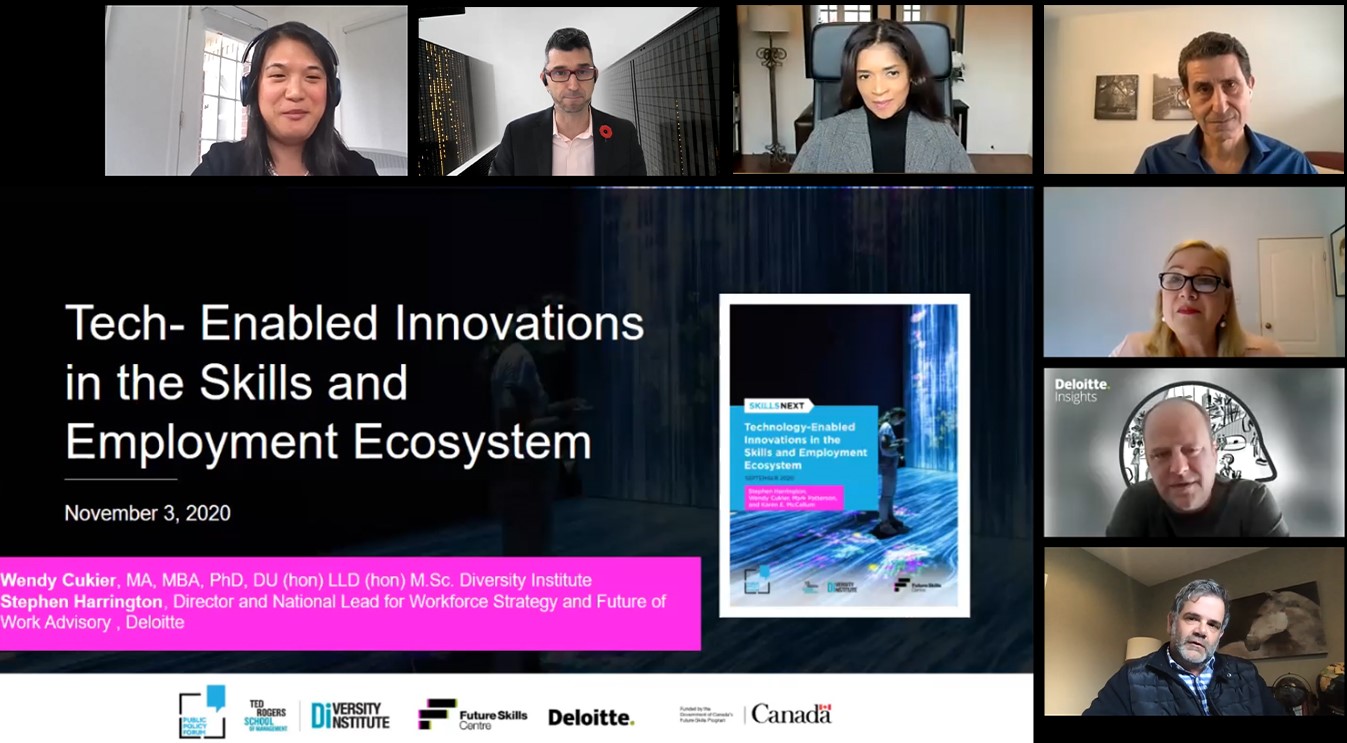
Namir Anani (external link) (President & CEO, Information and Communications Technology Council), Paula Allen (external link) (Senior Vice President, Research, Analytics and Innovation, Morneau Shepell), Mark Patterson (external link) (Executive Director, Magnet) and Robert Luke (external link) (CEO, eCampusOntario) joined Wendy Cukier and Stephen Harrington to share their insights on upskilling, reskilling and technology.
Employers and workers across the country are at a critical juncture, facing an unprecedented rate of change in their workplaces and an uncertain future. The adoption of technology in the workforce has significantly accelerated, even where it had previously been stalled, as a result of the COVID-19 pandemic. “Upskilling is becoming a critical component, not only for companies to survive, but to thrive in a global environment going forward,” Anani stressed.
Paula Allen stressed that in the future of work, it will be increasingly important to help workers learn throughout their careers and adapt to change. It is necessary to “put as much weight into that capability to be successful in a disruptive environment as we’re putting into the skills that are necessary for that disruptive environment,” Allen explained.
“We have the elements of a very powerful skills and employment ecosystem,” Dr. Cukier added. But the fragmentation within it is limiting innovation in the ecosystem and resulting in inefficiencies and replication. An integrated and connected ecosystem could facilitate a common understanding about skills, frameworks, and technologies, and allow for more curation, knowledge-sharing, and collaborative testing.
“How do we bring it all together?” Patterson asked. He suggested that a nation-wide digital infrastructure that is open and inclusive to new technologies and innovations is necessary to meet these opportunities and challenges. Patterson recalled great national projects like the trans-Canada railroad or highway as examples of what the country can accomplish when it comes together to develop shared infrastructure.
“We should take a step back and realize that technology is not neutral in this environment,” Robert Luke noted. All technologies have biases within them, excluding those who may not have the skills or capital to access them. Many in rural, remote, and Indigenous communities in Canada also continue to struggle with unreliable internet access, limiting their ability to use potentially beneficial technologies. Luke explained that it is important to take care to design these technologies from the margins, and consider those users who may face additional barriers accessing them or risk further exacerbating these barriers.
Both governments and organizations need to play a part in preparing Canadians for the future of work. The swift response to the outbreak and impacts of COVID-19 from government leaders and the business community shows that Canada has the capability and expertise to do so. But urgent coordinated action is needed. “If everybody is pointing to everyone else, then it never moves forward. If everybody is trying to solve multiple problems, we never move forward,” Allen explained.
Watch the webinar on-demand (external link) .
Skills Next

The Skills Next series, presented by the Diversity Institute in partnership with the Public Policy Forum (external link) and the Future Skills Centre (external link) , explores what is working in workplaces, universities, and the labour market – and where workers are falling through the gaps in our skills training system. Learn more about the series (external link) .
Subscribe to our newsletter (external link) to be among the first to know about new research from the Diversity Institute.