Using innovation to drive economic equality in a changing world
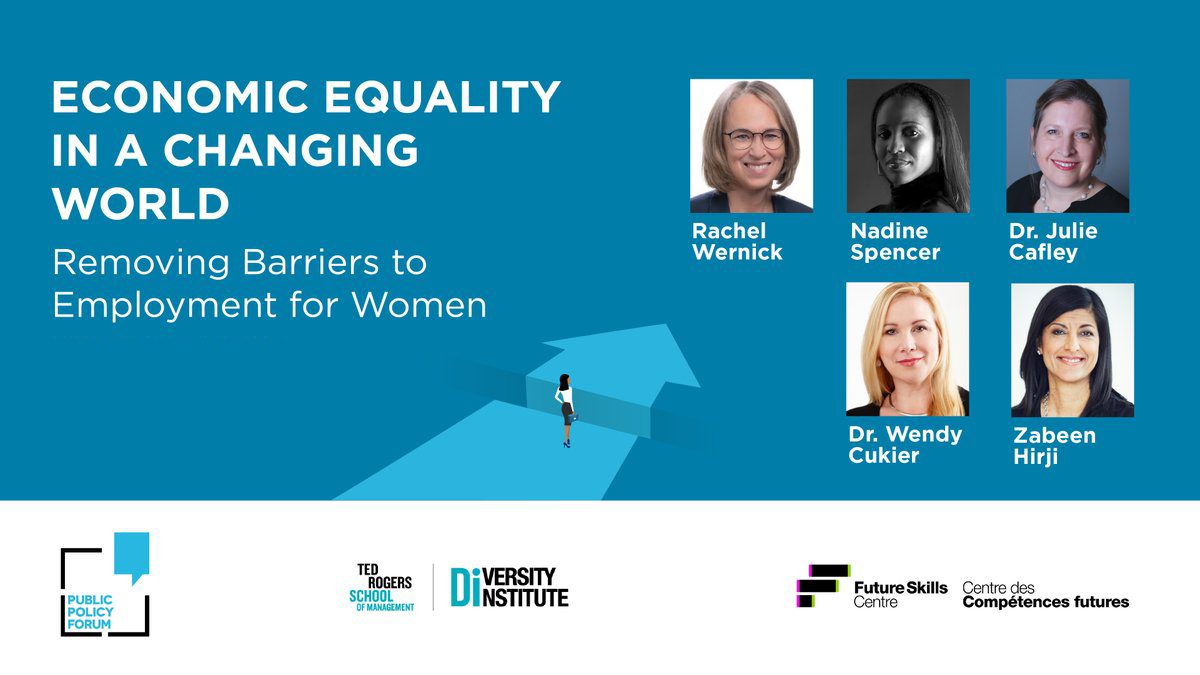
Persistent barriers to employment facing women in Canada have become even more pronounced due to COVID-19 and threaten to undermine well-intentioned recovery and growth strategies. Increasingly, research shows that the inclusion of women in strategies to drive economic growth and innovation in the country, particularly women from diverse populations, is essential if Canada is to reach its potential.
The Diversity Institute recently launched Economic Equality in a Changing World: Removing Barriers to Women’s Employment, a new report published alongside the Public Policy Forum (external link) and the Future Skills Centre (external link) as part of our Skills Next (external link) series that identifies four primary barriers to women’s employment that COVID has exacerbated.
As part of the launch, experts on career advancement for women from the corporate sector, public service, and academia came together to examine the report’s findings and recommendations. The insightful panel discussion featured Dr. Wendy Cukier, Academic Director of the Diversity Institute and Research Lead at the Future Skills Centre, Dr. Julie Cafley (external link) (Executive Vice-President, External Relations, Public Policy Forum), Rachel Wernick (external link) (Senior Assistant Deputy Minister, Skills and Employment Branch, Employment and Social Development Canada), Nadine Spencer (external link) (Chief Marketing Officer of BrandEQ Group and President/CEO, Black Business Professional Association), and Zabeen Hirji (external link) (Executive Advisor Future of Work, Deloitte).
Dr. Cafley introduced the research and provided insight into how COVID has exacerbated challenges stemming from the wage gap, the underrepresentation of women in STEM, the absence of women in leadership, and barriers facing women entrepreneurs. “Seeing the number and seeing the facts together really tells a story,” Dr. Cafley explained.
The impacts of the pandemic have disproportionately affected women and their ability to succeed in the workforce. Three of the top five industries negatively impacted by the pandemic, Dr. Cafley noted, are women-dominated. The sharp increase of unpaid work at home due to additional childcare and homeschooling needs has made it more difficult for women to continue their participation in the labour market at pre-COVID levels—especially for women with young children. In fact, over 30% of women have considered leaving their jobs entirely or not returning to work because of childcare concerns.
But Dr. Cafley emphasized that this is not simply a women’s issue. “This is an issue for the economy. This is an issue for all Canadians.”

“We are at a critical juncture”
From February to April this year, 5.5 million Canadian workers were affected by economic shutdowns spurred by COVID-19. Racialized women, who are overrepresented in sectors hardest hit by the pandemic, have been particularly affected. Rachel Wernick noted that labour market reintegration has been unequal, with women returning to work more slowly than men are. “I do think now we are at a critical juncture. I think there is a risk that we slide back and retrench inequalities. The challenge we are facing as a country is how to leverage the impacts of the pandemic and make the case for public change,” Wernick explained.
Wernick identified three key policy issues that require attention in Canada’s path forward. A glaring paradox has emerged as women in jobs that have been defined as essential services during the pandemic—like personal support workers—remain in precarious positions with low-pay, a lack job security, poor benefits, and in potentially dangerous situations. There exists a skills trap, Wernick argued, in which women lack the access to skills training programs necessary to advance in their careers. Wernick also observes evidence of a “hidden default” that often uses the male experience and male-driven data as the baseline for considering policy and designing programs, ultimately excluding women and their particular needs.
Addressing these challenges will require a systems approach that functions at the societal, organizational, and individual levels and involves innovative ways of thinking about economic investments, skills development and mentorship. “Innovation is not just about tech, it’s about doing things differently,” Dr. Cukier explained.
Thinking Differently Through a Systems Approach
Dr. Cukier suggested applying the notion of the “multiplier effect” used to justify investments in manufacturing jobs—that is, that each manufacturing job supports several others—to poorly supported positions largely held by women. “Given the crushing burden of unpaid work on women, investments in a single childcare worker—I would argue—produce multiplier effects that are not taken into account when we look at where to invest our money by allowing women to get back to work.”
In sectors where high-growth, high-paying jobs are available, significant challenges remain. Despite decades of advocacy, there are fewer women in computer science today, and only marginally more in engineering. In efforts to bridge the digital divide, Dr. Cukier emphasized the need to reframe how we think about technology careers to understand and support alternative pathways to digital skills. Many women in leadership positions at tech companies in the United States, for example, do not hold computer science or engineering degrees.
As important as the tech sector is, it is essential to ensure sectors where women are concentrated are not ignored. Dr. Cukier reminded participants that small- and medium-sized enterprises are the drivers of job creation in Canada, and women entrepreneurs are one of the fastest growing segments of that job creation. However, their businesses tend to be smaller, under-financed, concentrated in sectors most affected by economic shutdowns, and thus more vulnerable to the impacts of COVID-19.
Yet many of the government supports that have been designed to help Canadian businesses during this time have been designed for male-dominated, technology-oriented enterprises with employees. As a result, many women entrepreneurs are being left behind, as well as Black and Indigenous entrepreneurs. “The smallest businesses are the hardest hit, and it is like we are allowing the seedlings to get wiped out. Our future depends on these investments,” Dr. Cukier explained.
Organizations have an important role to play in eliminating the barriers to employment facing women as well. Zabeen Hirji underlined the need to think differently about recruitment to attract and retain more diverse candidates, and make clear and transparent diversity commitments that allow for accountability. Reconsidering eligibility requirements for board positions that currently exclude women and diverse candidates is one way to do so, Hirji explained. “We need to do things differently to have different outcomes. Women are there. Racialized people are there.”
On an individual level, business and workplace leaders can utilize their positions of privilege to champion women and help them advance in their careers. While mentoring is certainly important, Hirji made a notable distinction between mentorship and sponsorship. While a mentor speaks with a mentee, a sponsor vouches for a woman’s talent and expertise among their own networks.
On all levels, it is essential that racial biases that fuel discriminatory attitudes and acts are eliminated. As part of her work with the Black Business Professional Association, Nadine Spencer leads the BBPA Boss Women Entrepreneurship Training (external link) program sponsored by the Women Entrepreneurship Knowledge Hub (external link) . One virtual training meeting was hijacked by people wearing masks displaying swastikas who hurled racist slurs and personal attacks at an audience largely composed of newcomer women. The emotional story highlights the potentially violent and traumatic results of discrimination that racialized women, in particular Black women, face in their careers.
“I always say I have three challenges: I'm a woman. I’m Black. And I’m a Black woman,” Spencer said. “It’s one thing to get to the table. But how do we function at the table when it’s not an inclusive table?”
Learn More
Read Economic Equality in a Changing World: Removing Barriers to Employment for Women (opens in new window) to learn more the barriers to employment facing women, and the actions needed to dismantle them.
Subscribe (external link) to the Diversity Institute’s newsletter, and connect with us on Twitter (external link) and LinkedIn (external link) to be among the first to know about future research and events.