Canada’s Talent Pipeline Strengthened Through Inclusive AI and Workforce Programs
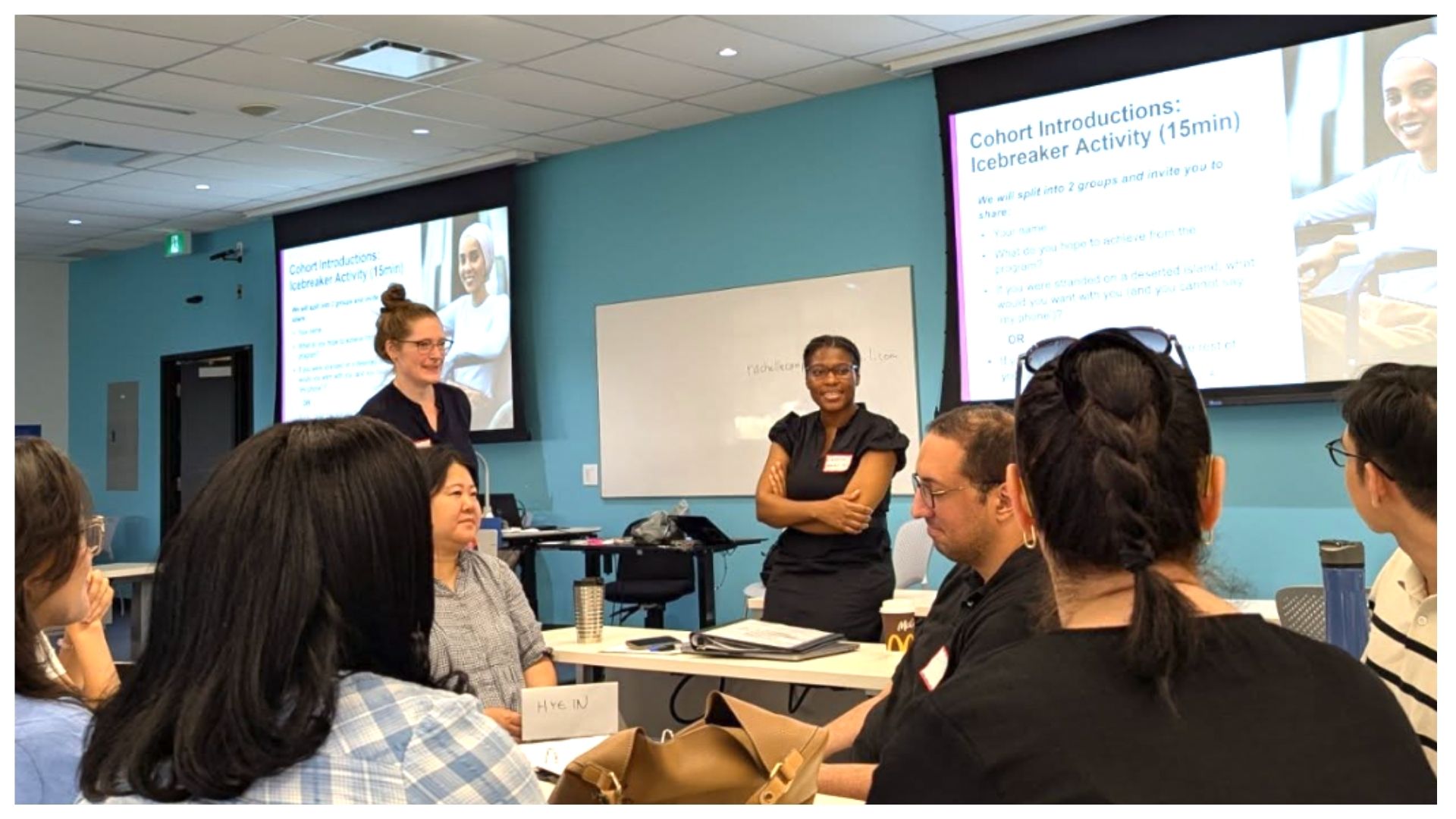
The Diversity Institute has developed a suite of training programs that effectively bridge skills gaps, expand opportunities and strengthen pathways into the workforce. On July 12, 2025, Sarah Shteir and Laurene Williams from the Diversity Institute, facilitated an orientation activity with the Newcomer Employment and Entrepreneurship Skills Hub program participants. The course is supported by the Ontario Government and delivered in partnership with the Scadding Court Community Centre.
With disruption from technology and global trade wars, Canada must urgently invest in building a resilient, future-proof workforce. The Diversity Institute (DI) supports a wide range of rapid upskilling programs as well as sectoral and employer-centered training pathways. Youth unemployment has reached historic levels, and research is reinforcing the need to invest upstream, particularly for youth from equity-deserving groups, to support their success in education and pathways to employment.
At the same time, businesses are navigating a global digital transformation. Canada is a world leader in developing artificial intelligence (AI) technologies, it is losing ground, which threatens competitiveness. While complex machine learning applications require advanced technical expertise, generative AI tools are increasingly accessible across disciplines. Some call it “the English major’s revenge,” because prompt engineering requires strong language and reasoning skills, not coding skills; demonstrating the need to prepare students and workers from diverse fields to continuously learn and upskill.
The Diversity Institute delivers training programs designed to strengthen Canada’s talent pipeline in a rapidly changing economy; From tutoring programs that support school-aged children in gaining foundational skills, to training programs that support post-secondary graduates or mid-level career professionals upskill, and accessible online training specific to small and medium-sized enterprises (SMEs). There are several programs developed and delivered by the DI and its sectoral partners that have produced consistent results; from high employment placements and successful business launches to improved digital and financial literacy. Research confirms that intentional program design, including customized training and support, enables diverse participants to succeed. These findings point to scalable solutions that help fill Canada’s skills shortages and job creation.
The programs are contributing to building a strong and inclusive economy. They upskill equity-deserving groups, such as Black youth and newcomers, while also supporting SMEs, which is Canada’s largest private sector employer. By focusing on the skills needed by employers which include AI literacy, financial literacy, entrepreneurship and digital skills — the programs help both individuals and businesses adapt and thrive.
ADaPT: Building Digital and Communication Skills
Working with Technation, Canada's leading association of information and communications technology (ICT) companies, the Advanced Digital and Professional Training (ADaPT) program was launched in 2014 to address Canada’s digital skills gap and to support young people with the skills they need to gain meaningful employment. More than 1,200 participants have gained in-demand skills, with a 90% employment placement rate. Nearly half of the program’s participants are arts and social sciences graduates, demonstrating that talent from non-traditional technology or computer science backgrounds can transition into high-demand digital roles. It is important to note that there are more technology jobs outside of the ICT sector than within it. And, digital skills are in-demand in the skilled-trade sector as well.
ADaPT has since expanded into tailored programs that respond to specific groups. For example, ADaPT for Black Youth, supported by the Ontario government, and ADaPT for BC Newcomers integrate the same combination of technical training and coaching but tailor content and supports to the realities of different participants. Research indicates that this targeted approach improves access and outcomes for groups that often face systemic barriers to employment while contributing untapped talent to employers who are facing a workforce shortage due to an aging population and lower immigration rates.
OCC Skills Bridge: Supporting SMEs
Skills Bridge, developed in partnership with the Ontario Chamber of Commerce and Magnet and supported by the Future Skills Centre, supports SMEs, which represent 99.7% of Canadian businesses. Many SMEs face labour shortages, limited HR capacity, and challenges in offering employee training. Skills Bridge provides an online platform (external link) with curated courses designed to meet these needs.
Between 2021 and 2023, more than 860 SMEs and 690 employee-learners participated in pilot phases of the program. Evaluation data shows 83% of learners met their objectives, 77% rated the course quality as high, and over 80% were likely to recommend the training. These findings highlight the importance of accessible and flexible upskilling tools for SMEs, the backbone of Canada’s economy.
NEESH: Entrepreneurship as a Pathway
The Newcomer Employment and Entrepreneurship Skills Hub (external link) (NEESH) is an Ontario Government supported, free, six-week program that DI and its partner Scadding Court Community Centre (SCCC) deliver. It helps newcomers enter the Canadian workforce. It combines professional skills training with entrepreneurship essentials such as finance, procurement, and social media. Flexible delivery and supports like childcare make the program accessible to a wide range of participants. Research from DI shows that many immigrants are pushed toward entrepreneurship (external link) because of exclusion from traditional jobs and the need for flexibility. NEESH equips newcomers with the tools to pursue self-employment as a viable career path while also strengthening their readiness for conventional work opportunities.
WE-Hub: Women’s Entrepreneurship Hub
Another program delivered by DI in partnership with SCCC and supported by the Government of Ontario provides diverse women with the skills, networks, and supports to start and grow viable businesses and create jobs. WE-Hub delivers entrepreneurship skills and competency-based training in business fundamentals, digital and AI literacy, and financial management; pairs entrepreneurs with coaching, mentorship, and peer cohorts; and offers practical market access through buyer connections, pop-ups, and procurement-readiness activities. Wrap-around supports (e.g., childcare, settlement and language help, device/connectivity access, and trauma-informed services) remove barriers for its participants. The program has demonstrated great success for its participants, creating new businesses and paths to employment. WE-Hub aligns directly with provincial and federal priorities on inclusive growth, productivity, and women’s economic participation.
Study Buddy: Tutoring as an Education and Economic Support
The Study Buddy program was launched in May 2020 in response to educational disruptions caused by COVID-19. It provided free one-on-one, online tutoring for kindergarten to grade 12 students (K-12) in Ontario by university students and recent graduates (both education and non-education specialists) as well as upper year high school students as part of a work-integrated learning (WIL) experience. Learning access gaps for K-12 students, particularly among Indigenous students and those from equity-deserving groups (Black, racialized, newcomer, students with disabilities, and those in rural/northern areas) have persisted post COVID. Similar to the disruption during the pandemic, educators are under strain, as are parents, during this difficult economic period. An ongoing educator retention crisis; nearly all educators report shortages impacting student supports. Weaker math and reading attainment today becomes tomorrow’s skills gap, weighing on innovation and long-run growth. The ability for a parent to work also depends on education wraparound supports such as school and child care reliability which includes tutoring.
Evaluation findings show that families reported reduced anxiety and improved confidence in online learning. Students developed skills in problem-solving and decision-making, while teacher candidates delivering tutoring gained valuable experience in pedagogy and classroom management. The program also offered social and emotional benefits, fostering a sense of hope for students and parents during a period of uncertainty.
Evidence on the Importance of Wraparound Supports
Findings from DI’s Impacts of Customization and Wraparound Supports for Digital Skills Upskilling report reinforce the importance of program design. Customization and supports addressing personal, logistical, and labour market needs significantly improve participant success rates. Programs that combine these elements are more effective in bridging skills gaps and supporting transitions to employment.
Across DI’s programs, the evidence shows that tailored, evidence-based approaches are making a measurable difference. They address systemic barriers, help businesses adapt, and strengthen Canada’s capacity to compete in a digital economy. With additional resources, these initiatives could be scaled to reach even more participants and further contribute to building an inclusive and resilient economy.