INNOVATION
Issue 44: Winter 2026
Tracking the future: How wireless positioning and AI are transforming health care and beyond
Partner to Innovate
Tracking the future: How wireless positioning and AI are transforming health care and beyond
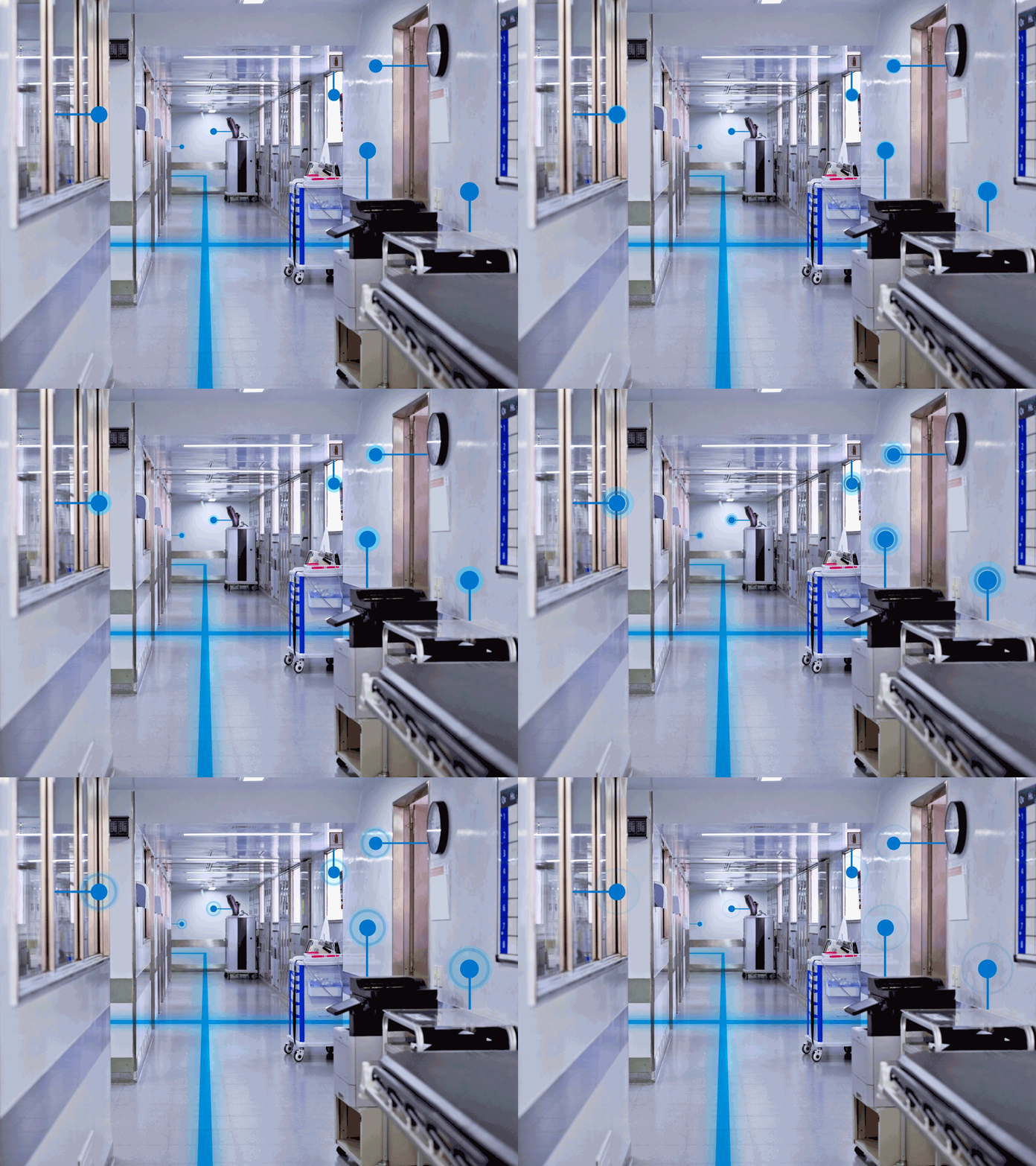
Across Canada, hospitals, factories and worksites are growing larger and more complex. Statistics Canada reports that the health care and social assistance sector added 53,000 jobs year over year as of September 2025. With more people and assets in motion than ever before, organizations need better ways to manage their operations safely and efficiently.
Knowing exactly where patients, staff, equipment or inventory are at any moment can save time, prevent accidents and support better decisions. Meeting this need requires tracking systems that are accurate, secure and scalable, while protecting privacy. These location technologies are becoming essential to modern operations and Canada’s global competitiveness.
Patent-backed innovation for real-world settings
Working with industry partner Peytec, Inc., Xavier Fernando, director of the Intelligent Communications and Computing Lab and an electrical, computer, and biomedical engineering professor at Toronto Metropolitan University (TMU), developed an advanced patented wireless positioning system for dynamic, indoor spaces. This real-time localization technology enables organizations to track large numbers of people and resources at the same time with high accuracy. It works well in busy, real-world settings where traditional tools often fail due to cost, battery limits or poor precision.
To achieve this, the system uses ultra-wideband radio signals to measure the time it takes for a signal to travel to and from a fixed reader. The system can locate tagged objects with centimetre accuracy indoors, even in busy spaces with many moving elements and physical obstacles.
“This leap in accuracy improves patient safety, inventory management and automation,” said professor Fernando.
By using multiple wireless readers and AI-driven motion detection, the system collects data only when something moves. This reduces unnecessary data processing and improves efficiency. Machine learning also helps predict movement and reduce signal problems caused by walls or metal, which are common in hospitals and factories. User-friendly tools let staff see locations in real time, review past data and automate responses.
Enabling digital twins in health care
One of the most promising applications of this technology is supporting the creation of digital twins – virtual representations of real people or assets. In health care, a digital twin could track not only a patient’s location but also medication delivery or activity patterns.
“Once we can identify these objects, it becomes possible to create a digital twin for each one,” said professor Fernando. “This opens new ways to monitor, predict and respond in real time.”
Information like this could help staff identify missed treatments, detect falls or spot changes in routine that signal a problem. This research provides the foundation for more personalized and responsive care.
Built to scale without sacrificing performance
Wireless tracking of a handful of objects is relatively simple. Tracking hundreds or thousands without losing accuracy or speed is far more challenging. Professor Fernando’s system is designed to scale efficiently, keeping performance strong as demand grows.
Together, these technologies make the system practical for hospitals, factories and other complex workplaces.
Protecting data and privacy
Because location and health data are highly sensitive, privacy and security are central to this system. Professor Fernando’s research uses blockchain technology to protect records and privacy-preserving methods such as federated learning. “Federated learning can help us analyze statistical patterns without identifying individuals," he explained.
This allows organizations to learn from large-scale data while safeguarding personal information.
From hospitals to highways: Real-world impact across industries
The potential impact of professor Fernando’s technology extends well beyond health care. In mining, it can improve safety by tracking workers and equipment underground. In manufacturing and logistics, precise location data can reduce delays and improve inventory management. The research is also advancing toward outdoor applications in connected transportation, where vehicles could share location data to improve road safety and traffic flow.
By focusing on solutions that are innovative, scalable and ethically designed, professor Fernando’s research is helping shape safer hospitals, more efficient industries and smarter communities.
Read professor Fernando’s book chapter, “Medical sensor network, blockchain and digital twin as the backbones of a connected ecosystem of smart hospitals,” in Sensor Networks for Smart Hospitals, to learn more.
Once we can identify these objects, it becomes possible to create a digital twin for each one. This opens new ways to monitor, predict and respond in real time.
