INNOVATION
Issue 44: Winter 2026
Ethical conduct in the age of AI: A new challenge for urban planners
Shaping Policy
Ethical conduct in the age of AI: A new challenge for urban planners
In Canada, a professional code of conduct and ethics obliges planners to act in the public interest, even if it puts them in conflict with the wishes of an employer or client.
As fast-evolving artificial intelligence (AI) tools rapidly reshape our world, how should planners utilize those technologies, and where do the ethical boundaries of public interest lie when it comes to AI use in planning? What are the potential consequences of automation eroding or replacing human judgment? Whose data, biases and values do these powerful AI tools represent?
Urban planners in Canada don’t currently have clear, codified answers to these questions, acknowledged professor Pamela Robinson of Toronto Metropolitan University’s (TMU) School of Urban and Regional Planning.
“When it comes to AI deployment, the public interest is a highly debatable proposition,” professor Robinson said. “There's a lot to think about, and not a lot of direction. Any professional direction will take a long time to arrive, because it has to go through a deliberative process, review and acceptance. The guidance will lag behind the technology.”
Playing a new card to protect the public interest
Given the gaps in definitive direction and technological timeliness, professor Robinson advocates for a shift in thinking about ethical guidelines to help ensure the public interest is maintained in the digital age.
“In an era of AI disruption, professional planners require more dynamic ways of thinking and doing,” she said. “We need to move beyond ethical compliance and focus our collective attention on ethical conduct.”
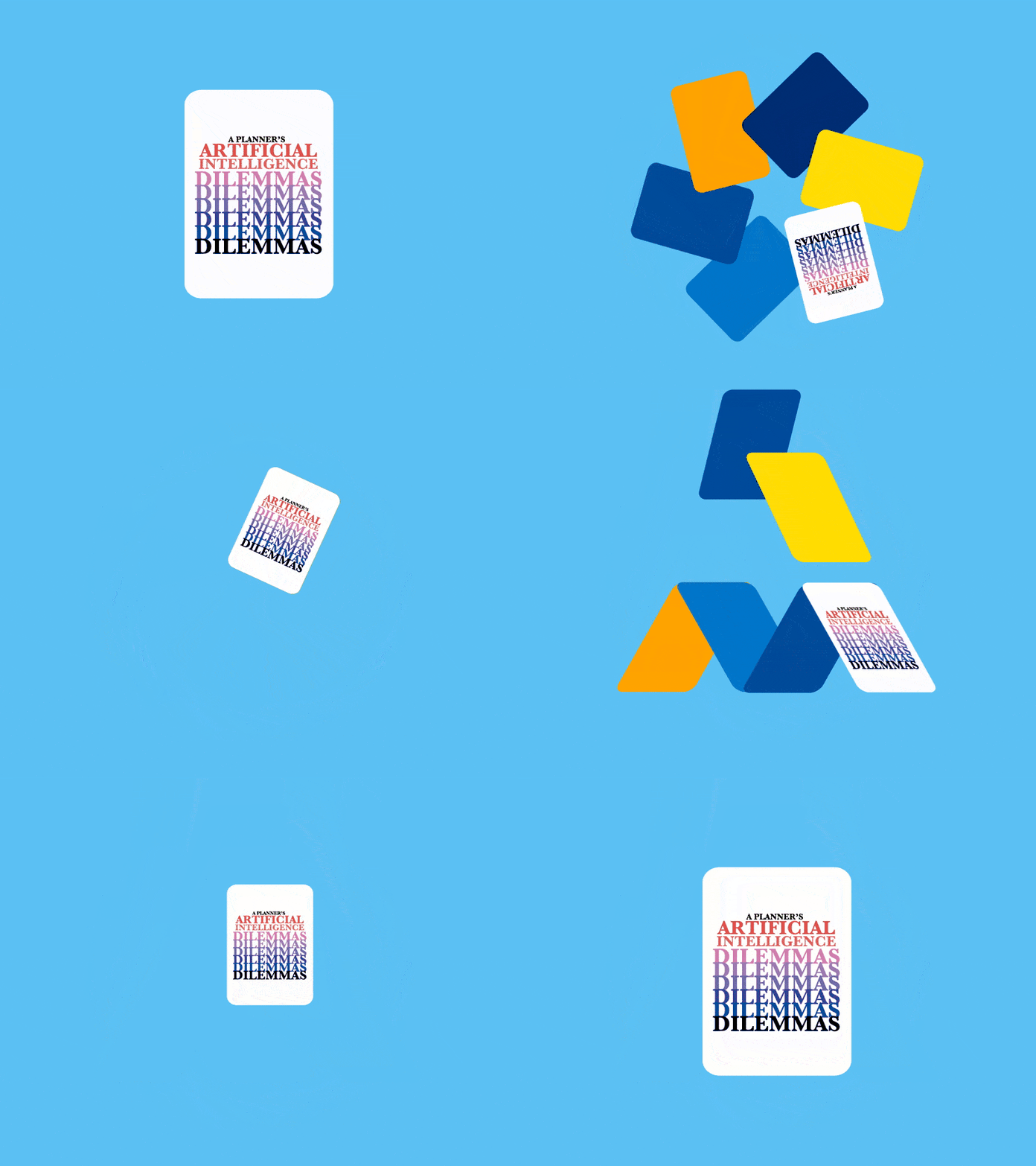
In a creative twist, professor Robinson and longtime research colleague Morgan Boyco have gamified their efforts to cultivate that conduct. The duo compiled a list of hypothetical AI-use dilemmas for planners and turned them into a set of cards, with each featuring a unique ethical scenario to ponder and debate.
The idea was inspired by another Canadian creation, the 1980s party game “A Question of Scruples.”
Professor Robinson and Boyco shared their cards on Research Gate with a creative commons licence, meaning people can download the set for their own use and even adapt them.
The cards have also been a big hit at professional workshops, both across Canada and internationally.
“In a rapidly changing technology landscape with so many choices in front of people and not a lot of guidance, these cards are useful,” professor Robinson explained. “They fill the gap between codes of ethics and practice and how we behave. They're a practical intervention to help people think on their feet and work through problems together.”
Sparking discussion and igniting critical thinking
Professor Robinson’s favourite card is titled “Is This My Job?” In the scenario, a planner attending a public open house is approached by a resident who believes an AI-driven decision has terminated their government income supplement.
“That one really gives people pause,” she said. “Lots of planners care, but they say, ‘It isn't my job.’ I would argue it is our job, working in the public interest. If a resident has a need and is being impacted, at minimum, we can help them find their way to people who can help. The card brings forward a conversation around ‘What would I do, and do I know how to do it?’”
Another card offers a scenario around the idea of “synthetic democracy.” This can involve planners posing questions to AI models instead of holding public consultations, or entering public data into large language models to summarize feedback rather than reading individual responses.
“That's probably the most common and tempting use-case for AI,” professor Robinson said. “People say yes and no emphatically for different reasons.”
Creating the cards was “definitely some of the most fun I’ve ever had as a researcher,” professor Robinson said. In the lively discussions they generate at workshops and events, she sees obvious signs of their influence and value.
“To safeguard the public interest, we must cultivate our ethical imagination,” professor Robinson said. “To do that, we need to have that critical thinking ignited. These cards help with that.”
When it comes to AI deployment, the public interest is a highly debatable proposition. There's a lot to think about, and not a lot of direction.

Download A Planner’s AI Dilemmas Cards (external link) on Research Gate.