INNOVATION
Issue 44: Winter 2026
Game changer: How video game design principles can help create digital twins that are more immersive, intuitive and interactive
Meet the Expert
Game changer: How video game design principles can help create digital twins that are more immersive, intuitive and interactive
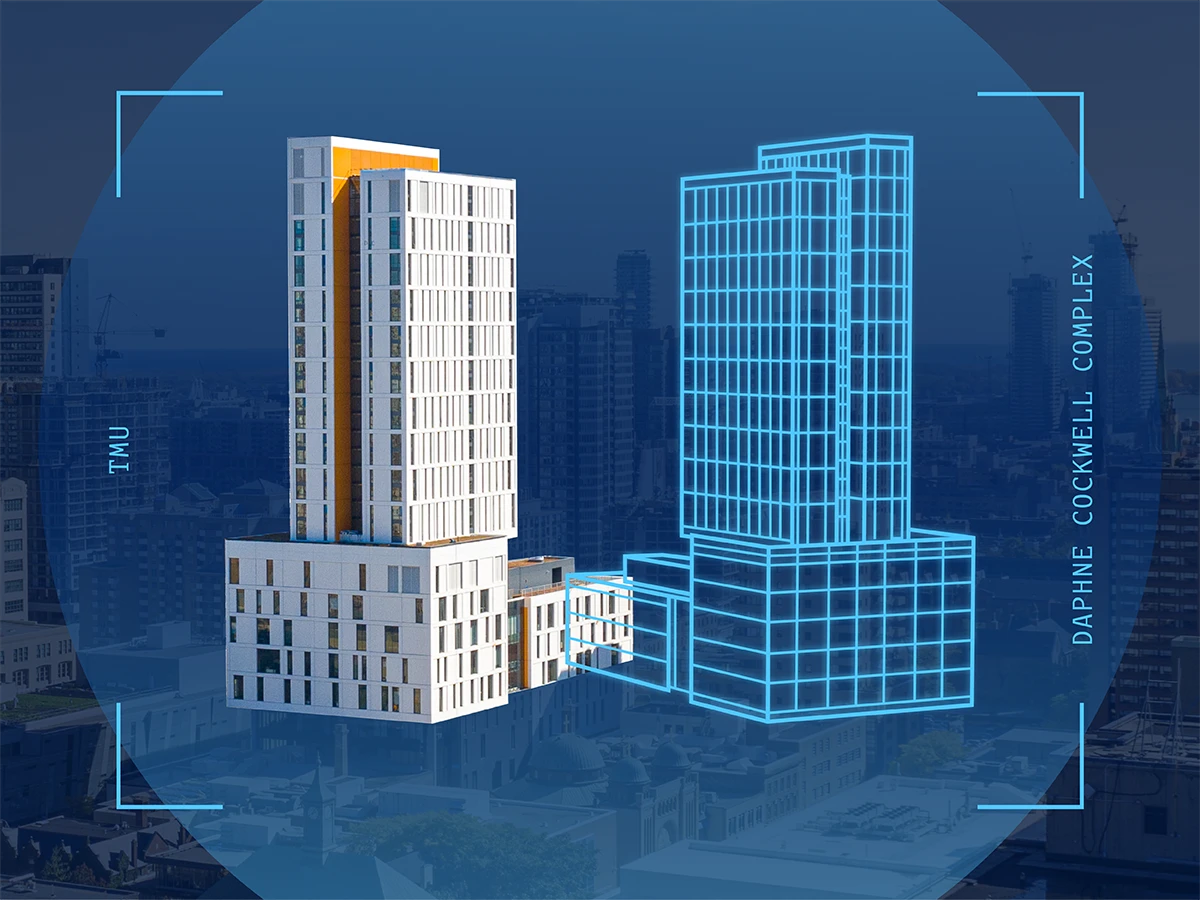
By applying the principles of video game design to the creation of a digital twin, RTA School of Media professor Kris Alexander helped turn a potentially intimidating technology experience into something engaging, intuitive and interactive.
Professor Alexander teaches video games and educational technology at Toronto Metropolitan University (TMU), where he is director of the Red Bull Gaming Hub. His purpose-driven approach to design helped overcome a persistent roadblock faced by colleague Jenn McArthur, a professor in TMU’s Department of Architectural Science.
Professor McArthur had used building information modelling, or BIM, to build a digital replica of the TMU campus. However, only a few people on TMU’s facilities management team knew how to use BIM software, meaning they weren't able to take advantage of her work.
The path to a solution came via collaboration with professor Alexander, a lifelong video gamer and passionate advocate for their educational applications.
“What jumped out at me is that this really seemed like an answer to our last-mile problem: How can we actually get our research adopted?” professor McArthur said. “Video games are probably the least intimidating technology in the world. Every kid can just pick up a controller and play around.”
Putting purpose first helps players achieve their goals
Purpose-driven design starts by asking the “why” question at the root of a new creation before proceeding to the “how” and “what.” For a video game, this means establishing a clear understanding of the goal of the game: what players will seek to accomplish. Games designed in this fashion have been shown to be more effective at achieving specific outcomes, such as educating players or changing behaviour.
An important aspect of purpose-driven video game design is its focus on three fundamental elements: the mechanics, dynamics and aesthetics. Mechanics are the rules and systems that govern the world inside a game, such as how players move and what they see. Dynamics refers to the behaviour of the mechanics, the way a player actively engages with a game. Finally, aesthetics refers to the look and feel of the game-play space, delivered through audio, visual and text-based cues.
For professor Alexander, the aesthetic of the project with professor McArthur was inspired by a video game character called Samus Aran. Samus debuted in the 1986 game Metroid, existing in a two-dimensional environment. By 2002, in Metroid Prime, Samus (and those who play as her) views a three-dimensional world through a “scan visor” that also displays contextual information in real time.
“We took that idea of Samus’ scan visor and applied it to a simplified version of the construction BIM for the Daphne Cockwell Building,” professor Alexander explained. “What we’ve effectively done is use video game technology to work on a digital twin and graphical user interface.”
Levelling up building maintenance with special powers
That basic BIM environment enabled simple, intuitive wayfinding for regular building users. However, those using the digital twin in the mode intended for facilities management staff and contractors needed other special powers, such as X-ray vision and the ability to “fly” from place to place, passing through walls and floors.
In this mode, professor Alexander explained, employees could rapidly detect and diagnose issues with essential equipment, such as heating and cooling systems.
“If you take out your phone while standing outside the building, you can look at the digital twin and see through the walls,” he said. “You can see all the air-handling units, as well as their airflow and temperature. You can tap on one of the air-handling units, point your phone down at the ground, and it will lead you exactly where you need to go.”
When the researchers presented the video-game version of their digital twin to TMU facilities management staff, the response was enthusiastic.
“While we were doing the demo, the energy manager asked about an ‘ideal’ visualization, which we were able to show on the spot,” professor McArthur said. “Their next question was ‘Can we play with this for a month?’ They found it really intuitive, and they were immediately able to see the value.”
Read the paper, “Applying video game design to building digital twin creation,” (external link) via the European Conference on Computing in Construction.
Video games are probably the least intimidating technology in the world. Every kid can just pick up a controller and play around.
