Trial & error: How I learned to save and budget
When I first started living in Toronto, I would constantly worry about money. It was my first time being on my own, so any financial decisions I had to make for myself used to overwhelm me. I didn’t want these concerns to come in the way of my academics. All I knew was that I had to overcome this fear in some way, but I didn’t know how.
Going to the bank for the first time
After my first day of classes, I went to the bank to set up my account. It had already been a long day of firsts — first university class, picking up my Onecard, having my first Tim’s coffee, riding the TTC for the first time. Thankfully, the bank I needed to go to was right next to campus. For most banks, you will find branches a few minutes from campus due to (PDF file) TMU’s central location.
The bank teller reassured me that the set-up process was easy. He answered my (sometimes embarrassing) questions patiently and opened up an account and a credit card for me. Many banks have credit cards with no annual fees for students, along with cashback or reward systems. Once I left the bank, I felt safer knowing that my place in this new city had become more established.
The bigger challenge now would be to figure out how to manage the money in my bank account. I had a lot to learn!

My favorite coffee at TMU's Oakham Cafe that doesn't break the bank
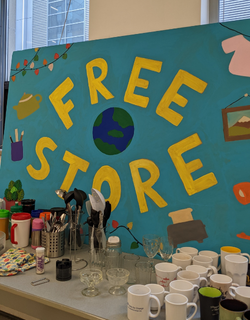
TMU's Sustainability Office where I picked up pre-loved home decor
Working on campus
My goal in Toronto was to be financially independent which meant paying my rent, groceries, and managing my personal expenses. The first step then was to find a job.
Before coming to TMU, I had spoken to International Ambassadors to learn more about being a student. They had many stories to tell about working at TMU and recommended looking for a job on campus. Inspired, I started applying to these jobs even before I even arrived in the country! I remember writing to TMUEats, who reached out to me for an interview and I ended up getting the job. This was a Marketing role, and it is what helped me realise that this is the field I wanted to major in.
The perks of this job was that I was able to schedule my shifts around my classes and learn to balance both. Not only did I learn a lot, I also was able to pay off my bills on my own. Getting that first paycheck was so exciting — it felt like the start of something new and evidence that financial independence is no longer just a pipe dream but something more tangible.

An Eras Tour themed event I helped organise at Pitman Hall by TMUEats
I also take advantage of the Career Boost program, which is how I found my current Summer role as Communications and Creative Assistant. In the summer, I usually work full-time and take up a second job for the weekends. This year, I am also doing some freelance writing on the side. Since I chose not to do summer school, I am able to use this time to accumulate savings so I can sustain myself more comfortably during the school year.
A combination of jobs is how I am able to sustain my expenses. And this is not just my story. You will find that many students at TMU hustle in similar ways. This environment has always inspired me to work harder and learn as much as I can in the process.
Learning how to budget
As much as steady paychecks are necessary, they are not helpful without learning how to budget. This is a lesson I learned the hard way! To escape the stress of budgeting, I used to avoid checking my bank account and tracking my expenses. But this only led to me mismanaging my funds and never understanding my spending habits.
I am still learning how to be better in this regard but I did learn some simple tricks to budget without it feeling stressful:
- Finding a budgeting strategy that works for me
Online pre-made templates can be easy to use, but they never really worked for me. A more productive way for me to stay on top of my expenses is through the expense tracker on my banking app. It categorises my spending based on groceries, phone bills, shopping, transportation etc. I simply put these numbers in my budget sheet to get a general sense of where I can cut back and where I can relax. This helps me feel more in control of the process.
I also like to use creative budgeting platforms such as Notion. I like to customize my template with color themes, fonts, and even motivating quotes that help me pull through when budgeting feels like a daunting task.
- Making use of my savings account
Most Canadian banks open two accounts for you: Chequing and Saving. In your Saving account, you can earn interest on your savings. Someone once shared the 80-20 rule with me — each time you get paid, deposit 20% of your check to your Savings account. This helps me save up for bigger expenses such as flights or paying my tuition fee!
- A healthy credit score
As a first-time user of credit cards, I was always concerned about over-spending and not being able to pay my card off on time, so I ended up being hyper vigilant and never using it at all! This was not a good idea because my bank offered cash back rewards on credit card purchases which I was missing out on. More importantly, these purchases are what help you build a credit history. When looking for apartments or making a bigger purchase such as a car, your credit history helps you establish your credibility. I realised soon that as long as I pay my card off periodically and on time, I have nothing to worry about.
- Availing student discounts
Did you know that a free Toronto Public Library (TPL) card in Toronto gives you access to events and attractions (external link) ? That includes the Royal Ontario Museum (ROM), the CN Tower, Ripley's Aquarium and my personal favourite, the Art Gallery of Ontario (AGO). You can also take the SPC membership (external link) , and gain discounts on brands such as H&M, Adidas, Levi’s etc. At Metro (a grocery store on campus), students can get 10% off every day of the week. I also like to use apps such as Flipp to see flyers for different grocery stores so I can get the best deal possible. In a city as busy as Toronto, there are always cheaper alternatives for anything you need; you just have to be intentional with your purchases!

A free Niall Horan concert at Sugar Beach, Toronto
Financial planning used to overwhelm me a lot, and it still does. But what helps is taking it slow and letting myself learn. There is no doubt that Toronto is an expensive city. However, it is also the hub for opportunities and learning experiences. I have learned a lot of lessons about financial planning that will benefit me even further once I graduate. Everything has a learning curve, you just have to find a place to begin.