INNOVATION
Issue 43: Fall 2025
Two-year research study finds “substantial link” between alcohol consumption and sports gambling activity
Policy & Perspective
Two-year research study finds “substantial link” between alcohol consumption and sports gambling activity
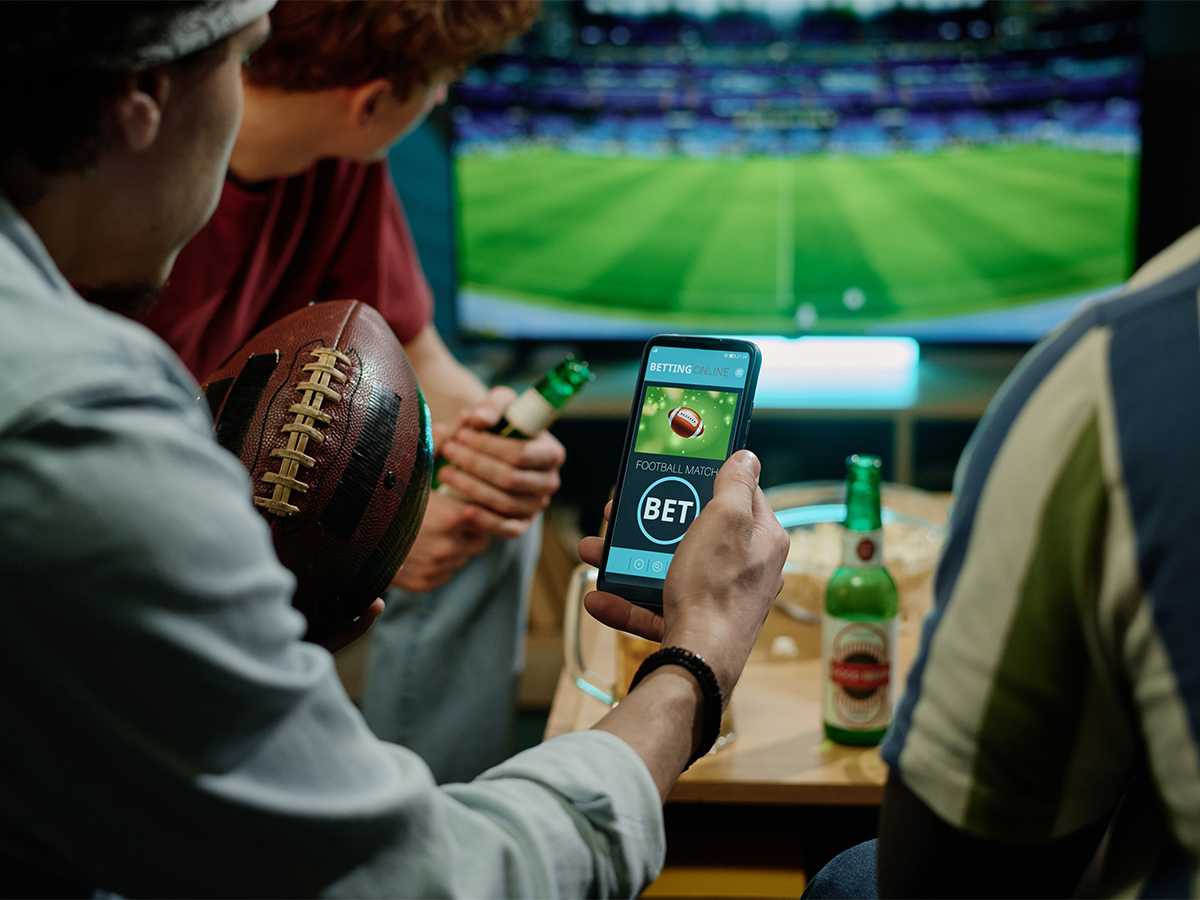
For many fans, the professional sports experience has long been intertwined with alcohol consumption, no matter whether they're watching at the stadium, at a bar or at home on the couch.
In recent years, the widespread adoption of legalized sports gambling across Canada and the United States has added another potentially addictive behaviour to the popular spectator sports environment.
For those who combine sports gambling with alcohol use, new research from Toronto Metropolitan University (TMU) shows that an increase in one problem behaviour is likely to result in an increase in the other.
TMU psychology professor Andrew (Hyounsoo) Kim, a Tier 2 Canada Research Chair in Addictions and Mental Health Comorbidity, was part of the team whose work revealed what he calls “a substantial link” between sports betting and alcohol consumption. The project was led by professor Joshua Grubbs of the University of New Mexico.
Tracking alcohol use and gambling behaviour over two years
The findings come from a unique longitudinal study that tracked alcohol use and gambling behaviour in more than 4,300 American adults over a two-year period, from 2022 to 2024.
“Most research looking at alcohol and sports betting only examines behaviour at a single point in time,” professor Kim explained. “This is one of the first studies to show how the behaviours change over time together, and whether there's a link.”
Across the sample group, alcohol use declined slightly over the survey period while gambling frequency stayed relatively stable. However, for those whose alcohol use went up, the results showed an associated rise in sports betting activity.
“The significant finding is that, yes, there seems to be this relationship where, as sports betting frequency increases over time, alcohol use problems also increase,” professor Kim said. “They were correlated; they didn't move independently. There was a relationship that once one moved, the other moved.”
By demonstrating that relationship, the research also infers that each individual behaviour, either alcohol or gambling, is a potential risk factor for the other, an understanding that could help inform treatment options by addressing both issues simultaneously.
Barriers to gambling eliminated as options expand
The relationship between alcohol and sports betting is of particular interest, professor Kim explained, because legislative and technological changes have eliminated past barriers to gambling while vastly increasing the options available to bettors.
Gambling activity has expanded through the legalization of in-play betting, where wagers are placed on small events within a game, not just the final outcome.
“It’s similar to a slot machine in the sense you can make rapid bets on micro-events that happen fairly quickly,” professor Kim said.
On the technology side, most of us carry cell phones that allow wagers to be placed through online apps and websites.
“You constantly have access, which makes it difficult for those who want to try and reduce their gambling because it's so available,” professor Kim said. “You can be drinking at home, watching the game, pull out your phone and make a bet.”
As gambling becomes as embedded in sports culture as alcohol already is, professor Kim sees potential problems for those unable to control their behaviours.
“When you drink, you're less inhibited,” he said. “I've done research suggesting that if people drink while betting on sports, it could be particularly harmful,” he said. “It's associated with people betting more than they intended, making more wagers and saying they've incurred more harms.”
In light of the risks, professor Kim believes in better harm reduction for problem gamblers, starting with national standards to control “rampant” levels of advertising. He also advocates for limit settings that control how many wagers an individual can place, as well as the option for people to self-exclude themselves from all gambling platforms available in their jurisdiction.
“Slowing things down and putting safeguards in place is a good idea,” professor Kim said. “It would be helpful to have stricter regulations and controls, and to help those who have problems with gambling and sports betting.”
Read the paper, "Sports Gambling and Drinking Behaviors Over Time (external link, opens in new window) ", in JAMA Psychiatry.
The significant finding is that, yes, there seems to be this relationship where as sports betting frequency increases over time, alcohol use problems also increase.
