INNOVATION
Issue 42: Summer 2025
Building a regional model for equity in health governance
Shaping Policy
Building a regional model for equity in health governance

The COVID-19 pandemic exposed stark inequalities in global health systems. Wealthy nations secured vaccines and critical resources early, while poorer countries – and even marginalized communities within developed nations – were left behind.
This disparity motivated Toronto Metropolitan University (TMU) law professor Uchechukwu Ngwaba to launch a multi-faceted research initiative to help define what it means to pursue equity in health governance. He also set out to determine where the conversation needs to happen for real change.
Equity beyond rhetoric: Power, access and health justice
In collaboration with researchers from TMU, York University and the University of Dayton, Ohio, professor Ngwaba hosted a research symposium and released the “Regional Health Governance Study” in 2024. Centring the idea of equity as something deeply tied to power dynamics, the study confronts a fundamental challenge: the profound inequities and structural limitations of the existing global health system.
“We noticed that equity, though frequently invoked, is often used in vague or inconsistent ways,” said professor Ngwaba. “Yet, in practice, it’s impossible to address equity without also confronting how power is distributed.”
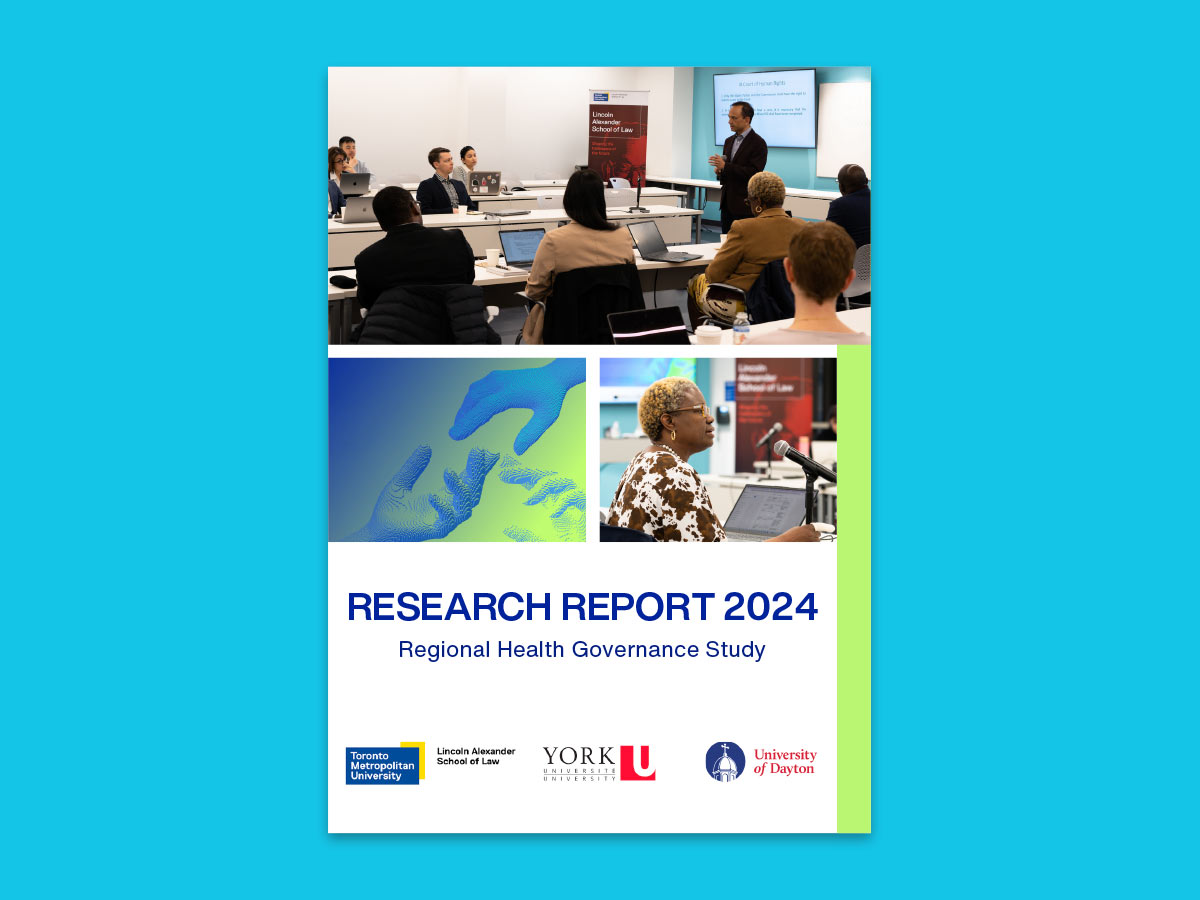
The 2024 Regional Health Governance Study report.
Strengthening a fragile global system through regional cooperation
The study critiques the limitations of national and global responses to health crises, including the unequal distribution of resources. It concludes that a regional health governance approach could help address gaps in equitable pandemic responses and manage health crises more effectively by embedding equity and cross-border coordination. “You are only as secure as the weakest health system around you,” said professor Ngwaba.
The team’s findings prompted them to ask, “Where can equity be pursued most effectively?”
Their innovative answer lay at the regional level – specifically, in the Americas. The study highlights the potential of the Inter-American System for the Protection of Human Rights as a powerful, more responsive model for health governance. Comprising 34 member states, this system has a strong track record in human rights accountability.
“States and communities there already engage in cooperation,” said professor Ngwaba. “There are pre-existing diplomatic and cultural ties, shared challenges and a history of collaboration.” These factors, the team argue, provide a stronger foundation for solidarity and collective action than the current global health governance model. During the pandemic, for example, the Inter-American system quickly established a mandate on economic and social rights that played a central role in shaping early policy responses.
From research to knowledge sharing
What began as a collaboration between two researchers has evolved into a network of over 15 scholars across seven institutions, incorporating valuable input from non-state actors, including non-governmental organizations. "We recognize the need to have frontline perspectives in our ventures," said the team’s project manager, Aeda Salim.
The team is creating infographics of their findings that will be shared through the study’s forthcoming website. Webinars and interviews will take place at the conclusion of the research review, where findings will be presented to the research community and policy briefs will be developed for easy communication of research findings to policymakers. The researchers are investing in leadership development by integrating equity-focused governance into health education and providing opportunities for newcomer professionals to contribute to the research.
"We recognize that this is a long-term project,” said professor Ngwaba. “It will take sustained work, resources and relationship-building.” Ultimately, the team describes its approach as being grounded in the simple truth that when your neighbour is vulnerable, you are, too. “Regional solidarity isn’t just moral - it is pragmatic."
Read the “2024 Regional Health Governance Study.”
Read “Regional health governance for future agile pandemic response” in our Spring 2024 Innovation newsletter.
In practice, it’s impossible to address equity without also confronting how power is distributed.

The research described in this article was supported by TMU’s Lincoln Alexander School of Law, New Comers Women Toronto, York University and the Social Sciences and Humanities Research Council (SSHRC) through a Knowledge Synthesis Grant.