INNOVATION
Issue 42: Summer 2025
A breakthrough in non-invasive disease management with new biotechnology
Idea to Innovation
A breakthrough in non-invasive disease management with new biotechnology
As global health-care systems face mounting challenges – from aging populations to increased rates of chronic illness – more accurate, timely and personalized medical treatments are needed. Combining the leading-edge technologies of machine learning, nanotechnology and biomedical engineering, a new invention co-developed by a Toronto Metropolitan University (TMU) researcher is poised to transform how we predict, diagnose and treat serious diseases, including cancer, Alzheimer’s and diabetes.
Introducing GET-EVs Kits: The next generation of fluid technology
TMU biomedical and mechanical engineering professor Scott Tsai, in partnership with University of Toronto medical biophysics professor Hon Leong, has developed the GET-EVs Kits, a novel, high-yield system for isolating extracellular vesicles (EVs). These tiny, bubble-like particles found in bodily fluids such as blood, saliva, and urine carry crucial information about cell health and disease.
To analyze EVs, scientists must first isolate them from other biological components. Existing methods often damage these particles or leave impurities behind. The GET-EVs Kits overcome this by using a gentle, enzyme-driven approach that keeps the EVs intact and pure. This high level of sample quality is essential for both accurate research and the development of personalized treatments tailored to individual patients.
“Achieving high levels of purity and concentration of EVs is essential for advancing EV-based biomarker development and EV-based therapeutics,” said professor Tsai, who conducts much of his microfluidics research at the Institute for Biomedical Engineering, Science and Technology (iBEST).
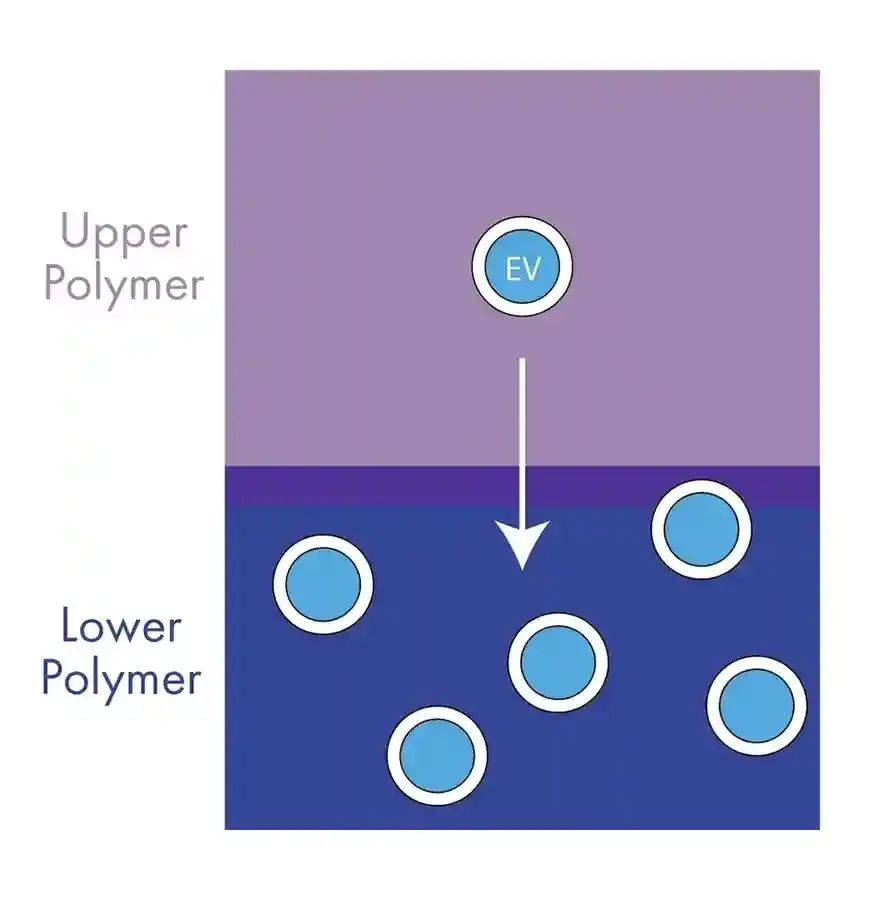
The principles of thermodynamics in EV isolation.
EVs naturally desire to remain in the lowest energy state possible. This is because the bilayer membrane structure has a hydrophobic interior. EVs partition to the lower polymer phase within minutes and minimal centrifugal force.
Tiny particles, big impact: Applications in diagnosis and treatment
The kits’ clean EV samples allow scientists to more accurately measure changes in EV number, composition and function, all critical indicators of disease presence, progression and response to treatment. The kits also unlock new possibilities in RNA extraction and analysis, deepening our understanding of how diseases develop and how they can be detected earlier and treated more effectively.
Beyond diagnosis, EVs have far-reaching clinical potential: they can support non-invasive tests like liquid biopsies (replacing some tissue biopsies), deliver medicine directly to diseased cells, and even activate the body’s immune system to fight illness.
Collaborating on personalized, real-time health-care solutions
By co-developing this advanced biosensing technology, the researchers are paving the way for personalized, real-time health-care solutions with wide-reaching clinical and educational impact. This work showcases Canada’s leadership in health tech innovation and TMU’s commitment to interdisciplinary research. “In biomedical research, the best ideas come together when different disciplines come together,” said professor Tsai.
The GET-EVs Kits team, including a PhD student from each lab, is targeting academic and commercial markets. Professors Tsai and Leong have filed a provisional patent and are seeking international protection for their invention.
Learn more about and order GET-EVs Kits. (external link)
Read “Next Generation Aqueous Two-Phase System for Gentle, Effective, and Timely Extracellular Vesicle Isolation and Transcriptomic Analysis” (external link) in The Journal of Extracellular Vesicles.
Achieving high levels of purity and concentration of extracellular vesicles (EVs) is essential for advancing EV-based biomarker development and EV-based therapeutics.

This research was supported by the Canadian Institutes of Health Research (CIHR) and the Natural Sciences and Engineering Research Council of Canada (NSERC).