Leveraging Public Land for Affordable Housing: The Case of McCleary District
By: Christine Wen, Assistant Professor, School of Urban and Regional Planning, Toronto Metropolitan University
June 12, 2026
(PDF file) Print-friendly version available
Toronto has been grappling with a housing affordability crisis for a decade: renters are particularly disadvantaged, with 2 in 5 households spending more than 30% of their income on shelter[1]. The condo market that has propped up the city’s new apartment supply since the 1980’s recently experienced a severe downturn in the slow economy following decades of speculative pressure[2]. While subsidies from the Canadian Mortgage and Housing Corporation (CMHC) helped boost new purpose-built rentals[3], supply remains constrained due to the lower developer profitability[4]. A 2022 Centre for Urban Research and Land Development (CUR) report proposed several policy options to reduce the development costs of rentals while incentivizing affordability, one of which is the use of publicly-owned land[5].
This is why research carried out by a team of students enrolled in a TMU School of Urban and Regional Planning (SURP) studio last fall recommended the development of 100% purpose-built rental with 30% below market-rate units in their housing proposal to clients at CreateTO, the city’s real estate agency. The project was the latest in an intense sequence of client-based studios spanning their four years of study - this time, creating a development concept for a city-owned vacant site in the Port Lands’ McCleary District. It would feature a complete community with affordable rentals, family-supportive services, and office/retail centred around the creative industries, for CreateTO’s ongoing precinct-planning work in the broader McCleary District[6]. The studio team situated their site analysis within comprehensive research to identify current shortfalls, available supports, and contextual sensitivities. This involved examining the planning frameworks, incentive programs, design guidelines, nearby development applications, environmental and infrastructural constraints, existing services and amenities, film industry studies, and housing market conditions.
The Port Lands were only recently made available for development by flood protection work, so there is no established demographics baseline. It is the closest to South Riverdale neighbourhood, where the median household income is $100,000, 42% of households rent, and 36% of households are in core housing need according to the 2021 census[7]. Around that general area, including parts of downtown, monthly lease rates start from almost $2,000 for a studio to more than double that for a three-bedroom – with the latter having increased faster than the city-wide average over the past two years; studios and one-bedrooms accounted for 66% of all units leased last year[8], with highest vacancy rate for three-bedrooms[9] – suggesting that families might be getting priced out.
The McCleary District itself is about 20 hectares of non-residential land use. To the north is the proposed East Harbour Transit Hub that will add 4,000 residential units and 10 million square feet of office space; to the west is Ookwemin Minising (formerly Villiers Island) that will become a mixed-income community of 15,000[10]. Within the district, four private applications for high-rises were already under review on adjacent parcels. The area is in need of infrastructural upgrades and soil remediation. Environmental and heritage considerations, as well as the Billy Bishop flight paths overhead, impose additional limits to what can be developed.
With the intersecting opportunities and constraints all linked, the students then produced the site layout shown in the figure below with four towers plus a mid-rise building supplying 1,865 rental units, 30% of which are secured as affordable at 80% of CMHC's city-wide average market rent (AMR: $1,109 for a studio to $2,257 for a three-bedroom in 2025[11]) to be integrated with market-rate units throughout. The unit mix was determined using the lease-shares by unit type in the region, with upward adjustments for smaller sizes to accommodate the growing one-person households,[12] as well as three-bedrooms for families to balance out the relatively low proportions in the surrounding developments.
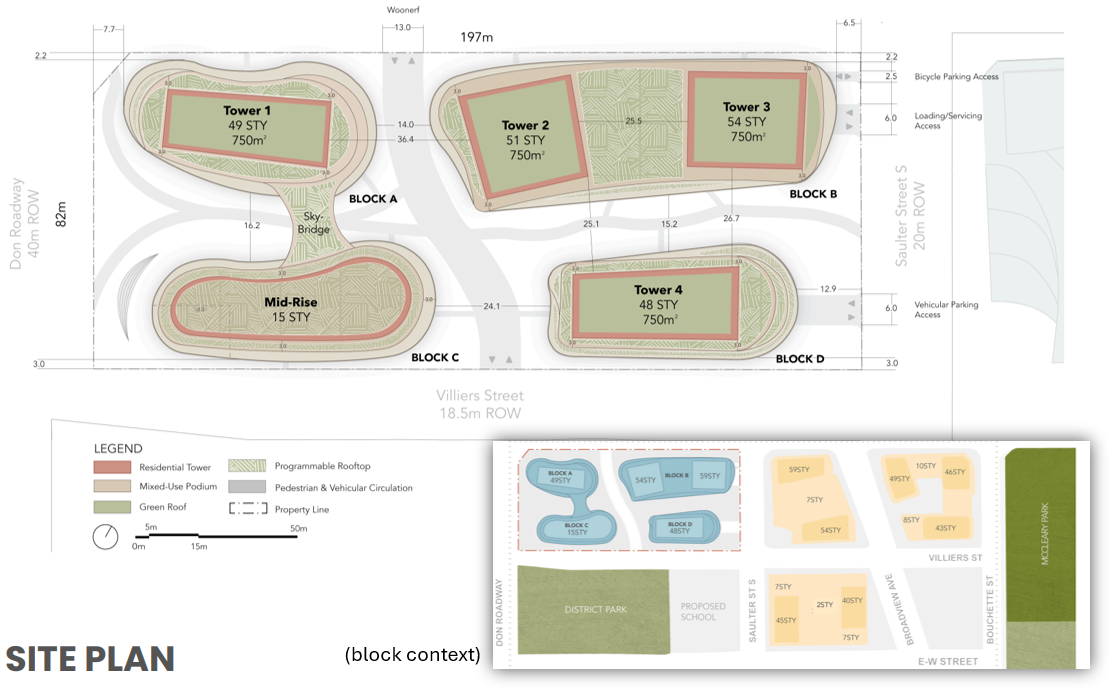
Complementing this mix of market-rate and affordable units is 30% of GFA for non-residential uses in the podium, consisting mainly of film production offices and studios - to support the emerging industry cluster anchored by Pinewood Toronto Studios to the south - as well as childcare and other community spaces. The students created 3D massing models for not just these buildings but also proposed high-rise developments in the adjacent blocks to test height transitions and shadow impacts to ensure synergy with their Indigenous-centered public realm plan.
Finally, all the project parameters, costs/rates, and assumptions about financing and future escalation are plugged into a developer’s pro forma to help assess the financial feasibility. These default values can be adjusted by the user to dynamically update the projected returns. Total development costs for the team’s proposal came to approximately $1.24 billion in the baseline scenario, including hard and soft costs, land remediation, and contingency costs, plus various charges. The project would break even by Year 5 and generate a return of 9.2% - a viable threshold. More striking is the stress test: pushing affordable units to 40% while simulating more favourable financing under affordable housing incentives improves it to 13.5%. Additionally, returns are slightly higher if the demand is driven more by singles than by families, and the most conservative scenario simulating an economic recession still returned 8.2%.
All four scenarios turned out feasible because the model assumes $0 land cost under a 99-year public land leasing agreement with no rental payment - per CreateTO’s instruction. The City ultimately retains ownership of the land and benefits from its appreciation. The Centre has often made the case for more aggressive deployment of public lands as one of the few remaining levers to close the affordable rental gap[13]. This SURP studio project demonstrated how this structure can be complemented with affordable housing incentives to improve returns for both the developer and the city, and how CUR’s work connects students to practice.
Studio team members: Alex Di-Carlo, Azhar Moolla, Brayden Zawalykut, Daniel Tagsa, Eisham Ghuman, Evelyn Romano, Gianluca Spagnolo, Leanne Crowe, Michelle Jacob, Psyche Li, Rebecca Jeon, Victor Kniat, and Xiu Lin Amy Tan.
End Notes
[1] Toronto Neighbourhood Profiles (2021 census): https://www.toronto.ca/city-government/data-research-maps/neighbourhoods-communities/neighbourhood-profiles/ (external link) (citywide, summed by neighbourhood).
[2] Canadian Mortgage and Housing Corporation (CMHC). “Is Toronto’s condo market downturn a repeat of the 1990s?”: https://www.cmhc-schl.gc.ca/observer/2025/is-toronto-condo-market-downturn-repeat-of-1990s (external link) .
[3] Canadian Mortgage and Housing Corporation (CMHC). “Spring 2026 Housing Supply Report”: https://www.cmhc-schl.gc.ca/professionals/housing-markets-data-and-research/market-reports/housing-market/housing-supply-report (external link) .
[4] Hamilton Lane. “Toronto Purpose-Built Rental Apartment Market”: https://www.hamiltonlane.com/en-us/insight/toronto-apartment-market (external link) .
[5] Centre for Urban Research and Land Development. 2022. “Why isn’t a lot more purpose-built rental housing being built in the Greater Toronto Area?”: (PDF file) https://www.torontomu.ca/content/dam/centre-urban-research-land-development/pdfs/CUR_Limited_Purpose-Built_Rental_Housing_Being_Built_in_the_GTA_June_16.pdf.
[6] CreateTO. “McCleary District (Precinct Planning)”: https://createto.ca/projects/mccleary-district (external link) .
[7] City of Toronto and Statistics Canada. “2021 Census Neighbourhood Profiles”: https://open.toronto.ca/dataset/neighbourhood-profiles/ (external link) .
[8] Toronto Regional Real Estate Board (TRREB): “Rental market reports 2025 Q1-Q4”. The area is located in TRREB area E01, but because there are so few leases, the larger surrounding area including also C08, C09, E02, E03 was used in the market analysis: https://trreb.ca/market-data/rental-market-report/rental-market-report-archive/ (external link) .
[9] CMHC. “Rental market data: Purpose-built rental housing market (urban and rural centres) / Vacancy Rates”: https://www.cmhc-schl.gc.ca/professionals/housing-markets-data-and-research/housing-data/data-tables/rental-market?ap=a1-p2 (external link) .
[10] City of Toronto. “Port Lands (planning study)”: https://www.toronto.ca/city-government/planning-development/planning-studies-initiatives/port-lands/ (external link) .
[11] City of Toronto. “Current average market rents & utility allowances” (historical data accessed from reports): https://www.toronto.ca/community-people/community-partners/social-housing-providers/affordable-housing-operators/current-city-of-toronto-average-market-rents-and-utility-allowances/ (external link) .
[12] City of Toronto Planning. “Housing occupancy trends, 2001-2021”: (PDF file) https://www.toronto.ca/legdocs/mmis/2024/ph/bgrd/backgroundfile-247218.pdf (external link) .
[13] Centre for Urban Research and Land Development. 2019. “Governments in Ontario making headway in using surplus lands for housing”: (PDF file) https://www.torontomu.ca/content/dam/centre-urban-research-land-development/pdfs/CUR_Report_Surplus_Lands_April_29.pdf.
References
Amborski, David and Petramala, Diana (2019). “Governments in Ontario Making Headway in Using Surplus Lands for Housing” CUR. April 29, 2019. [Online]. Available: (PDF file) https://www.torontomu.ca/content/dam/centre-urban-research-land-development/pdfs/CUR_Report_Surplus_Lands_April_29.pdf.
Canada Mortgage and Housing Corporation (2020). “Rental Market Data” November 19, 2020. [Online]. Available: https://www.cmhc-schl.gc.ca/professionals/housing-markets-data-and-research/housing-data/data-tables/rental-market?ap=a1-p2 (external link) .
Canada Mortgage and Housing Corporation (2025). “Is Toronto’s condo market downturn a repeat of the 1990s?” September 24, 2025. [Online]. Available: https://www.cmhc-schl.gc.ca/observer/2025/is-toronto-condo-market-downturn-repeat-of-1990s (external link) .
Canada Mortgage and Housing Corporation (2026). “Spring 2026 Housing Supply Report.” March 11, 2026. [Online]. Available: https://www.cmhc-schl.gc.ca/professionals/housing-markets-data-and-research/market-reports/housing-market/housing-supply-report (external link) .
City of Toronto (2024). “Housing Occupancy Trends, 2001-2021.” June 24, 2024. [Online]. Available: (PDF file) https://www.toronto.ca/legdocs/mmis/2024/ph/bgrd/backgroundfile-247218.pdf (external link) .
City of Toronto (2026). “Port Lands.” May 5, 2026. [Online]. Available: https://www.toronto.ca/city-government/planning-development/planning-studies-initiatives/port-lands/ (external link) .
City of Toronto (2026). “Occupancy Costs for Affordable Housing.” May 14, 2026. [Online]. Available: https://www.toronto.ca/community-people/community-partners/social-housing-providers/affordable-housing-operators/occupancy-costs-for-affordable-housing/?WT.rd_id=%2Fcommunity-people%2Fcommunity-partners%2Fsocial-housing-providers%2Faffordable-housing-operators%2Fcurrent-city-of-toronto-average-market-rents-and-utility-allowances%2F (external link) .
City of Toronto (2026). “Neighbourhood Profiles.” [Online]. Available: https://open.toronto.ca/dataset/neighbourhood-profiles/ (external link) .
Clayton, Frank and Paton, Graeme (2022). “Why Isn’t a Lot More Purpose-Built Rental Housing Being Built in the Greater Toronto Area?” CUR. June 16, 2022. [Online]. Available:
CreateTO (2024). “McCleary District: Precinct Planning.” [Online]. Available: https://createto.ca/projects/mccleary-district (external link) .
Hamilton Lane (2025). “Toronto Purpose-Built Rental Apartment Market.” February 3, 2025. [Online]. Available: https://www.hamiltonlane.com/en-us/insight/toronto-apartment-market (external link) .
Toronto Regional Real Estate Board (2026). “Rental Market Reports 2025, Q1-Q4.” [Online]. Available: https://trreb.ca/market-data/rental-market-report/rental-market-report-archive/ (external link) .