The Case for Developing the Former Pickering Airport Lands With Missing Middle Housing
By: Frank Clayton, Ph.D., Senior Research Fellow
May 6, 2026
(PDF file) Print-friendly version available
Abstract
The federal government has a significant one-time opportunity to make a meaningful contribution to improving housing affordability in the Toronto region by comprehensively planning and developing the former Pickering airport land for a new community.
The about 9,000 acres (3,642 hectares) of federal land, until recently intended for a future Pickering airport, should be used to create a new community. The Toronto region has an extreme shortage of affordable housing. These lands could easily accommodate 30,000 or more new homes in affordable, low- and medium-density configurations. Importantly, the lands could be planned and developed comprehensively on leased land, since they are under a single ownership, with the federal government as the lessor controlling land uses now and in the long term.
For five decades, the Pickering airport lands have been intended for urban use
The federal government is aware of the housing supply and affordability crisis in the Toronto region.[1] The Pickering lands, for five decades, were intended for extensive urban use – a new airport. Now that the government has determined that an airport is not a priority use, it is in the public interest to develop the land for a high-priority urban need: improving housing affordability.
On January 27, 2025, two federal ministries released information on the future of the former Pickering airport lands. Using the lands for a priority urban need, like housing, is conspicuous by its absence in the two releases.
The Minister of Transport and Internal Trade announced that the federal Pickering lands will not be used for a future airport. The Minister stated the government's intention to transfer high-conservation-value lands to Parks Canada[2] Simultaneously, Parks Canada announced the government's intent to significantly expand the Rouge National Urban Park, with consultations to begin on the potential transfer of the Pickering lands from Transport Canada to Parks Canada.[3] The mention that the priority step in consultations would be with Indigenous groups and other stakeholders, including tenants and leaseholders of the mostly agricultural land, suggests a possible bias by the federal government against using the land for a new community.[4]
Affordable housing is a greater priority need than expanding the Rouge National Urban Park
Unfortunately, the federal announcements raised hopes among environmental and farm lobbies that the land would be used mostly for their purposes.[5] They overlook the fact that the land was previously intended for a large-scale airport, which is very much an urban use.
Much more housing is needed in the Toronto region, especially so-called “missing middle” housing such as townhouses, accessory suites, structures with 3 to 6 units (“plexes”), stacked townhouses, and low-rise apartment buildings[6] Providing these homes on the former Pickering airport lands would enhance housing affordability for aspiring homeowners and renters and offer affordable alternatives to high-rises.[7]
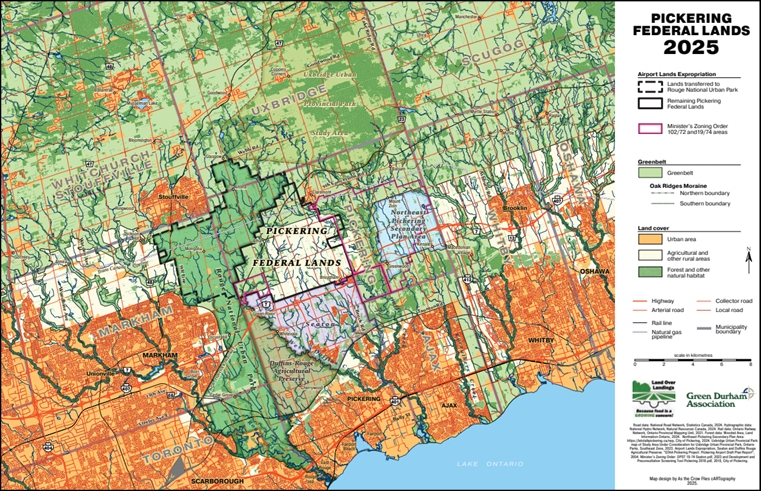
It is difficult to argue convincingly that the lands are essential to expanding the Greenbelt by adding them to the Rouge National Urban Park, which, at 19,600 acres (7,930 hectares), is already one of the largest urban parks in North America. It should be noted that the federal government had previously transferred more than half of the original airport lands (9,703 acres, or 3,935 hectares, in total) to the park. Moreover, roughly 2 million acres (809,370 hectares) of Greenbelt land are protected from development in the Toronto region, including lands close to these former airport lands (see appendix map).[8]
The case for retaining the lands for agriculture is also tenuous, as they have been intended for urban use for the past 50 years. No additional agricultural land is lost beyond what was already decided decades ago.
The appendix map shows the vastness of the existing Rouge National Urban Park and the Greenbelt lands (mainly in agricultural use) in proximity to the former airport lands (called Pickering Federal Lands on the map).
The case for residential development of the former airport lands
The case for residential development is compelling:
- First, the lands are located close to the city of Toronto and York region, with their substantial job bases;
- Second, the lands are located immediately north of the large-scale Seaton community, with its growing employment along the Highway 407 corridor, which is now being developed, and the likely development of the sizable Pickering lands east of Seaton;
- Third, the lands are under single ownership, which has not been seen on such a scale since the planned communities of Erin Mills and Meadowvale in Mississauga in the 1970s, allowing them to be comprehensively planned and developed with a balance of housing and employment opportunities;
- Fourth, by leasing the lands, the federal government, not private owners, can be the beneficiary of future increases in land value over the long term; and
- Fifth, the development of these lands could be on a scale to encourage productivity improvements in how infrastructure is installed and housing is built.
In planning and developing the former airport lands, the federal government could create a greener, more sustainable model for housing development by incorporating viable green infrastructure. In addition, these lands, combined with the large-scale development of Pickering lands south of the 407 corridor east of Seaton, should enhance the viability of rapid transit linkages and transit-oriented development for the larger area.
Building on the UK initiative to create a new generation of new towns
In this regard, the current government in the United Kingdom is embracing the creation of a new generation of new towns as part of its ambitious homebuilding program, many decades after the creation of new towns in the late 1940s. The government established a New Towns Task Force in July 2024 to identify locations for a new generation of new towns in England to address low productivity and a significant shortfall in housing stock.[9] It recommended 12 potential new-town locations, each with at least 10,000 new homes, delivered through a specially created development corporation. The United Kingdom government, earlier this year, released a list of locations for seven new towns, with each location expected to deliver at least 10,000 new homes, and several delivering 40,000 or more.[10]
Developing the former Pickering airport lands as a new town would offer the opportunity to create an exemplary urban environment, with affordable, non-high-rise accommodation that many residents of the Toronto region desire.
Enhancing housing affordability and housing needs by increasing the supply of missing middle housing significantly
What kind of housing will provide the most relief to the housing affordability challenges experienced in the Toronto region? The thrust should be on missing-middle housing forms, ranging from duplexes to four-storey apartment buildings. Over the past quarter-century, the mix of housing built in the Toronto region has shifted from single-detached houses to apartments (until recently, condominiums, now purpose-built rentals).
The decline in affordability of single-detached houses, aided and abetted by planning policies and exploding municipal financial obligations, was a major cause of the shift. What is needed in the regional marketplace are many more affordable, reasonable substitutes for single-detached houses - missing-middle housing units.[11] Single-detached houses would be permitted if they incorporate one or more accessory apartments, thereby converting them into duplexes or other plexes, which are missing-middle formats.
Provincial and federal initiatives are indeed encouraging municipalities to build more missing middle housing, especially in existing low-density neighbourhoods. Provincial legislation was passed in 2022 to allow “as-of-right” rezonings for up to three units per lot in most existing residential areas.[12] The federal government has been working with municipalities to expand missing-middle housing options.[13]
However, the number of missing middle housing units built through densifying existing neighbourhoods is small relative to the need. CMHC noted in mid-2025 that the city of “…. Toronto’s missing middle construction is modest compared with both its size and its overall housing needs.”[14]
The development could include employment serving the local population and industrial/office development along Highway 407, complementing employment activities in the Seaton community.
Ownership and financing recommendations to the federal government for the development of the lands
The federal government should consider the following ownership and financing features of the development plan for the lands, beyond building missing middle housing: (a) maintain ownership of the lands with sites leased for 99 years; (b) maintain ownership of all rental housing (land and structures) with management by nonprofit and commercial providers; (c) exempt rental housing from land lease payments; (d) setting initial land lease payments for ownership housing at a reduced share of market value; and establishing a single development agency responsible for building out the community.
Maintaining ownership of the land would give the government the flexibility to provide a mix of below-market and market-rate housing throughout the new community over the long term. Future uplift in land values would remain with the government, not the purchasers or future owners of the land, as is the case in the housing market today. This way, it can ensure the land will not become expensive freehold market housing in the future. Keeping ownership of the rental housing would allow the government to maintain the affordability of the rental housing stock over time. Finally, with a single development agency, the lands will be developed comprehensively in accordance with the federal government's affordability and housing mix objectives.
Bottom line
The bottom line is that the federal government has a significant one-time opportunity to make a sizable contribution to housing affordability in the Toronto region by comprehensively planning and developing the former Pickering airport land for a new community.
End Notes
[1] For example, CMHC. “Canada’s housing supply shortages: moving to a new framework.” June 2025.
[2] Transport Canada. “Minister of Transport announces the Pickering Lands will not be used for a future airport site.” News release, January 27, 2025.
[3] Parks Canada. “Government of Canada Announces Intent to significantly expand Rouge National Urban Park.” News release. January 27, 2025.
[4] This impression is reinforced by the government only mentioning Parks Canada's administration rather than a housing body such as Canada Mortgage and Housing Corporation, the Canada Lands Company, or its latest creation, Build Canada Homes.
[5] See for example: Ontario National Farmers Union. “Media Release: Addition of the ‘Pickering Airport Lands’ to Rouge National Urban Park a Soaring Achievement, says National Farmers Union.” Press releases. January 27, 2025, and Environmental Defence. “Environmental Groups Celebrate Planned Expansion of Rouge Urban National Park.” January 27, 2025.
[6] CUR has done extensive research into housing preferences in the Toronto region, which indicates a dominant demand for ground-related housing types (singles, semis, townhouses) or, second best, close substitutes like stacked townhouses. See, for example, Frank Clayton. “What Kinds of Housing Are Homebuyers or Intending Homebuyers in the GTHA Choosing?” CUR, June 28, 2022. Many renters also prefer accommodation types other than high-rise apartments.
[7] CMHC. “How Common is ‘Missing Middle’ Housing Development in Canada?” October 23, 2025, and Frank Clayton and Diana Petramala. “A Strategy for Significantly Increasing the Supply of ‘Missing Middle’ Housing in the City of Toronto.” CUR. February 6, 2019.
[8] This map was prepared for Land Over Landings by Chris Brackley of As the Crow Flies cARTography.
[9] New Towns Taskforce. “New Towns Taskforce Report to Government.” September 2025.
[10] Ministry of Housing, Communities and Local Government, Homes England. “Seven New Towns Proposed to Kickstart Housebuilding Push.” Press Release. March 22, 2026.
[11] Kaitlin Webber. “In-Between Issues: Exploring the ‘Missing Middle’ in Ontario.” Pragma Discussion Paper. Spring 2019.
[12] Environmental Registry of Ontario. “Opportunities to increase missing middle housing and gentle density, including supports for multigenerational housing.” ERO number 019-5286. December 19, 2022.
[13] Infrastructure Canada. “Solving the Housing Crisis: Canada’s Housing Plan.” 2024.
[14] CMHC. “How Common is ’Missing Middle’ Housing Development in Canada.” October 23, 2025.
References
Canada Mortgage and Housing Corporation (2025). “How Common is ‘Missing Middle’ Housing Development in Canada?” October 23, 2025. [Online]. Available: https://www.cmhc-schl.gc.ca/observer/2025/how-common-missing-middle-housing-development-canada (external link) .
Canada Mortgage and Housing Corporation (2025). “Canada’s housing supply shortages: moving to a new framework.” June 19, 2025. [Online]. Available: https://www.cmhc-schl.gc.ca/professionals/housing-markets-data-and-research/housing-research/research-reports/accelerate-supply/canadas-housing-supply-shortages-a-new-framework (external link) .
Clayton, Frank (2022). “What Kinds of Housing Are Homebuyers or Intending Homebuyers in the GTHA Choosing?” CUR. June 28, 2022. [Online]. Available: (PDF file) https://www.torontomu.ca/content/dam/centre-urban-research-land-development/CUR_Preference_Homebuyers_Intending_Hombuyers_GTHA_June_2022.pdf.
Clayton, Frank and Petramala, Diana (2019). “A Strategy for Significantly Increasing the Supply of ‘Missing Middle’ Housing in the City of Toronto.” CUR. February 6, 2019. [Online]. Available: (PDF file) https://www.torontomu.ca/content/dam/centre-urban-research-land-development/pdfs/TREB/CUR_Missing_Middle_Housing_Toronto.pdf.
Environmental Defence (2025). “Environmental Groups Celebrate Planned Expansion of Rouge Urban National Park.” January 27, 2025. [Online]. Available: https://environmentaldefence.ca/2025/01/27/environmental-groups-celebrate-planned-expansion-of-rouge-urban-national-park/ (external link) .
Environmental Registry of Ontario (2022). “Opportunities to increase missing middle housing and gentle density, including supports for multigenerational housing.” ERO number 019-5286. December 19, 2022. [Online]. Available: https://ero.ontario.ca/notice/019-5286 (external link) .
Infrastructure Canada (2024). “Solving the Housing Crisis: Canada’s Housing Plan.” [Online]. Available: (PDF file) https://housing-infrastructure.canada.ca/alt-format/pdf/housing-logement/housing-plan-logement-en.pdf (external link) .
Ministry of Housing, Communities and Local Government, Homes England (2026). “Seven New Towns Proposed to Kickstart Housebuilding Push.” March 22, 2026. [Online]. Available: https://www.gov.uk/government/news/seven-new-towns-proposed-to-kickstart-housebuilding-push (external link) .
New Towns Taskforce (2025). “New Towns Taskforce Report to Government.” September 28, 2025. [Online]. Available: (PDF file) https://assets.publishing.service.gov.uk/media/68d694b79cb44667f7a1cee7/New_Towns_Taskforce_Final_Report.pdf (external link) .
Ontario National Farmers Union (2025). “Media Release: Addition of the ‘Pickering Airport Lands’ to Rouge National Urban Park a Soaring Achievement, says National Farmers Union.” January 27, 2025. [Online]. Available: https://nfuontario.ca/news/media-release-addition-of-the-pickering-airport-lands-to-rouge-national-urban-park-a-soaring-achievement-says-national-farmers-union/ (external link) .
Parks Canada (2025). “Government of Canada Announces Intent to significantly expand Rouge National Urban Park.” January 27, 2025. [Online]. Available: https://www.canada.ca/en/parks-canada/news/2025/01/government-of-canada-announces-intent-to-significantly-expand-rouge-national-urban-park.html (external link) .
Transport Canada (2025). “Minister of Transport announces the Pickering Lands will not be used for a future airport site.” January 27, 2025. [Online]. Available: https://tc.canada.ca/en/initiatives/pickering-lands (external link) .
Webber, Kaitlin (2019). “In-Between Issues: Exploring the ‘Missing Middle’ in Ontario.” Pragma Discussion Paper. Spring 2019. [Online]. Available: (PDF file) https://uwaterloo.ca/environment/sites/default/files/uploads/documents/missingmiddle_pragma2019backgroundreport.pdf (external link) .
Appendix: Location of the Former Pickering Airport Land and Land Uses Context