TMU researchers examine why using robots in restaurant kitchens leads to a “love chasm” for human diners
Most drivers don’t think any less of their car because a robot helped put it together. Likewise, you wouldn’t expect someone to stop taking their prescription medication if they knew a robot sorted and packaged the pills.
Tell people you’re using robots to prepare food in a restaurant kitchen, however, and it can have a big impact on how positively they perceive a meal will taste, and how much they’re willing to pay for it.
That’s the finding of research by a group including Toronto Metropolitan University (TMU) marketing management professors Matthew Philp and Nükhet Taylor, both from the Ted Rogers School of Management.
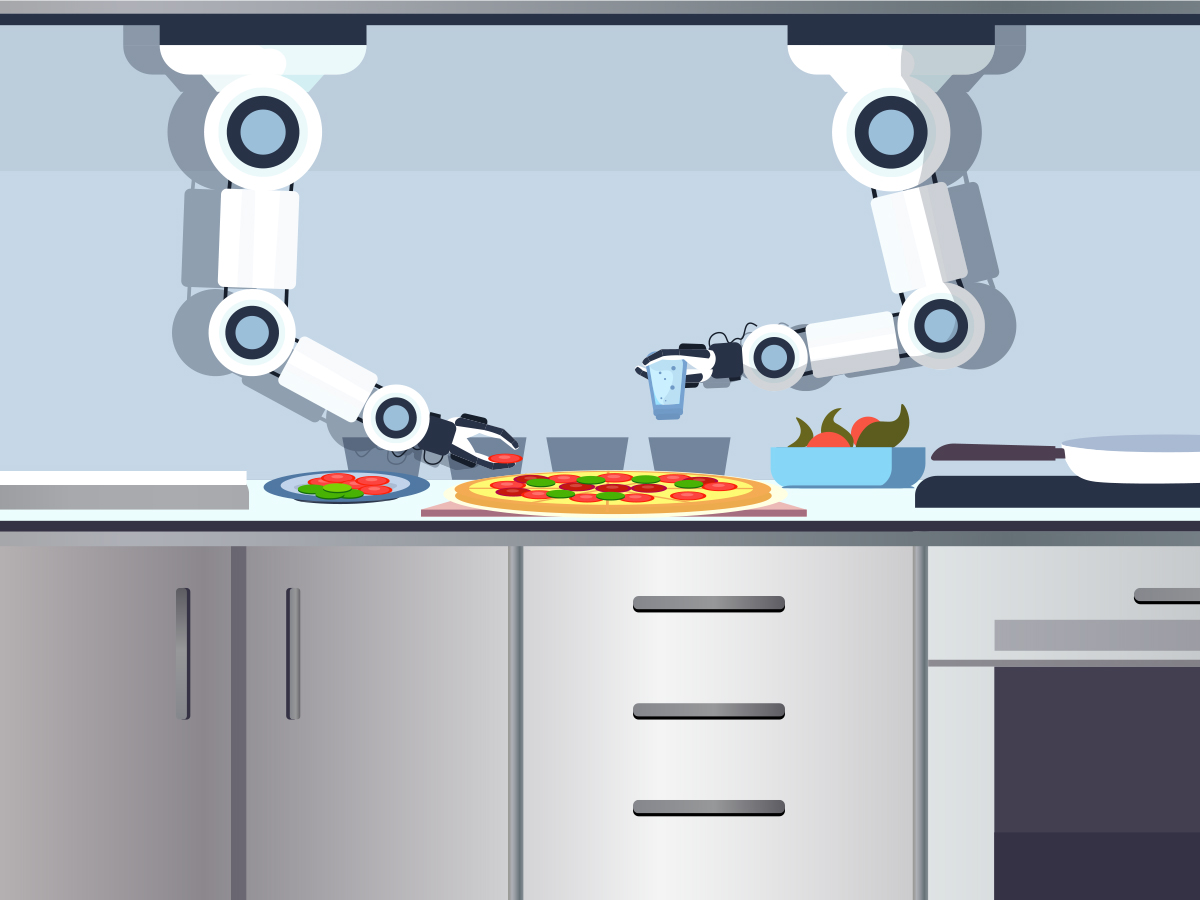
According to forecasts cited in their paper, 82 per cent of jobs in the food service industry are expected to be replaced by robots. Existing examples of automation in restaurant kitchens include an AI-powered arm that safely fries food, robots that combine ingredients to prepare salads, and a pizza-making robot that can stretch dough, spread tomato sauce and sprinkle cheese and toppings.
Despite customer benefits that include higher standards of cleanliness and consistency, the research shows that North American diners aren’t ready to give robots five-star reviews, as demonstrated by a series of four experiments involving fast-food customers in the United States.
The results suggest consumers believe machine-prepared food will taste worse than human-prepared food. They’re also not willing to pay as much for the same meal if it’s made by a robot instead of a person. In one study, diners said they’d pay an average of US$11.16 for a human-prepared salad bowl but only US$9.43 when the identical dish was presented as robot-made, a 16 per cent decrease.
Machine-made food leaves customers feeling a “love chasm”
What’s behind diners’ distaste for automated food preparation? When consumers know an emotionless machine has prepared their meal, the outcome is what professor Taylor calls a “love chasm,” an absence of the perceived warmth and care we tend to associate with dishes made by humans. For many of us, the sentiment is the result of an intense connection with food that often begins early in life.
“Food is such a deep experience,” professor Taylor said. “It's one of the first things we experience with our parents when they feed us. It's a way of nurturing and loving a child.”
According to the research, a reduced feeling of symbolic love is one of two distinct but simultaneous “contagion effects” that arise from awareness of automated food preparation. The second is increased disgust, a feeling that arises from the moral opposition to machines taking jobs from humans in the name of higher profits.
“This dual action is something you don't usually see,” professor Taylor explained. “Usually, if something negative touches you, it's only a negative experience. Here we see taking away and infusing, and both are negative. Love is going away, and disgust is increasing.”
Addressing customer concerns about restaurant automation
Despite this double dose of displeasure, the research finds restaurant owners may be able to successfully adopt technology while also overcoming customer misgivings. In the last of the four experiments, the level of disgust with machine-prepared food was reduced by clearly communicating the customer-focused benefits of automation (decreased wait times, fewer ordering errors, increased food safety) while minimizing the business-centric benefits (reduced wages and costs).
The paper notes that cultures around the world view food as a human-driven “act of creation and care,” no matter how much that culture accepts or embraces modern technology. While North American diners may find it novel to eat a meal that wasn’t human-made, the transformation of many restaurant kitchens is already well underway.
North Americans already accept some level of automation in the production of certain foods, professor Philp said, noting that the reluctance to new technologies typically diminishes over time as awareness and understanding grow.
“Just like when you buy a candy bar at the grocery store, you know it wasn’t made by hand,” he said, “it’s likely that in a culture or a society where this technology is more prolific or more common, the (contagion) effects would possibly fade away.”
Read the paper, “Robots in the kitchen: The automation of food preparation in restaurants and the compounding effects of perceived love and disgust on consumer evaluations (external link, opens in new window) ,” in Appetite.