Right on cue: Crafting a world of sound

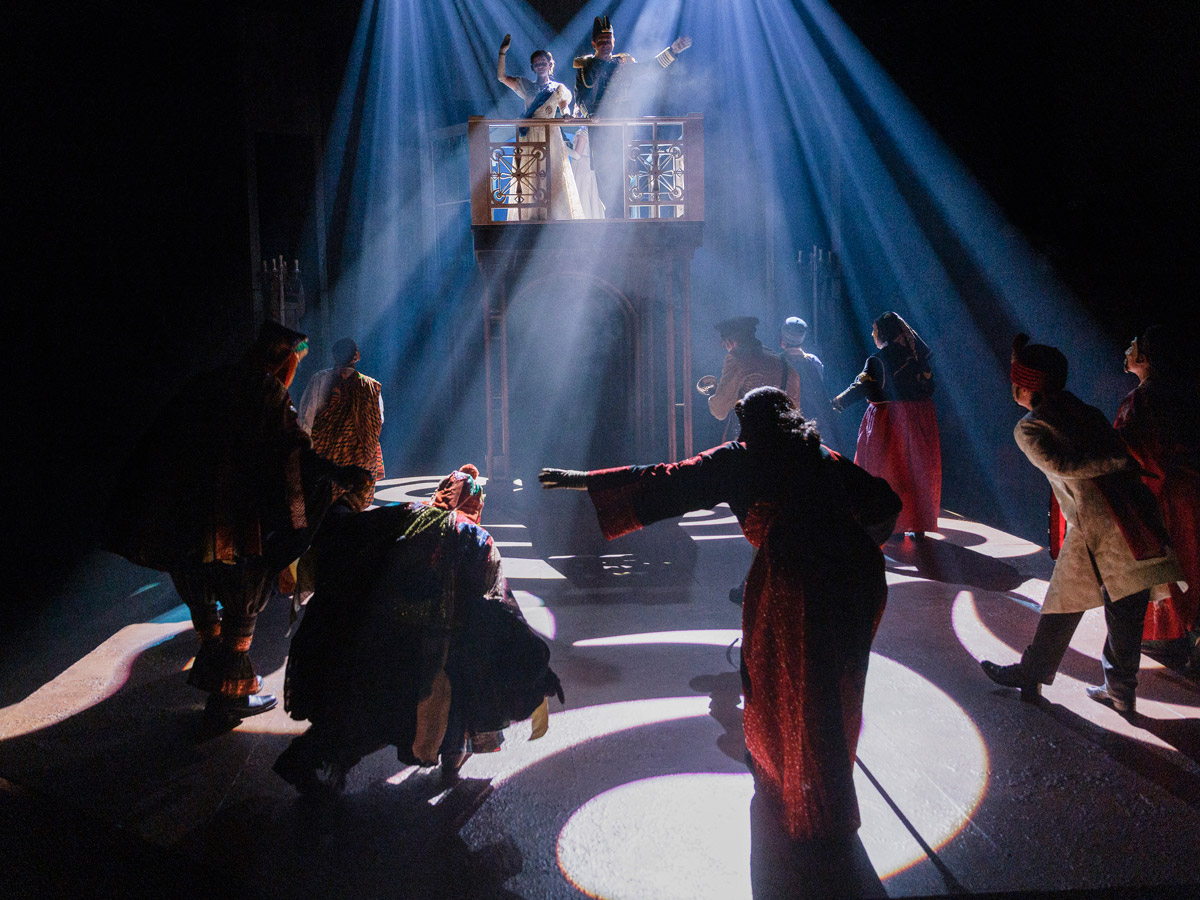
Akosua Amo-Adem as Iyaloja with members of the company in Death and the King's Horseman. Stratford Festival 2022. Photo by David Hou.
The theatre is dark. Then, the stage lights come up. Over the speakers, you hear something: children running, the whistle of a train, and the music and chatter of a raucous party. The sounds help transport the audience into the world of the play.
This latter part of the theatrical experience is usually crafted by the production’s sound designer, a role often fulfilled by performance professor Debashis Sinha from The Creative School. In addition to his award-winning sound design work for Toronto and Ontario theatre companies, professor Sinha is a musician and composer who researches machine learning and sound.
He describes the role of a theatrical sound designer as being responsible for anything coming out of a speaker, whether it’s music or effects like birds chirping, during the performance. A regular contributor at the renowned Stratford Festival, professor Sinha was most recently the sound designer for “Death and the King’s Horseman,” a play by Nobel Prize winner Wole Soyinka during his sixth season with the festival.
Developing the soundscape for a performance may include using digital sound libraries, creating original cues with computer software, composing original music and using physical effects. As the sound designer, professor Sinha works with the theatre production’s creative team to shape the audio experience that will help immerse the audience in the performance.
“I have to make sounds that work with the lighting, the set, the director’s vision and my own vision. So all the decisions I make are really in service of the story as we are telling it in that production,” he said. This process includes finding inspiration from different aspects of the production, whether it be a costume or how a set moves or an actor speaks a line.
After initial pre-production discussions with the director, professor Sinha says “a sound environment takes shape in my mind.” He then makes “sound sketches” to build the world. With the rest of the production’s artists, such as set or costume designers, he develops an environment both on and offstage to enable a space where everyone can do their best work.
“By being open to conversations with people who are not sound-forward, who have other considerations, you discover things about your own practice that makes it better,” professor Sinha said.
Andrea Rankin (left) as Companion to The Prince and Josue Laboucane as The Prince with members of the company in Death and the King's Horseman. Stratford Festival 2022. Photo by David Hou.
For “Death and the King’s Horseman,” which takes place in Nigeria in the 1940s, there were culturally specific components to the production that were important to get right, he says. To feature authentic sounds, the sound team worked with a Nigeria-based music lecturer who also manages a sound archive. He was able to make field recordings, such as the background bustle of a marketplace or the audio experience of nighttime in the country, that professor Sinha used to create many of the play’s sound cues.
Professor Sinha also pursues music, art and research and has an exhibit at Toronto’s Museum of Contemporary Art until January 8, 2023. The exhibit, which includes a component displayed on the museum’s exterior, is called Saṅkhyā Stories: Machine Learning Fables (external link, opens in new window) . The exhibit taps into his research into machine learning and sound, examining the results of inputting audio materials into artificial intelligence tools and considering what the results say about the state of the tools themselves from different practical and cultural perspectives.
Related links:
Blending creativity with machine learning processes to uncover new modes of storytelling
20.9 Running Feet Trans from “Watching Glory Die” audio clip description: With an alarm blaring in the background, someone bangs on a door or wall and loudly rattles a doorknob. Loud footsteps can then be heard, growing quieter as if the person is moving further away. For a few seconds, only the alarm can be heard. Banging and the rattling of a doorknob begin again as the alarm continues to sound in the background.
The Killing Of King Richard from “Breath of Kings” audio clip description: A sharp and loud exhalation of breath is followed by more sharp and short inhalations and exhalations, giving the impression of someone physically exerting themselves. The breathing grows quieter and fades into silence.