Inspired by physics, TMU mathematics professor finds solution to 70-year-old problem

Mathematics professor Konstantinos Georgiou was looking for a diversion from work, so he clicked on his favourite YouTube channel. That fortuitous choice put him on the pathway to the solution to a common problem that had gone unanswered for almost 70 years.
In search theory, which uses mathematical frameworks to optimize strategies for finding a target, the problem that professor Georgiou solved is well known. Imagine you’re lost in a forest. A fixed distance away, say one kilometre, the forest ends with a clear boundary line that’s only visible once you reach it. However, you have no idea which way to go to find it.
You could pick any direction and walk one kilometre, then eventually discover the forest boundary by following a circle with a one-kilometre radius from your original starting point. However, that’s not the most efficient approach. For decades, mathematicians had struggled to definitively prove what route, on average, will lead you out most quickly.
While professor Georgiou’s solution is purely mathematical, it establishes a method that other researchers can use to solve related problems in robotics, theoretical computer science and other fields.
Fermat’s principle provides inspiration
Professor Georgiou’s solution was inspired by Fermat’s principle, or the principle of least time. Proposed in the 17th century, it states that a ray of light travelling between two points will always take the path that’s fastest, even if it’s not the shortest.
The implications of that principle struck professor Georgiou one night in the spring of 2025. He’d been working late in his home office and wanted to clear his thoughts. As is his custom, he cued up a science documentary on YouTube. In the video, Fermat’s principle was demonstrated by a pencil being placed in a glass of water.
In the air above the water, light moves at one speed. Below the surface of the denser water, however, light slows down and changes directions, or refracts. Looking at the glass, the impact of that refraction can be easily seen – the pencil doesn’t line up on either side of the water’s surface.
“The moment I saw the video, it was clear in my mind,” professor Georgiou recalled. “I immediately realized that Fermat’s principle was applicable to my search theory problem, and that I could use the idea to prove what the optimal solution is by remodelling it as the question of how the light would travel if the path was divided into countless thin layers, each allowing progressively faster speeds.”
Professor Georgiou spent nearly five months working to fill in all the details and complete the proof. His solution determines the optimal trajectory of the fastest average route to the boundary with an answer accurate to at least six decimal digits.
The new solution also disproved something mathematicians had long believed: that the best average route to the boundary met and followed that imaginary, fixed-radius circle around the starting point. Professor Georgiou’s proof shows that the best average trajectory actually lies outside that circle.
“That's what makes the solution counterintuitive,” he said. “It doesn't seem optimal to be away from the circle but, by doing so, you can escape from possible future placements of the boundary faster.”
Professor Georgiou submitted a paper on his new proof to a competitive, leading conference, the International Symposium on Theoretical Aspects of Computer Science (STACS). In the blind peer review process, all reviewers gave his paper clear accept scores, a sign of its strength and quality. In March of this year, professor Georgiou travelled to Grenoble, France, to present his research at the 43rd annual STACS conference.
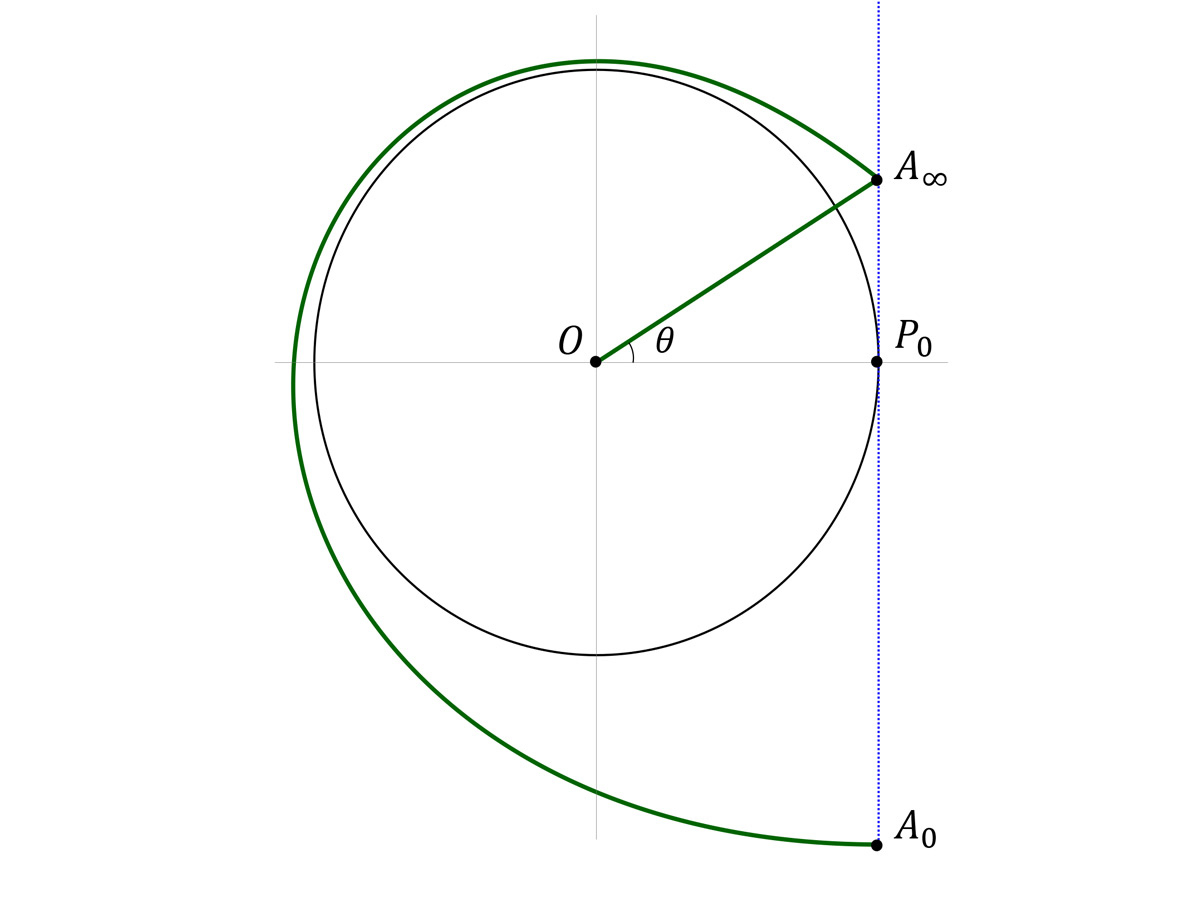
A depiction of professor Georgiou’s solution to the search theory problem. Surprisingly, the optimal trajectory surrounds the circle touched by all possible boundary lines, crosses it only once, and never follows its perimeter.
A proof from the Book
Style counts to mathematicians, and professor Georgiou is particularly proud of his unique, elegant proof for the search theory problem, one known as a “proof from the Book.” The term comes from the late Hungarian mathematician Paul Erdős, who used it to describe the finest proofs, typically those revered for their brevity and elegance, insightfulness or other unexpected qualities.
“It's not often that you come up with a proof from the Book,” professor Georgiou said, “a proof with a surprising ingredient in which you inject a scientific approach from another area, and it simplifies or gives intuition to your technical arguments. When you find this bridge between abstract ideas and intuitive concepts, it’s a great asset to an idea.”
Read professor Georgiou’s paper, Optimal Average Disk-Inspection via Fermat's Principle (external link, opens in new window) , in arXiv.