Reducing dementia risk: What research says about modifiable risk factors across the life course

Alzheimer’s disease and other forms of dementia affect hundreds of thousands of Canadians, and our aging population means the number of cases is likely to soar in the years ahead.
However, research suggests that taking meaningful actions to support brain health at every stage of life can help delay or reduce the risk of dementia.
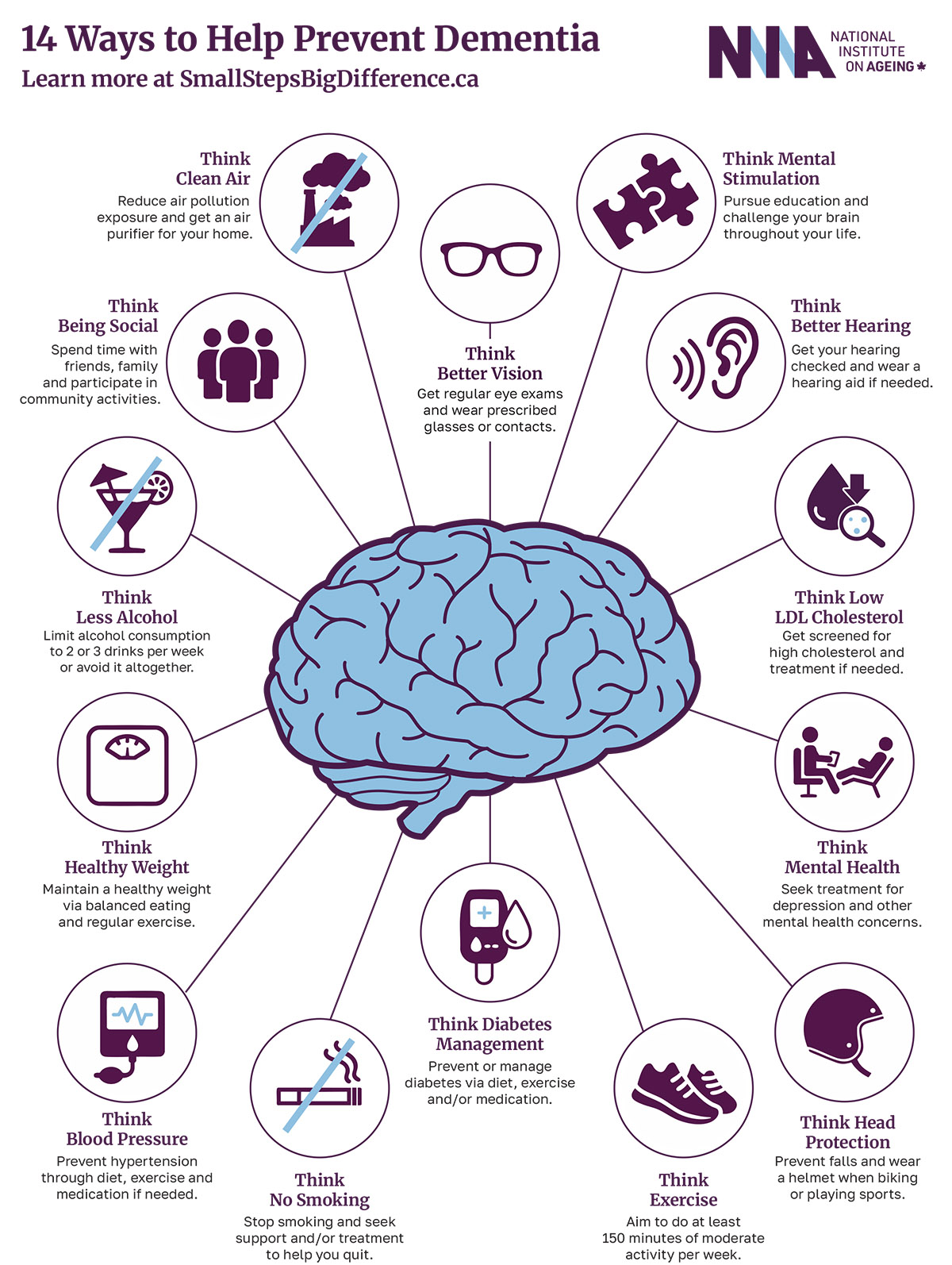
Some of those actions may seem obvious, such as avoiding traumatic head injuries, cutting out smoking and limiting consumption of alcohol. Others are less apparent but no less important, from cultivating a healthy social network to consulting with health care professionals to maintain our sight and hearing.
According to research by the 2024 Lancet Commission, as many as 45 per cent of global dementia cases could be prevented or delayed by addressing 14 “modifiable risk factors” at different stages of life.
Those 14 factors are the focus of Small Steps, Big Difference, a new dementia-awareness campaign from the National Institute on Ageing (NIA) at Toronto Metropolitan University.
“There are a lot of misunderstandings or misconceptions around dementia,” said Dr. Samir Sinha, director of health policy research at the NIA. “People just assume that as you get older, your memory and cognition become increasingly impaired, and that's not the case.”
Last year, with support from the Slaight Family Foundation Dementia Initiative, the NIA released the first of three reports, Addressing Dementia in Canada: Current Trends, Challenges and Opportunities in Improving Public Awareness, Reducing the Risk and Challenging Stigma Related to Dementia.
“We’re working to improve Canadians’ knowledge and awareness around dementia and ensure people know it's not an inevitability,” Dr. Sinha said. “A lot of people don't put those things together and consider the benefits these actions can have to help us stay healthy and well, and to prevent or delay dementia.”
As the report explains, between 60 and 80 per cent of all dementia cases in Canada are caused by Alzheimer’s disease, a progressive and incurable brain disorder.
Those with Alzheimer’s and other forms of dementia commonly experience memory loss, diminished cognitive capacity and difficulty with words and speech, as well as other symptoms such as behavioural changes that can include mood swings or irritability.
“As dementias progress, they tend to increasingly affect our ability to remain independent and perform day-to-day tasks,” Dr. Sinha explained. “As that becomes more severe, it could affect your ability to do things like prepare or even eat meals, to bathe and dress yourself and attend to other basic needs.”
Growing older is the most substantial known risk factor for developing dementia. According to the NIA report, dementia rates in Canada roughly double for every five-year age group from ages 65 to 69 until 85 to 89, rising from one per cent of the population in the younger group to 19 per cent in the final age bracket.
The NIA report cites research from The Alzheimer Society of Canada (ASC) that estimates 772,000 Canadians currently live with dementia, a figure that’s projected to grow to 1.7 million by 2050. The ASC predicts that as many as one million caregivers, both unpaid and professional, will be required to care for this cohort.
Still, as Dr. Sinha points out, current rates of dementia in Canada are actually lower than predictions made 20 years ago.
“In part, that's due to better recognition of and the addressing of some of these modifiable risk factors,” he said. “That's why awareness is helpful, because it helps people understand what dementia is and what it isn't, as well as what we can actually do to prevent or delay it.”
Lifelong learning with a strong early foundation is among the 14 modifiable risk factors cited by the Lancet Commission.
“We have to think of our brain as a bit of a muscle,” Dr Sinha said. “Even though our brains are not technically muscles, it's a good analogy to help us understand how, if you exercise your brain, it'll grow and stay strong.”
Social connections and activities also activate our brains through conversation and exchange, Dr. Sinha said, but also serve the vital purpose of helping stave off loneliness and depression.
“Severe loneliness, for example, has been equated to being the equivalent of smoking upwards of 15 cigarettes a day,” Dr. Sinha said. “Isolation and loneliness might increase your risk of depression, which is another risk factor. If it's not addressed and appropriately treated, that can also increase your risk of dementia.”