TMU researchers tackle micromobility, migration, and disability justice, with SSHRC Partnership Development Grants
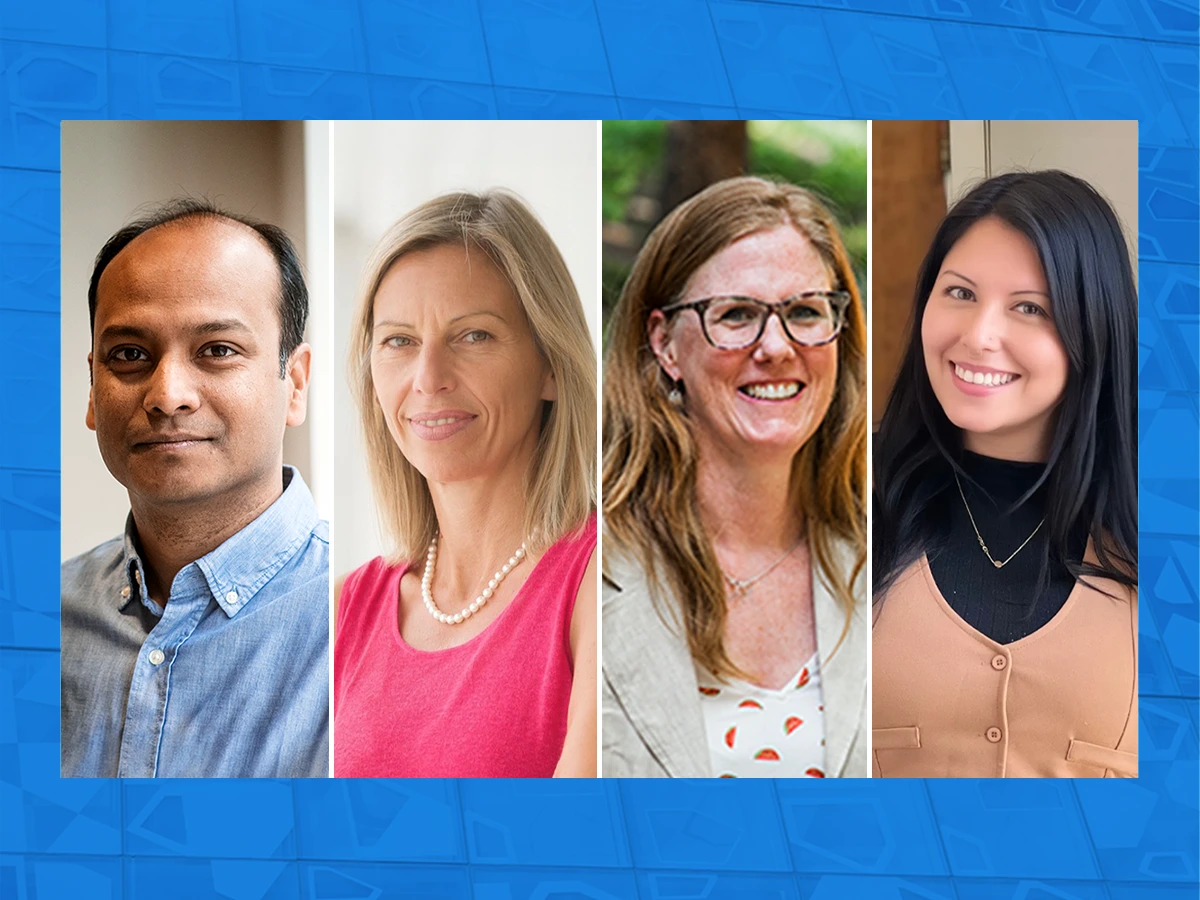
Partnership Development Grant recipients from the Social Sciences and Humanities Research Council (SSHRC), from left to right, professors Raktim Mitra, Anna Triandafyllidou, Kathryn Underwood and Nicole Ineese-Nash.
Toronto Metropolitan University (TMU) researchers have received Partnership Development Grants from the Social Sciences and Humanities Research Council (SSHRC). These TMU-led partnerships support timely and influential projects and will bring together leading experts and organizations to develop insightful solutions.
“Congratulations to professors Mitra, Triandafyllidou, Underwood and Ineese-Nash,” said Steven N. Liss, vice-president, research and innovation at TMU. “This work highlights the importance of community-engaged scholarship to address pressing societal challenges, from sustainable transportation to shaping the future of migration to advancing disability justice. When research is rooted in equity, innovation, and local, national and international collaboration, we are creating impact that is both meaningful and wide-reaching.”
Rethinking micromobility in the suburbs
In his project Shared Electric Micromobility as a Transportation Solution in Canadian Suburban Communities, professor Raktim Mitra of the Faculty of Community Services is investigating how micromobility, such as shared e-bikes and scooters, can be integrated into suburban transportation systems.
“From a municipal perspective, there's a great need to have a better understanding of the benefits and risks related to these shared micromobility systems,” explained professor Mitra. In many urban centres, the proliferation of private e-bike and scooter rentals has overwhelmed municipalities since they came on the scene in 2017, impacting vehicular and pedestrian traffic. In Ontario and elsewhere in Canada, provincial legislation allows municipalities to take a measured approach to how they are adopted through pilot projects.
Through his project, suburban communities, including the cities of Brampton and Mississauga in Ontario and the cities of Coquitlam and North Vancouver in British Columbia, will participate in research that informs how micromobility vehicles are being used, who is using them, what barriers are in place and what incentives can be adopted to increase their use as an alternative form of public transportation. The result of the research will then be used to shape and develop policies around these devices and how they can make transportation systems more equitable and more multi-modal by reducing excessive dependency on private automobiles.
Professor Mitra anticipates more municipalities will partner with the project as it grows, expanding the scope of knowledge with the goal of creating a reliable resource that communities across Canada can use to inform their future planning. “It will give municipalities important insights that can inform whether they want to make these pilot projects permanent, or for cities that don't have it, provide information to consider when planning for shared micromobility as a future transportation option.”
Envisioning the future of migration
Technology, climate change, urbanization and global inequality are transforming how and why people move, both physically and virtually. Trends like digital nomadism, forced migration and displacement are reshaping mobility in ways that are outpacing traditional research.
Professor Anna Triandafyllidou, TMU’s Canada Excellence Research Chair in Migration and Integration, aims to explore what these trends mean for the future of migration as the lead investigator for FUTUREMIG – Futures of Migration and Mobility Partnership. This international project brings together researchers, artists and civil society organizations to explore the future of migration by drawing on the imagination of human beings and the data-informed predictions generated by AI and other adaptive technologies.
FUTUREMIG aims to influence public understanding and policymaking and to create a global network of scholars, students, civil society members and artists who are prepared to respond to the complex challenges of the future.
Professor Triandafyllidou emphasized that this project pushes past traditional research to explore human imagination and digital predictions in re-imagining migration. “It's about what we call foresight, a combination of forecast and insight, so we can imagine what the future will look like,” she said.
Through labs in four different continents, the project will engage scholars, artists, civil society stakeholders and migrants themselves in different world regions who will co-create written texts and artistic expressions (such as in visual art or film) exploring themes that include aging populations, the future of mega-cities, climate change, placeless work and remote employment. The project will generate a digital and physical exhibition of future visions of mobility, which will contrast authentic human expressions with what adaptive technologies can create, opening a dialogue about how these technologies inform and shape human experiences.
Indigenous knowledge and disability justice
The Indigenous-Disability Affirming Early Learning and Care (IDAEL) partnership is a collaborative research initiative led by Faculty of Community Services professors Kathryn Underwood and Nicole Ineese-Nash. The project builds on previous research exploring the experiences of families caring for and raising disabled children.
“The project is informed by our own understanding of disability experiences and disability justice, recognizing Indigenous theories and practices and acknowledging the tangible and material realities of particular communities as they engage with children and families,” said professor Ineese-Nash.
The project brings together a wide range of partners, including First Nations organizations Nishnawbe Aski Nation, Independent First Nations, Niwasa Kendaaswin Teg and Keepers of the Circle; Black and racialized organizations African Canadian Social Development Council and Finding Our Power Together; and academic and municipal partners Peel Region, Wellington County, City of Hamilton and the City of Toronto.
The collaborative project will create culturally appropriate, community-based solutions informed by those who have lived experiences of disability care at the intersection of oppression and marginalization. The project will enlist the help of an advisory committee of individuals who identify as Indigenous, Black, racialized and disabled, as well as their kin. The inclusion of kin recognizes that care often involves entire communities, not just individuals.
With the team’s knowledge of disability care and Indigenous knowledge shared by elders and communities, professor Underwood explained that the project aims to create training materials for early childhood educators “that don't teach a medicalized view or a normative view of children’s development, but instead to bring in a much deeper understanding of what disability experiences look like, and that are informed by respectful, ethical and intentional relationships.”
These training materials will be piloted and evaluated by early childhood educators and caregivers in participating communities. The resulting open-source resources will be made accessible for communities and families that support disabled children.
Learn more about how Partnership Development Grants support the development of partnered research and related activities in the social sciences and humanities (external link, opens in new window) .
Related links
TMU researchers receive $15.9 million in federal grant funding
Learn more about The Indigenous-Disability Affirming Early Learning and Care (IDAEL) partnership