TMU researcher developed mental health crisis response police training now mandatory in Ontario
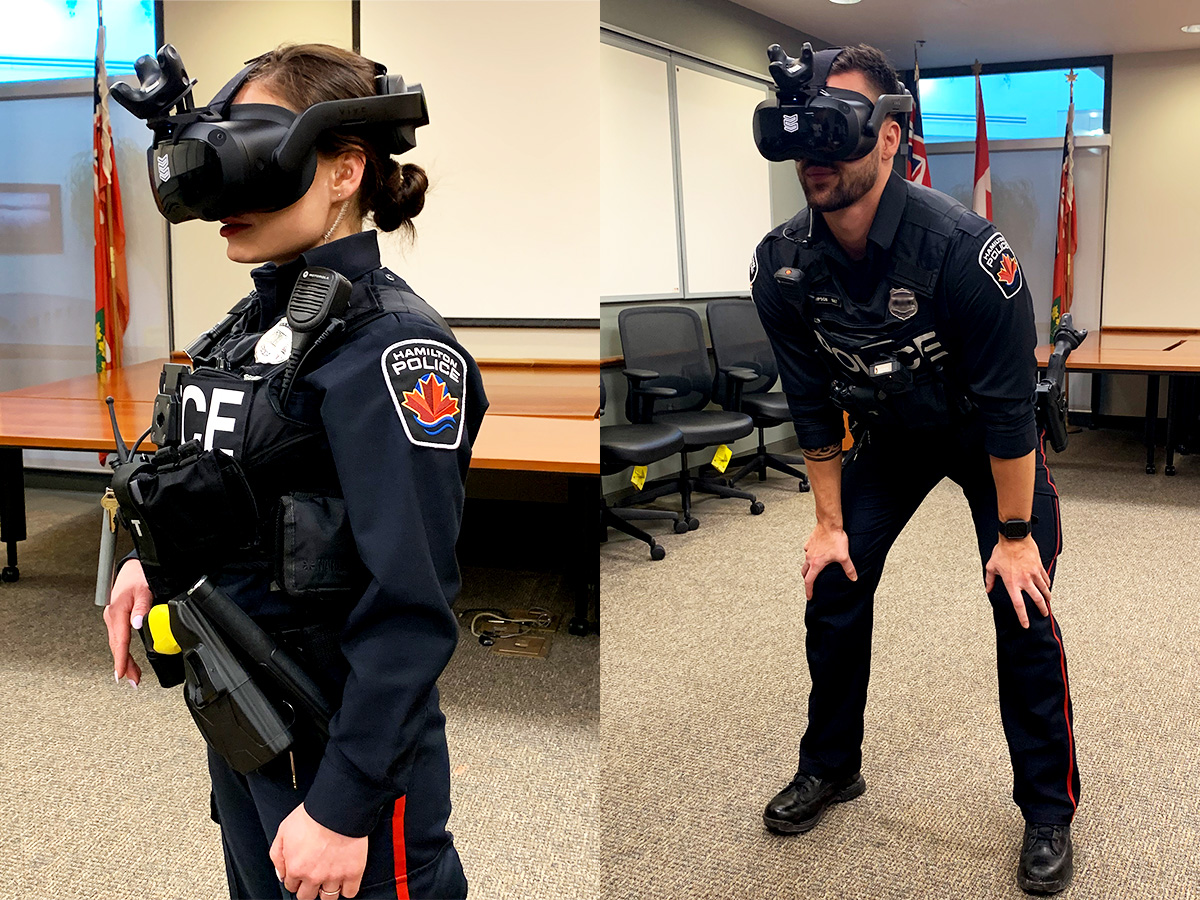
Image courtesy of Natalie Alvarez
A police officer participates in a virtual reality immersive training scenario developed by professor Natalie Álvarez and her collaborators.
Police officers across Ontario will be required to take innovative immersive scenario-based simulation training created to improve response to mental health crisis situations by Toronto Metropolitan University (TMU) School of Performance professor Natalie Alvarez and her collaborators.
On April 1, 2024, the Mental Health Crisis Response Applied Training and Education Program developed at TMU became a regulatory requirement for all front-line officers as part of recent revisions to Ontario’s Community Safety and Policing Act.
Scenario development and implementation
Professor Alvarez and her colleagues began work in 2017 on live-action scenario training as a response to an idea sparked by a recommendation in Ontario Ombudsman Paul Dubé’s 2016 report, A Matter of Life and Death, that called for standardized and mandatory police de-escalation training. The ombudsman report was written in the wake of teenager Sammy Yatim’s death in 2013.
The researchers crafted the live-action scenario training then continued the project by translating them into virtual reality simulations. In both the live action and virtual reality scenarios, participants experience different types of mental health crisis calls – an example is someone having auditory hallucinations – commonly encountered by officers. The training targets 14 competencies that equip officers to respond to and de-escalate these crisis situations. The virtual reality option helps to ensure the training is accessible for officers stationed in remote areas.
The simulation training and evaluation framework was researched, developed and tested with community stakeholders. The team and stakeholders include academic researchers and experts, ranging from people with lived experience to Indigenous cultural safety specialists to clinicians to de-escalation trainers.
Establishing professional standards
“This is an historic regulation that establishes, for the first time, a professional standard in de-escalation and mental health crisis response training in the domain of policing, which has long been dominated by a Use of Force paradigm. It's incredibly rewarding to see eight years of research and development culminate in these regulations,” said professor Alvarez.
This training, developed by professor Alvarez, Wilfrid Laurier University criminology and psychology professor Jennifer Lavoie, University of Victoria theatre professor Yasmine Kandil and their collaborators, has been taken by more than 1,600 officers since 2018. Now front-line officers from across Ontario’s 44 police departments will complete the training. Active officers will have up to two years to meet the first regulatory requirement and will require re-qualification training every 12 months. New recruits will also take the training, as the curriculum has been integrated into the Basic Constable Training Program at the Ontario Police College.
“It is such a validation of the community’s efforts, too,” said professor Alvarez, noting that stakeholders with lived experience are “just beside themselves speechless” and are thrilled to see this change after years of effort.
The research team recently won an international award, the Wayman Mullins Award for Best Journal Article, for an article about the co-design methodology. Read the award-winning article in the Journal of Police and Criminal Psychology (external link, opens in new window) .
This research has been supported by the Social Sciences and Humanities Research Council and the Natural Sciences and Engineering Research Council of Canada.
Related links
Improving police response to mental health crises through immersive simulation training (Fall 2022)