Undergraduate research on display at annual URO showcase
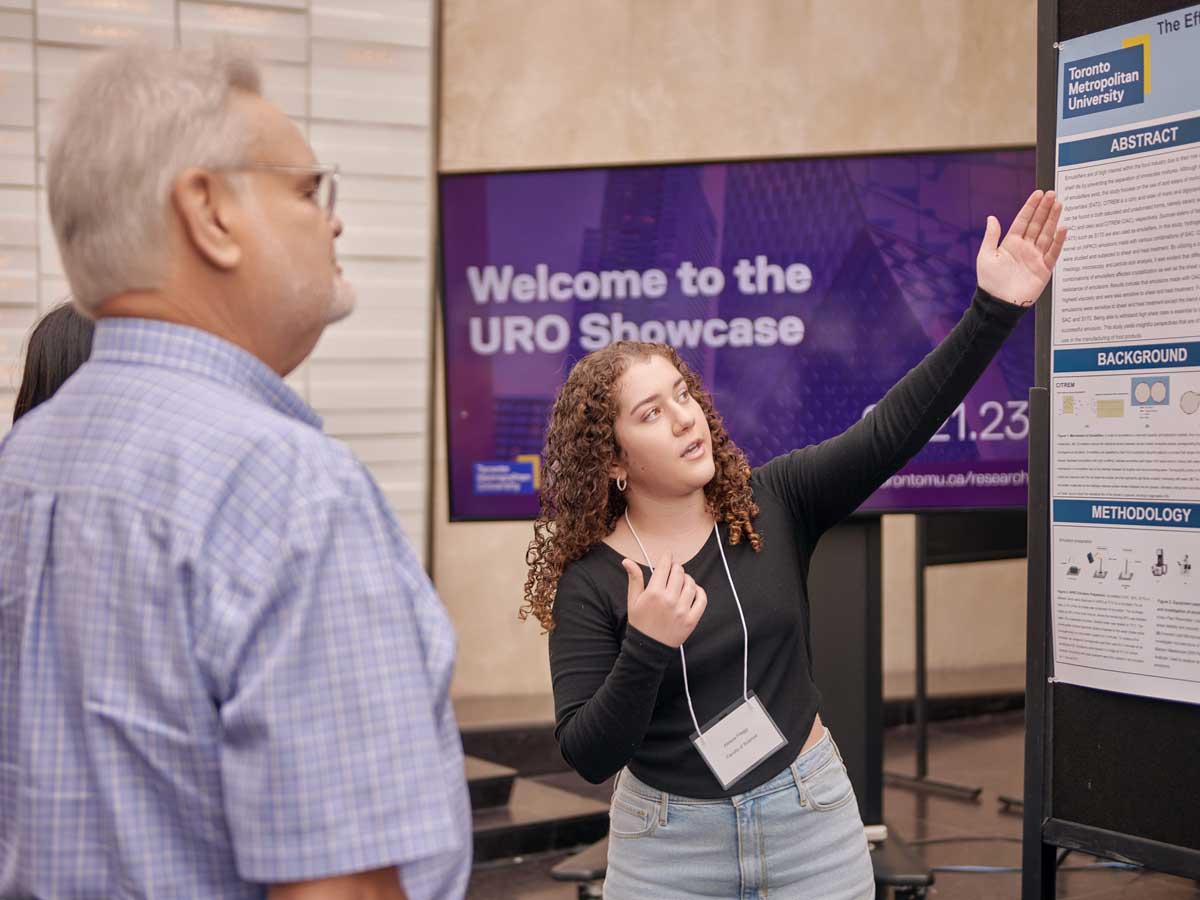
A participant in the Undergraduate Research Opportunities Showcase speaks about her project. Photo credit: Alyssa K. Faoro.
Toronto Metropolitan University (TMU) students representing six faculties presented their research projects at the Undergraduate Research Opportunities (URO) showcase on Sept. 21, 2023.
Nearly 50 student projects, ranging from robots for STEM education to innovation in cancer cell research, were on display at the Sears Atrium during the culminating two-hour event.
Running annually since 2019, the URO program is funded by the Office of the Vice-President, Research and Innovation (OVPRI) and offers students a paid opportunity to contribute to scholarly, research and creative (SRC) activities. Students benefit from working with a faculty mentor for 14 weeks during the summer on a research project and attend workshops hosted by TMU Libraries and the OVPRI to learn key knowledge translation skills.
“I’d like to acknowledge the contribution you make by participating and collaborating with the faculty who serve as your mentors, but also the ways you contribute to scholarship and the overall SRC enterprise at the university,” said Steven N. Liss, TMU’s vice-president, research and innovation. He highlighted the value of the research skills gained by the students as technology impacts the future of work. “It is a very dynamic world that we live in, and one where the tools and very learnings which take place in the SRC environment are critical.”
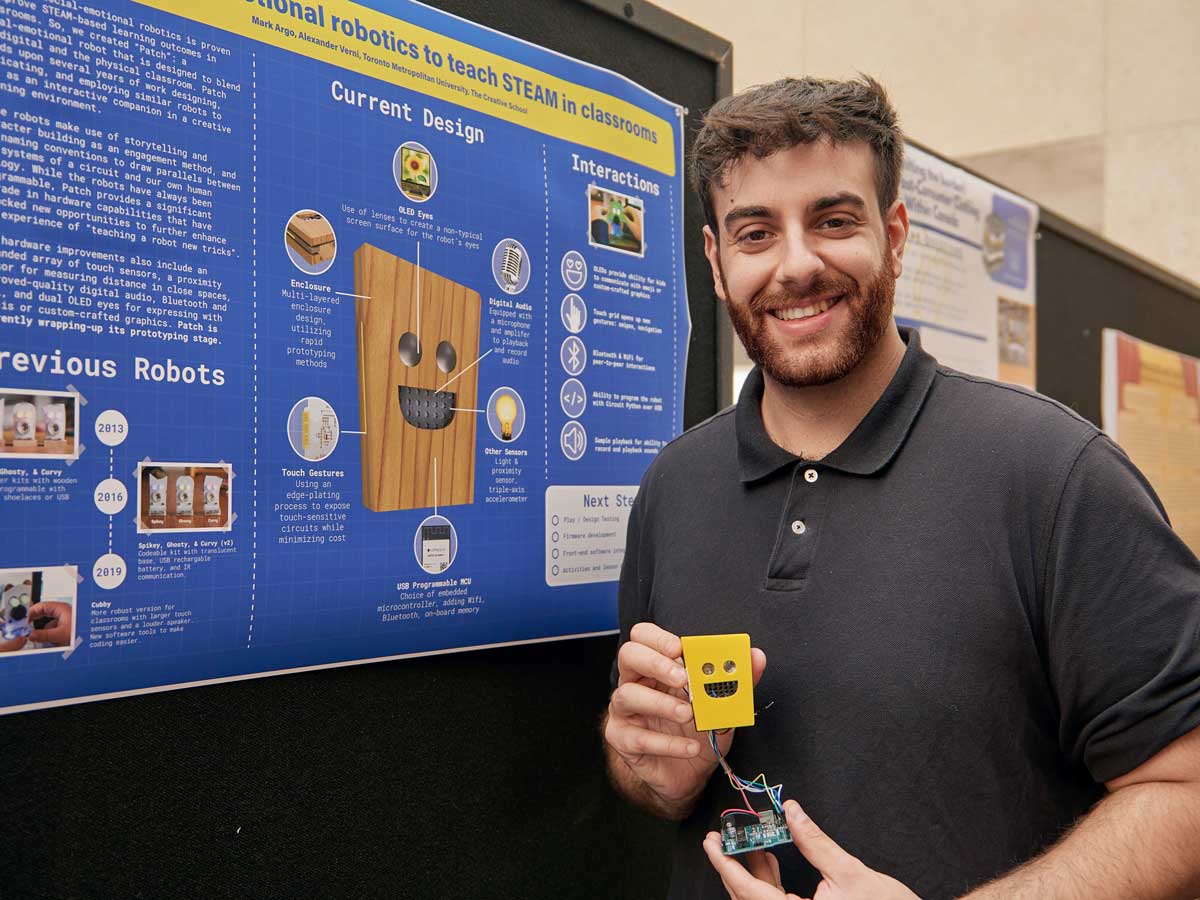
Alexander Verni shows off “Patch,” an educational robot prototype he helped design as part of the URO. Photo credit: Alyssa K. Faoro.
Below is a small sample of the projects presented at the URO showcase.
“Patch”: Social-emotional robotics to teach STEAM in classrooms
Social-emotional robotics can be used in classrooms to help students learn STEAM subjects (science, technology, engineering, arts and math). The Creative School student Alexander Verni spent his summer helping design and prototype “Patch,” a small robot that can physically interact with and provide students with coding opportunities using CircuitPython – a programming language that uses plain English, increasing its accessibility.
“We can introduce these to even Grade 3, Grade 2 students,” Verni said at the showcase. He and his supervisor, professor Mark Argo, designed “Patch” to be an upgrade over previous learning robots designed by professor Argo. Improvements include an expanded array of sensors and specialized eye screens that students can program.
Management of non-communicable diseases and/or chronic conditions during COVID-19 pandemic in Francophone African countries
How did health professionals in African Francophone countries manage diseases and chronic conditions such as diabetes or hypertension while COVID-19 pandemic measures were in place? Faculty of Community Services nursing student Samara Esack presented the results of this study, supervised by professor Margareth Zanchetta, at the showcase.
“There’s an underlying issue – a lot of health information is very jargony,” said Esack. The study dug into how the new challenges of medical jargon, COVID-19 misinformation and disruptions to medical supplies impacted health professionals from countries such as Algeria and Cameroon. It also examined the solutions they found, including more intensive, one-to-one conversations with patients, ensuring health information was user-friendly and accessible, and integrating cultural health practices. Esack will present these research findings at the upcoming Canadian Conference on Global Health in mid-October.
Towards an efficient context-aware recommendation system for e-commerce
When shopping online, customers are frequently given recommendations for new or additional products. However, those recommendations can be influenced by fake ratings. Faculty of Engineering and Architectural Science student Ahmed Aly spent the summer working with supervising professor Rasha Kashef to create a recommender system that can provide e-commerce users with more reliable recommendations.
“Our research specifically focused on implementing a variational auto-encoder neural network to increase performance, and an anomaly detection mechanism that aims to decrease the effect of fake rating attacks,” said Aly. The model Aly helped develop outperformed other state-of-the-art models by giving more accurate recommendations.
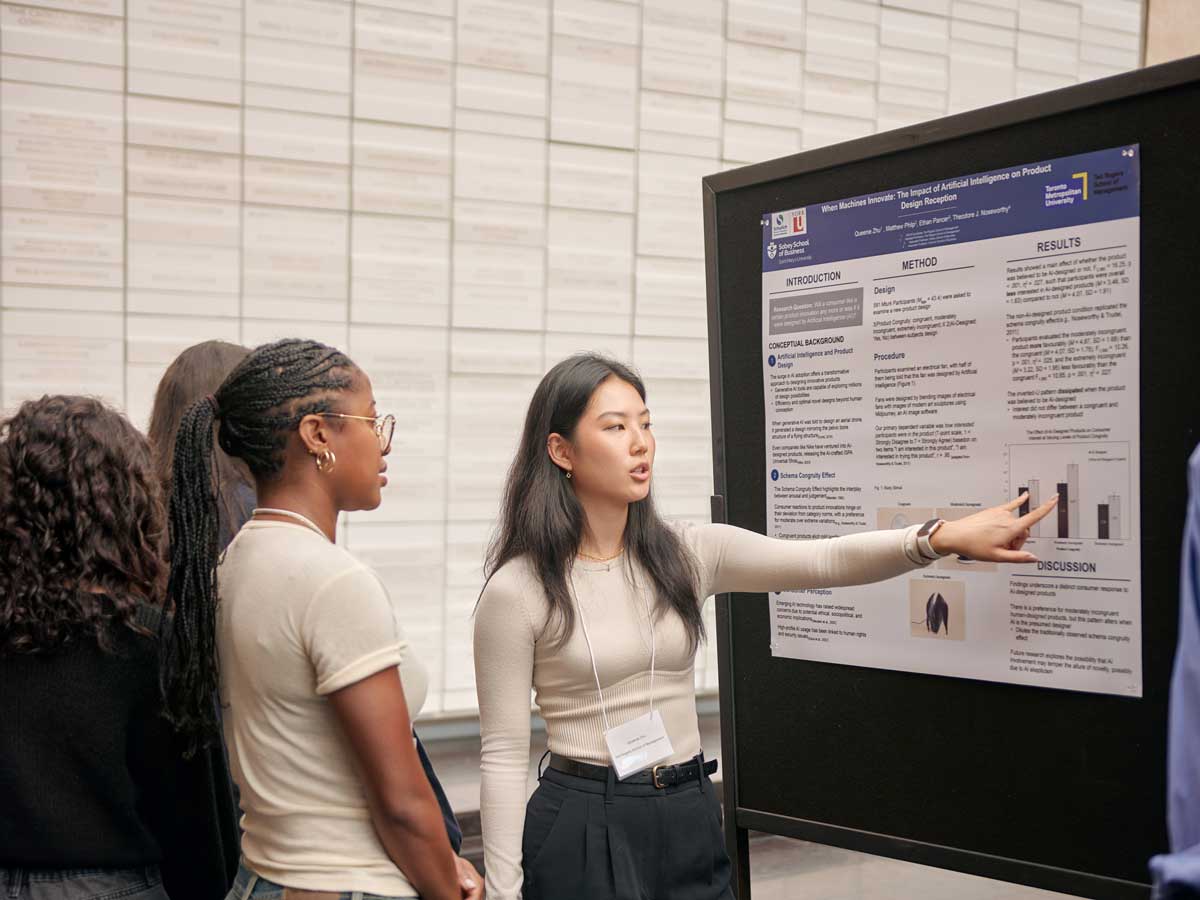
Queenie Zhu shares her research into consumer reactions to AI-designed products during the showcase. Photo credit: Alyssa K. Faoro.
The role of AMPK in metabolic adaptation in triple negative breast cancer cells
Faculty of Science student Ayshin Mehrabi shared her success developing a new tool for tracking cell movement, decreasing the time needed to analyze cell migration from weeks to minutes. Mehrabi worked with professor Costin Antonescu in his lab that studies fundamental cellular processes. One part of the lab’s research involves targeting and understanding a protein that regulates cell movement to unveil potential mechanisms cancer cells use to metastasize to other locations in the body. However, there was one obstacle in the research. “There’s no good method of tracking cell migration,” said Mehrabi, who explained that the cumbersome nature of tracking cells manually prevents some research from being pursued.
To solve this, the newly developed tool scans and captures an image of the cells every 20 minutes over 24 hours. When the images are stitched together, like a movie, researchers can see the speed, direction and distance the cells moved.
When Machines Innovate: The Impact of Artificial Intelligence on Product Design Reception
Will consumers like a product’s design more – or less – if it is designed by artificial intelligence (AI)? To help answer this question, Ted Rogers School of Management student Queenie Zhu and professor Matthew Philp measured nearly 600 participants’ reactions to three different electrical fan designs of varying levels of congruency, ranging from a standard-appearance fan to significantly unusual. Participants were shown one of the three designs; half were told it was designed by AI and the other half that it was human-created. Overall, the somewhat unusual, or moderately incongruent, design was most positively received – but all three were considered less favourable if told that AI had designed it.
“One key takeaway is generative AI is present in our everyday lives, but it’s important for marketers and designers to look at the perceptions of consumers,” said Zhu. She said further research should address why people react less favourably to AI-designed products.
Learn more about the URO program.
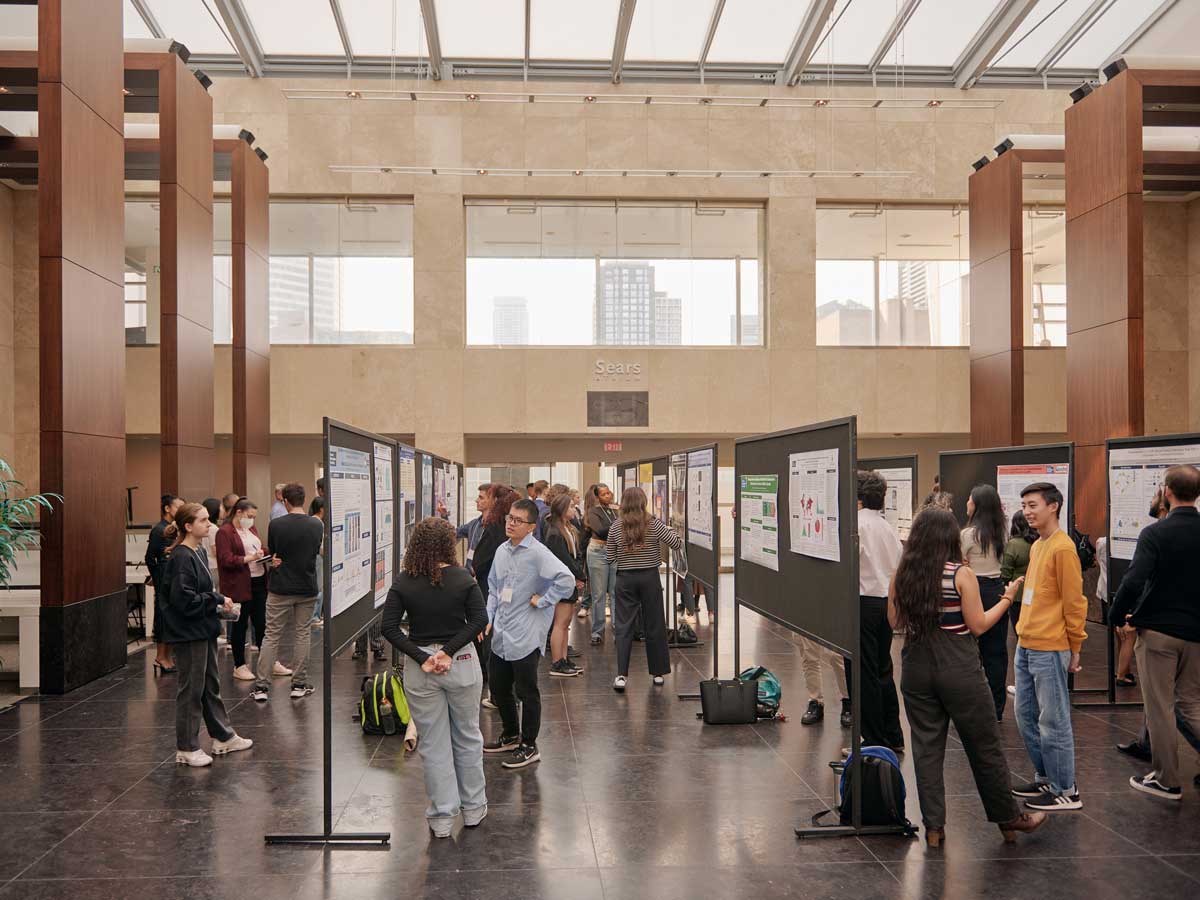
Almost 50 students participated in the URO Showcase in September. Photo credit: Alyssa K. Faoro.
List of the undergraduate students who participated in the 2023 URO program
Drawing the Line: Freedom of Expression and the Regulation of Hate Propaganda in Canadian History
Jacob Gorodensky
Supervised by professor Jennifer Tunnicliffe
Gardening Agrobiodiversity and Food Security in the City
Aminah Haghighi
Supervised by professor Sarah Elton
Examining the effect of acute stress exposure on emotion recognition accuracy and gaze among older adults
Mila MacNeil
Supervised by professor Alexandra Fiocco
Predictors and Perceptions of Online Misogyny and Cyber Sexual Harassment
Ayse Makarnaci
Supervised by professor Caroline Erentzen
Assessing group choir singing for patients with chronic obstructive pulmonary disease
Tara Raessi
Supervised by professor Frank Russo
Place-based policy for national welfare
Andrew Robertson
Supervised by professor Rowan (Hilary) Shi
Management of non-communicable diseases and/or chronic conditions during Covid-19 pandemic in Francophone African countries
Samara Esack
Supervised by professor Margareth Zanchetta
(Re)Imagining Accessibility on Toronto's Waterfront
Omar Hirji
Supervised by professor Samantha Biglieri
Qualitative Investigation of Holter Monitor User Lived Experiences
Sungyeon (Angela) Kang
Supervised by professor Kateryna Metersky
Demographics & Trajectories of Care for Medically Uninsured Women Accessing Health Care During Pregnancy
Momina Khan
Supervised by professor Manavi Handa
Building a Framework for Community-Based, Black-Centered, Black-Informed Planning Practices
Jodie Laborde
Supervised by professor Magdalena Ugarte
Acute effects of carbohydrate ingestion as a pre-workout food on cognitive performance in recreational athletes
Megan Wurtele
Supervised by professor Nick Bellissimo
Towards an efficient context-aware recommendation system for e-commerce
Ahmed Aly
Supervised by professor Rasha Kashef
Vision-based localization and mapping for multi-rotor unmanned aerial vehicles
Bryan Kikuta
Supervised by professor Reza Faieghi
Next Generation Electrodes for Enhanced Carbon Dioxide Conversion and Utilization
Harris Li
Supervised by professor Chung Lee
Developing efficient Machine Learning models for in-game emotion recognition for therapeutic VR games
Abdullah Mohamed
Supervised by professor Naimul Khan
Prediction of Residential House Hourly Space Heating Demand using AI and ML Techniques
Maaz Rashid
Supervised by professor Alan Fung
Evaluation of Buckling-Restrained Steel Braces
Derek Wong
Supervised by professor Saber Moradi
Regulation of O-antigen production in highly pathogenic bacteria
Angie Awadallah
Supervised by professor Dustin Little
The role of splicing and GPI-anchor formation in regulating endocytosis
Amanda Dias
Supervised by professor Mojca Mattiazzi Usaj
Mechanisms of phagosome resolution
Josh Ferguson
Supervised by professor Roberto Botelho
Developing a liposome-based SARS-CoV-2 Virus-Like Particle (VLP)
Nina Grishchenko
Supervised by professor David Cramb
Dye design for controlled light-driven reactivity at polymer interfaces
Osama Haj Husein
Supervised by professor Bryan Koivisto
Sound spectra response of zooplankton to light, sound and other factors in a changing environment
Roha Iqbal
Supervised by professor Stephanie Melles
Testing novel boron compounds for anti-fungal and anti-cancer properties
Shirin Kalavi
Supervised by professor Sarah Sabatinos
The role of AMPK in metabolic adaptation in triple negative breast cancer cells
Ayshin Mehrabi
Supervised by professor Costin Antonescu
SlicerTrack: an open-source research toolkit for motion tracking
Teo Mesrkhani
Supervised by professor Elodie Lugez
Studies in food emulsion stability
Alessia Pileggi
Supervised by Dérick Rousseau
A novel centriolar protein important for ciliary function
Daniel Samir
Supervised by Gagan Gupta
Covalent peptidomimetic library to discover COVID therapeutics
Breanna Seto
Supervised by Marc Adler
Multi-energy X-ray imaging of cardiac disease
Jamie Tien
Supervised by professor Jesse Tanguay
Examining how fear affects travel behaviour
Jane Doan
Supervised by professor Wayne Smith
Building cyber resilience in a post-pandemic world – cybersecurity challenges, awareness, and training in the transition to hybrid work
Steven Gal
Supervised by professor Burcu Bulgurcu
Management accounting and control for conservation: The recovery of species at risk in Canada
Naomi Gebereyesus
Supervised by professor Claire Deng
Building cyber resilience in a post-pandemic world – cybersecurity challenges, awareness, and training in the transition to hybrid work
Minaam Khokhar
Supervised by professor Burcu Bulgurcu
Northern women entrepreneurs
Kaitlyn Washbrook
Supervised by professor Sonya Graci
Using twitter data to measure consumer house price expectation and future price movements
Pedram Yazdani
Supervised by professor Anson Ho
Consumer perceptions towards products designed by artificial intelligence
Queenie Zhu
Supervised by professor Matthew Philp
JeRI: Journalism Representation Index
Jisele Bayley-Hay
Supervised by professor Asmaa Malik
The Fabric of Crime: Forensic Histories of Fashion
Camilla Calzado Leonelli
Supervised by professor Alison David Matthews
Let's stop shifting the burden! Exploring barriers and opportunities for managing post-consumer clothing and textiles within Canada
Janique Douen
Supervised by professor Anika Kozlowski
Black Placemaking and Counter Gentrification: Community Care and Belonging
Nala Haileselassie
Supervised by professor Miranda Campbell
The State of Producer Training in Canada and Pay What You Can Afford (PWYCA) Ticket
Shona Kiyama
Supervised by professor Owais Lightwala
Harmed in Hamilton: Hamilton Fringe Festival
Rochelle Raveendran
Supervised by professor Sonya Fatah
Drawing for Food
Eira Roberts
Supervised by Stephanie Davidson
Thermodynamic biodegradation analysis of enzyme-produced PHA biopolymers in aquatic freshwater environments
Sahand Sabzparvar
Supervised by professor Ehsan Behzadfar
Reducing Packaging Waste in Toy E-commerce: Possibilities for the Ships-in-Own
Grace To
Supervised by Jonghun (Jay) Park
“Patch”: Social-emotional robotics to teach STEAM in classrooms
Alexander Verni
Supervised by professor Mark Argo
Exploring girl-specific communities of media education and production practice: a pilot
Ailey Yamamoto
Supervised by professor Tatyana Terzopoulos