Examining the proliferation of vaccine misinformation on social media
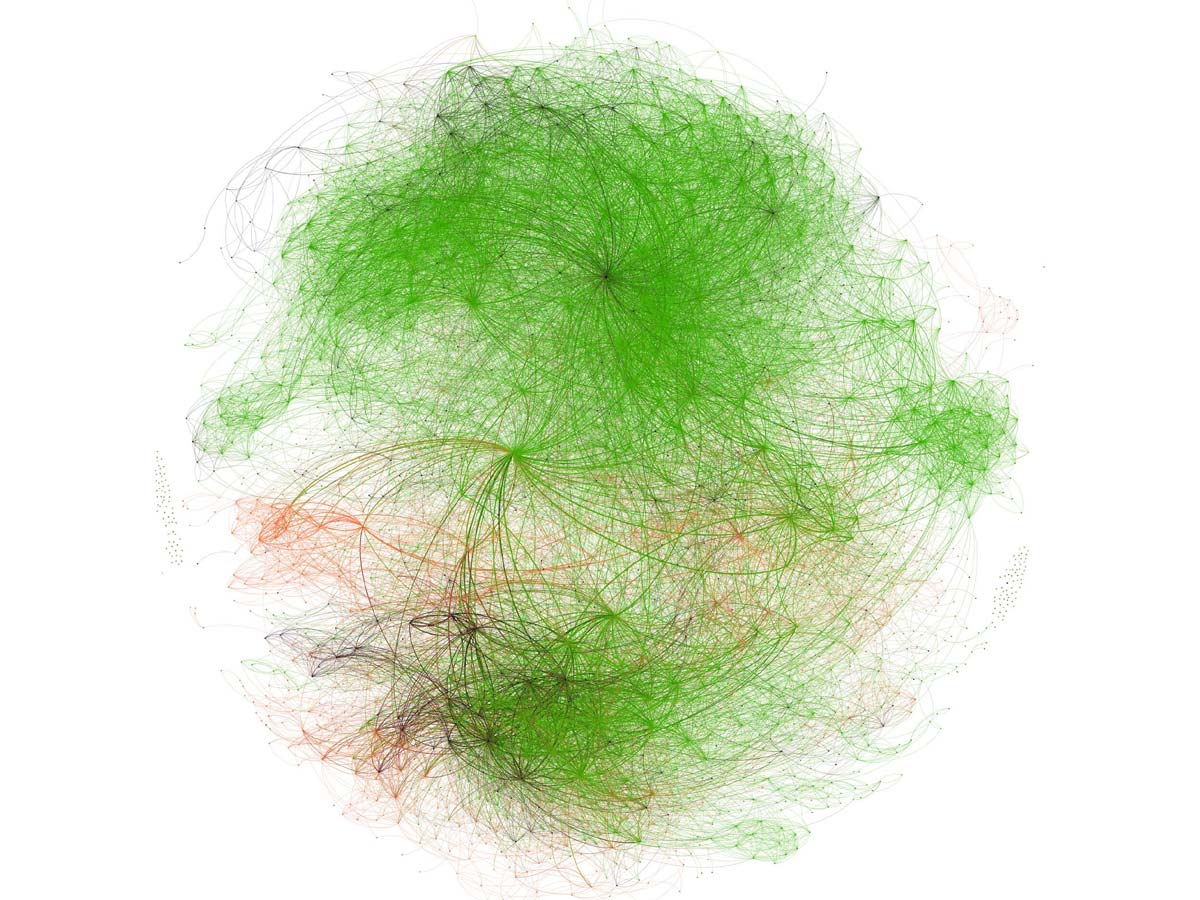
YouTube’s Related Videos network of 2,260 vaccine-related videos. Pro-vaccine videos are shown in green, anti-vaccine videos are shown in red, neutral videos are shown in black. A. Gruzd et al, 2023.
More work is needed to counter misinformation, such as anti-vaccine content on social media platforms, found a research team led by Toronto Metropolitan University’s (TMU) professor Anatoliy Gruzd. The team investigated the role of social media in exposing audiences to COVID-19 vaccine misinformation videos on YouTube and Facebook.
The team collected data by reviewing thousands of YouTube videos shared during June 2020. They classified the videos as pro, anti or neutral toward vaccines and examined two categories of videos to create their datasets. The first category focused on YouTube videos shared via Facebook, creating a dataset of 2,260 videos. The second category included videos recommended by YouTube to viewers who had watched a vaccine-related video, creating a dataset of 539 videos.
Professor Gruzd, the Canada Research Chair in Privacy-Preserving Digital Technologies and co-director of the Social Media Lab, said that 57 per cent of the videos shared on Facebook were classified as anti-vaccine. He said this number demonstrated that, despite the research taking place after YouTube and Facebook announced measures to reduce COVID-19 vaccine-related misinformation, it was still being posted and shared. “It just shows the gaps in their approach to remove potentially harmful content,” said professor Gruzd.
This research also highlighted pockets of anti-vaccination content, which professor Gruzd said can lead people to an echo chamber of opinions. In the researchers’ Facebook-based dataset, only 56 public Facebook pages generated 75 per cent of all the interactions. “There are a few misinformation spreaders … with an outsized impact on the whole platform,” professor Gruzd said.
As part of their research, the team examined how YouTube finds and recommends vaccine-related videos. They found that popular news and education-based YouTube channels, such as the BBC, TEDx Talks, Jimmy Kimmel Live! and The Doctors, effectively counter anti-vaccination information by often appearing as next-watch recommendations, reaching a large audience with fact-based information. Based on this finding, the researchers recommended that public health organizations partner with these and other popular, science-based channels or influencers to amplify health messaging. They noted that due to the apparent gaps in social media platforms’ efforts in combatting misinformation, public health agencies need to be proactive to ensure their announcements and information are highly visible on social media to reach their audiences, which could be achieved with such collaborations.
“We can’t really trust social media platforms to fix the problem of misinformation, but this doesn't mean that we should also stop demanding that from them, to be more responsible, kind of curators of our data and curators of our eyeballs,” said professor Gruzd.
For more information, read “From Facebook to YouTube: The Potential Exposure to COVID-19 Anti-Vaccine Videos on Social Media (external link) ” in the journal Social Media and Society. The paper was co-authored by Deena Abul-Fottouh, Melodie YunJu Song and Alyssa Saiphoo, all of whom are former Social Media Lab postdoctoral fellows.
This research was supported by the Canada Research Chair program, the Canadian Institutes of Health Research and the Natural Sciences and Engineering Research Council of Canada.