Students hope to take personal flying device to market
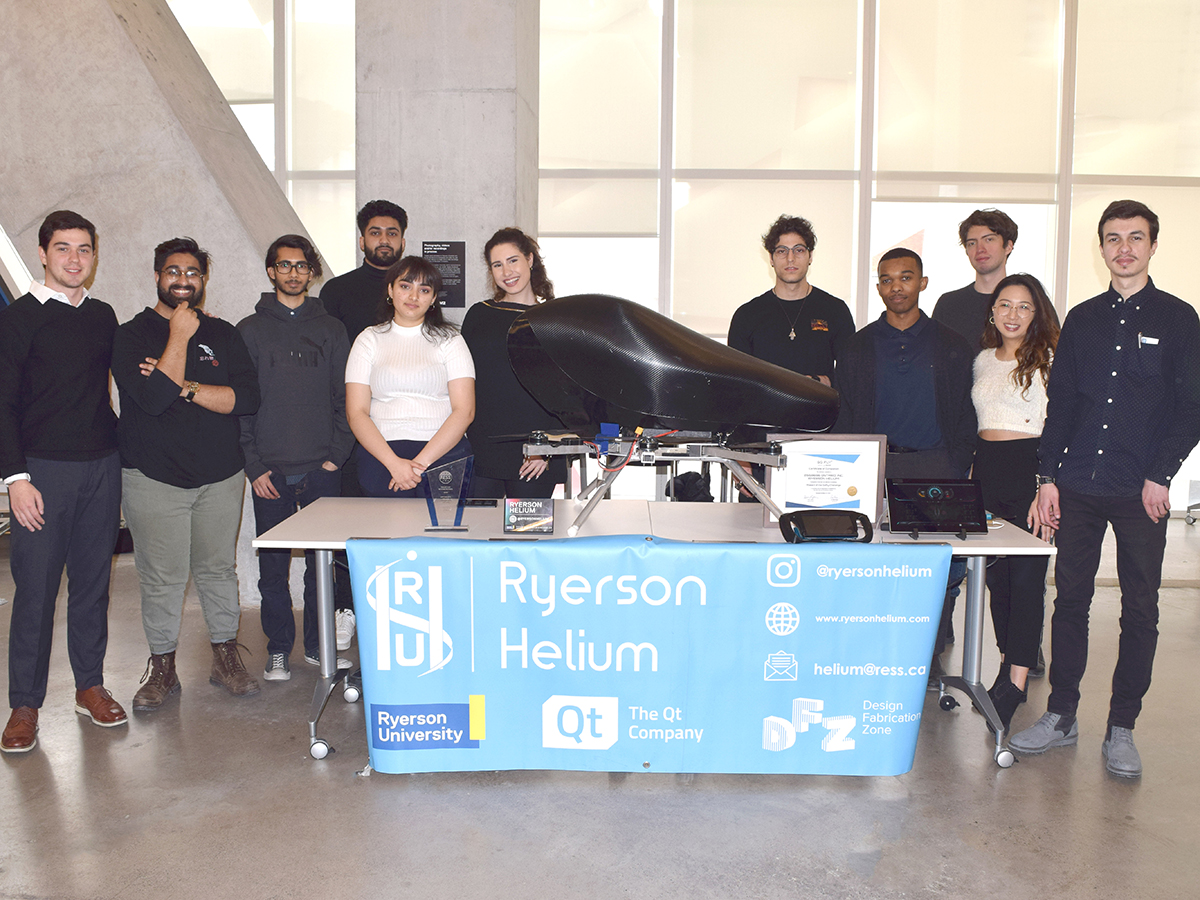
Members of the Ryerson Helium team demonstrated features of their EMAV VI-2 personal flying device and a half-scale model of the vehicle at an event at the DMZ Sandbox.
A team of Ryerson students who have developed a personal flying device are setting their sights on turning their invention into a business. Last month, at a demonstration event held at Ryerson’s DMZ Sandbox, the Ryerson Helium team explained that since making it to the final of a major international competition, they are exploring ways of selling their machine to the public. The features that they hope will make their vehicle stand out among the competition are its user experience, digital interface and simple controls.
“We’ve tried to make a vehicle that is intuitive, comfortable and that can be used in the real world,” said Keith Watts, an aerospace engineering student and Ryerson Helium’s propulsion team lead. “That’s why we’re trying to bring as much inspiration from the car industry as we can. For example, we have incorporated an infotainment system, pedals and a steering-wheel-influenced yoke.”
Two years ago, the team began their ambitious project with just eight founding members. Now, with more than 50 students in the group, they are preparing their vertical take-off and landing (VTOL) vehicle for the final of the Boeing-sponsored GoFly contest. The event takes place at the NASA Ames Research Center in California’s Silicon Valley at the end of February 2020. Ryerson Helium will exhibit their single-person vehicle, EMAV VI-2, alongside 23 other finalists, after being selected out of more than 850 applicants representing 103 countries, including Canada, Australia, Botswana, Nepal, the Netherlands, Russia and the United States.
As the demands of the project have increased, the team has grown in size, with additional members required to help make and test components. From their base at Ryerson’s Design Fabrication Zone, the team has developed all aspects of the vehicle’s design, including its propulsion system of 12 rotor blades, the body and seat, the navigation system and a digital interface. They have also built a drone to test their guidance, navigation and control systems.
Ryerson Helium has seven sub-teams that are all made up of volunteer students from across Ryerson’s faculties. Each sub-team looks after a different part of the operation, and with responsibilities ranging from technical and engineering aspects to human resources and finances, the group is already running like a company. After the GoFly contest has concluded, the team will work with a mentor to develop a business plan and conduct market research.
“We’ve included a lot of aspects in the design that aren’t required for the competition, mainly because we want to continue with the project and have something market-ready,” said Lior Saprikin, an aerospace engineering student, Ryerson Helium co-founder and business team lead. “Since we’re aiming to enter a new class of aircraft, we’re hoping that regulations can accommodate the innovative technologies that we’ve included.”
The team has exhibited its working half-scale model of EMAV VI-2 at events at Ryerson and across Toronto, including the Future Festival World Summit which was held in fall 2019. The positive public response to their work has encouraged them to consider taking the vehicle to market.
“After the feedback from events and seeing people extremely excited about the vehicle, we thought that there was potential for way more than the competition,” said Saprikin.
The team has received support and advice from Ryerson faculty members, particularly Seyed Hashemi, an aerospace engineering professor, and Filippo Salustri, a mechanical engineering professor, as well as Paul Walsh, an aerospace engineering professor, and Dimitri Androutsos, an electrical, computer and biomedical engineering professor.
Read more about Ryerson Helium’s journey
Visit the Ryerson Helium website (external link, opens in new window)