Professor Trevor Hart delivers talk, “Sexual Health Research for Gay and Bisexual Men”, in Sarwan Sahota Ryerson Distinguished Scholar Lecture Series
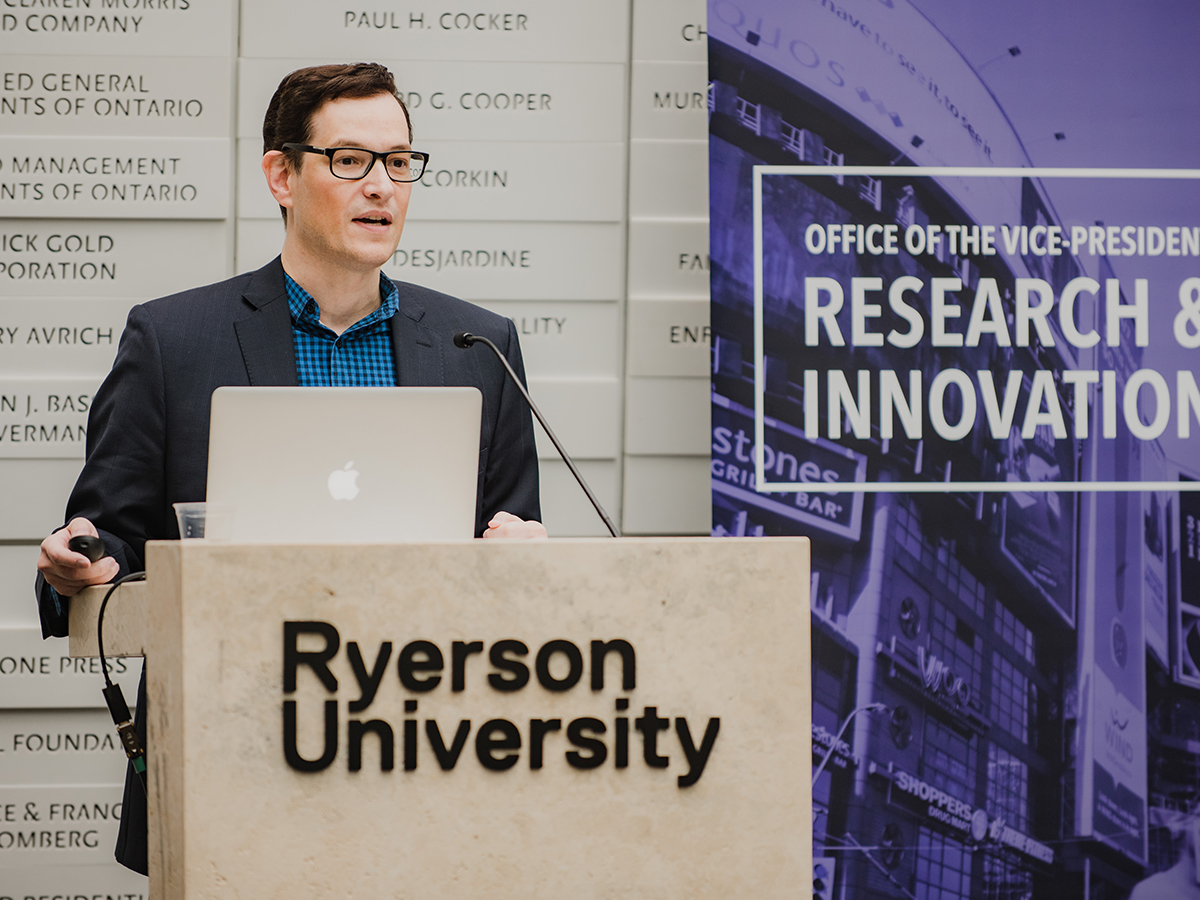
Professor Trevor Hart, of the Department of Psychology at Ryerson University, delivers his lecture “Sexual Health Research for Gay and Bisexual Men” on October 30, 2019, as part of the Sarwan Sahota Ryerson Distinguished Scholar Lecture Series.
Professor of psychology Trevor Hart has dedicated his career to researching HIV risk and prevention. As director of Ryerson University’s HIV Prevention Lab, he leads the development of pioneering techniques that directly address the complex factors behind continued HIV prevalence.
This year, his outstanding research was recognized by Ryerson when he was selected as a recipient of the Sarwan Sahota Ryerson Distinguished Scholar Award, the university’s highest honour recognizing research excellence. Students, researchers, and the public were given the chance to hear about some of professor Hart’s most impactful work when he delivered a special lecture associated with the award on October 30, 2019.
The lecture was hosted by the Office of the Vice-President, Research and Innovation (OVPRI) and attended by Ryerson professor emeritus Sarwan Sahota, whose joint contribution with the university funds the award. During the talk, titled “Sexual Health Research for Gay and Bisexual Men”, professor Hart outlined two approaches to health, wellbeing and HIV risk reduction that he has developed with colleagues at the HIV Prevention Lab.
“Despite what some people might think, there is no cure for HIV, and HIV transmission rates among men who have sex with men… continue to be high,” he said, outlining the importance of new research in this area.
In professor Hart’s view, the most effective HIV prevention approaches must address a variety of underlying issues that can increase a person’s risk of HIV contraction or transmission. The overarching framework of his lab, therefore, is to create prevention programs that acknowledge the relationship between sexual health, mental health, physical health and social wellbeing.
“We know from some of our research that gay men and bisexual men want programs that offer more than HIV prevention,” he said. “It’s not that they don’t care about it, but they’d like to take a look at health more holistically, including mental health.”
Two successful health interventions
The first program that professor Hart outlined was Gay Poz Sex (GPS), which invites men who are HIV-positive to talk about their sexual health in small groups with a trained counsellor. The men create their own goals — which can relate to areas such as loneliness, social anxiety, intimacy and guilt — and discuss how they will meet them. According to professor Hart, tests of GPS across two studies showed that it is “sustainable and successful”, with participants reporting reductions in loneliness and condomless sex, among other findings.
“What we really wanted people to do is to be empowered, to make their own sexual decisions,” said professor Hart. “Our two studies show that adapting motivational interviewing, including information and behavioural components, is efficacious, and it works in community settings, so there’s not a disconnect — it’s administered in the community by peer facilitators.”
Following the creation of GPS, professor Hart developed a psychotherapy program focused on sexual confidence and anxiety. In one-on-one sessions, counsellors used cognitive behavioural therapy to help gay and bisexual men manage and restructure their thoughts in situations that create anxiety. Testing was a success, and reductions were found in areas such as social anxiety, depression and condomless sex.
“No-matter how you look at it, no-matter how you slice and dice it, there are significant drops from before the therapy to after the therapy, and a continued drop at the three-month follow-up. And at the six-month follow-up, most of those gains are maintained,” he said.
Professor Hart and the HIV Prevention Lab team are now preparing a new study that will compare this psychotherapy method with another form of behavioural therapy. The lab is also conducting a large epidemiologic study into Pre-exposure Prophylaxis (PrEP) medication, which prevents HIV contraction, to see how the recent availability of PrEP is affecting STI and HIV incidence.
The Sarwan Sahota Ryerson Distinguished Scholar Award
Established in 1995, the Sarwan Sahota Ryerson Distinguished Scholar Award is presented annually to one or more faculty members who have made an outstanding contribution to knowledge or artistic creativity in their areas of expertise. Naomi Adelson, associate vice-president, research and innovation at Ryerson, told the audience that the award would not be possible without professor Sahota’s vision and generosity.
“Professor Sahota has a long and distinguished history as a faculty member at Ryerson,” she said. “He served as chair of chemical and biology sciences, dean of business, president of the RFA, sat on several academic council committees and was a founder of Ryerson’s Academic Standards Committee.”
Professor Trevor Hart is a professor in the Department of Psychology, within the Faculty of Arts, and joined Ryerson in 2007. He holds a Research Chair in Gay and Bisexual Men’s Health from the Ontario HIV Treatment Network. He has received several awards, including membership into the College of New Scholars, Artists, and Scientists with the Royal Society of Canada. Professor Hart has published more than 110 articles and book chapters. His research is funded by organizations that include the Canadian Institutes of Health Research (CIHR), the Canadian Foundation for AIDS Research (CANFAR), and the Ontario HIV Treatment Network (OHTN).
Watch the full lecture, “Sexual Health Research for Gay and Bisexual Men”
Table of Contents
- Introduction, OVPRI – 00:00
- Introduction, Trevor Hart - 04:00
- Gay Poz Sex (GPS) Study Number One – 15:08
- Gay Poz Sex (GPS) Study Number Two – 32:22
- Sexual Confidence – 46:12
- Summary and Future Directions – 59:49
- Q&A - 1:04:33