New funding from Canada’s National Cybersecurity Consortium supports quantum-resilient cybersecurity research at TMU
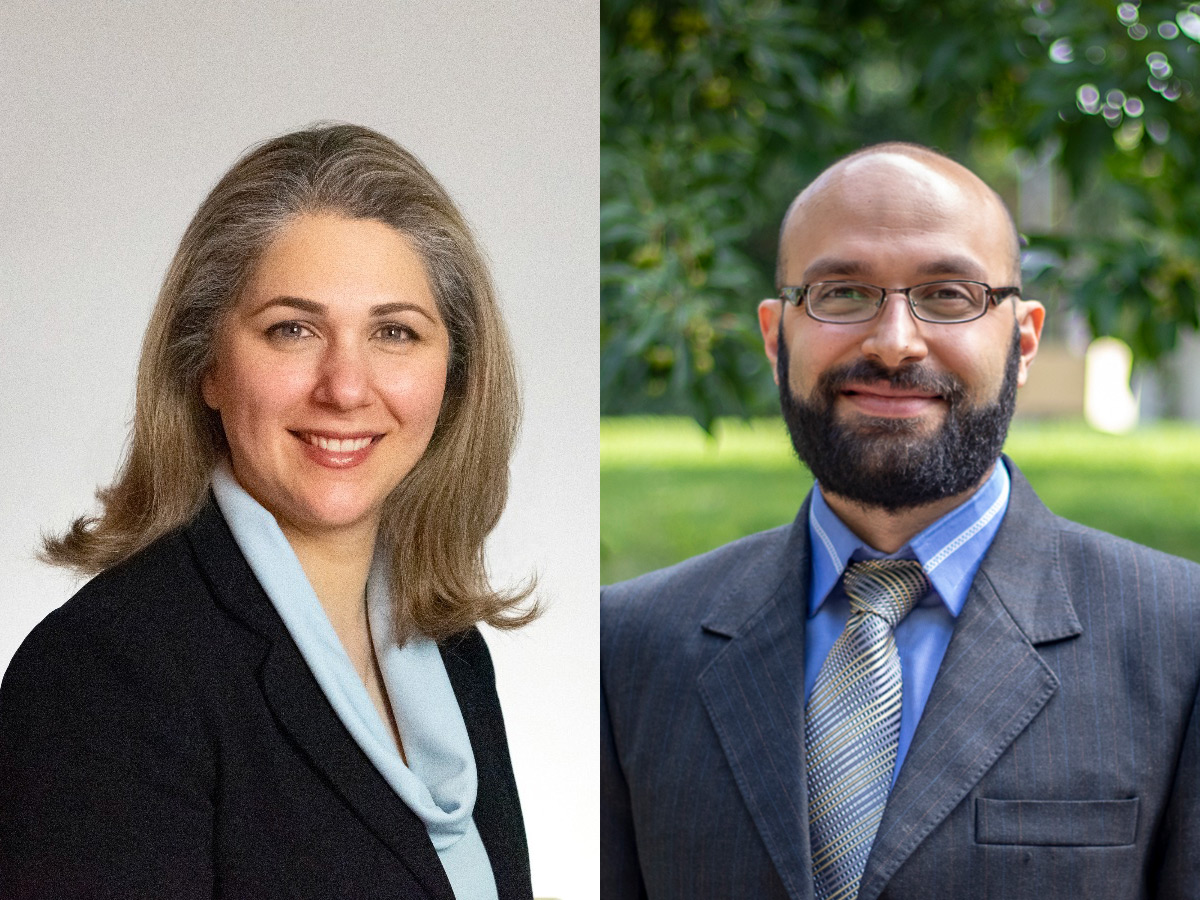
Ted Rogers School of Management professor Atefeh (Atty) Mashatan and Faculty of Engineering and Architectural Science professor Reza Arani will explore how to protect power grids from future cybersecurity threats that could arise as quantum computers become more powerful.
The Government of Canada announced new funding through its National Cybersecurity Consortium (NCC) that supports a collaborative cybersecurity project at Toronto Metropolitan University (TMU).
The project, led by Atty Mashatan, Tier 2 Canada Research Chair in Quality of Security Framework and professor in the Ted Rogers School of Information Technology Management at TMU, is focused on mitigating cybersecurity risks to critical infrastructures such as power systems. She will collaborate with Reza Arani, Tier 2 Canada Research Chair in Smart Grid Cyber-Physical Security and professor in TMU’s Faculty of Engineering and Architectural Science, as well as ABB Canada and Hydro-Québec Research Institute (IREQ). The project will receive a total of $575,500 in funding support from project partners.
“I am very pleased to congratulate professors Mashatan and Arani on securing this critical funding opportunity,” said Steven N. Liss, TMU’s vice-president, research and innovation. “In collaboration with key local industries, this project will help protect Canada and Canadians from cyber threats and drive our country toward a resilient digital future.”
As the founding director of TMU’s Cybersecurity Research Lab (CRL), professor Mashatan is a leading expert in quantum-resistant security solutions. The project, Post Quantum Resilience for Cyber-Physical Power Systems, will explore how to protect power grids from future cybersecurity threats that could arise as quantum computers – machines that can perform certain calculations much faster than today’s computers – become powerful enough to break today’s cryptography.
The project will test post-quantum cryptographic (PQC) algorithms in real-time power system simulations to find secure, practical solutions for quantum-vulnerable infrastructures. The goal is to help utilities adopt quantum-safe technologies without compromising performance or reliability.
“Quantum-enabled attacks can threaten the confidentiality, integrity and availability of sensitive assets in critical infrastructures,” said professor Mashatan. ”Our project will focus on creating mitigating solutions that are appropriate for the context of power systems.”
Since its inception in 2023, the NCC has funded 86 projects, contributing more than $133.1 million to Canada’s cybersecurity ecosystem. The 31 newly funded projects represent 22 Canadian organizations across academia, industry and the non-profit sector, with a total investment of more than $40.6 million.
Learn more about the Cybersecurity Research Lab (CRL) at TMU.
Read the Government of Canada’s announcement. (external link, opens in new window) (October 2025)
Related stories:
TMU professors’ cutting-edge research will prepare energy sector for quantum threats (May 2024)