Five TMU researchers receive Canada Foundation for Innovation John R. Evans Leaders Fund infrastructure grants
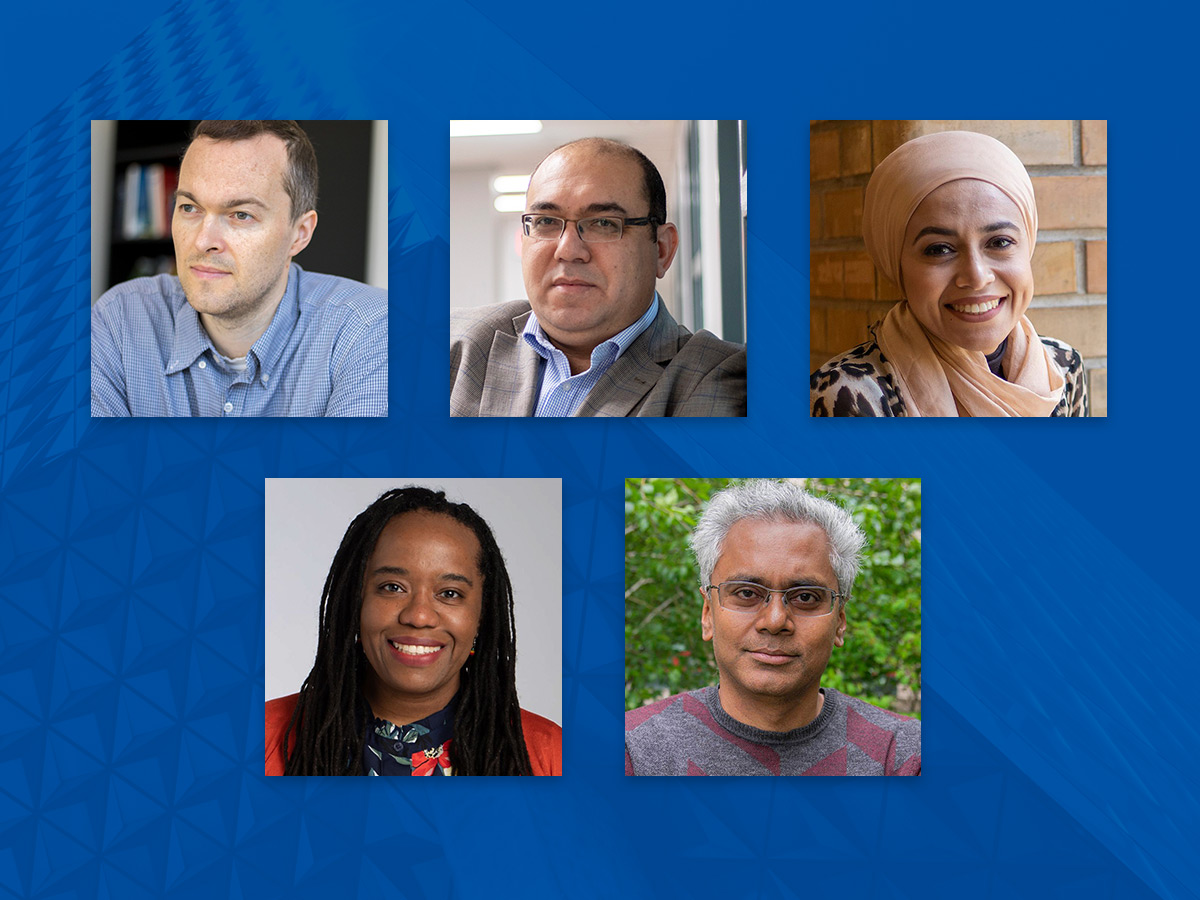
The Government of Canada has announced new funding through the Canada Foundation for Innovation (CFI) for investments in research infrastructure. Five Toronto Metropolitan University (TMU) researchers are receiving support to acquire foundational research infrastructure through the CFI’s John R. Evans Leaders Fund (JELF).
Four of the five researchers are from TMU’s Faculty of Engineering and Architectural Science and the fifth is from The Creative School.
Through the fund, their respective projects will receive support to acquire foundational research infrastructure to enable a range of goals, from removing dangerous contaminants from water to developing accessible and searchable Black creative histories and enhancing early detection of different types of cancer.
“It is my great pleasure to congratulate these five professors on receiving funding that will assist their valuable scholarly, research and creative activity,” said Steven N. Liss, TMU’s vice-president, research and innovation. “Thanks to the acquisition of new, important infrastructure, these researchers and their teams will be able to enhance their impact. Their exciting work promotes sustainability and clean water, public and community health, and innovative new technologies to assist with exploration and discovery.”
Professor of performance Cheryl Thompson is a Tier II Canada Research Chair in Black Expressive Culture and Creativity, and Director of Black Creative Lab. Her project, Digitizing Black History, will utilize new digital asset management and digital archiving systems to centralize storage, access, management, organization and long-term preservation of Black Canadian history, people and places.
Aerospace engineering professor and Tier II Canada Research Chair Anton De Ruiter is working to help maintain and enhance Canada’s relevance in the exploration of outer space. His research project, Advanced Co-operative Mobile Robotic Manipulation Test Facility, is a multiple rover-based test facility intended to help develop Canadian expertise in the construction and maintenance of structures supporting missions to the moon and Mars.
Civil engineering professor Elsayed Elbeshbishy’s project is Innovative Waste-to-Bioenergy Technologies for Water Research for Resource Recovery. Professor Elbeshbishy studies waste-to-bioenergy technologies with a focus on anaerobic digestion, which converts organic waste into biogas for heat or electricity. His funding will be used to acquire innovative technologies for the Water Research for Resource Recovery (WR3) laboratory, helping enable the development of advanced waste-to-bioenergy systems.
Clean water is the objective of civil engineering professor Rania Hamza’s project, Integrated Solutions for PFAS Removal in Wastewater. Her research focuses on improving the detection, separation, and destruction of PFAS, a group of contaminants known as "forever chemicals." Professor Hamza’s grant will be used to acquire a combustion ion chromatograph, an advanced analytical tool to support the development of new treatment technologies.
Mechanical, industrial, and mechatronics engineering professor Krishnan Venkatakrishnan’s project is Quantum Sensor for Multi Cancer Early Diagnosis. His work seeks to create an early detection test for multiple types of cancers, allowing for earlier interventions and better outcomes for cancer patients around the world. His grant will enable research to improve the diagnostic accuracy of multiple cancer types at early stages, when chances of successful treatment are highest.
Related links:
Read the Canada Foundation for Innovation announcement. (external link, opens in new window)
Learn more about the John R. Evans Leaders Fund (JELF). (external link, opens in new window)
Canada Foundation for Innovation infrastructure grants awarded to TMU researchers (September 13, 2024)