M.Arch Student Christopher Cleland Presents Innovative Research at ACSA’s 2024 INFLECTIONS Conference in Mexico
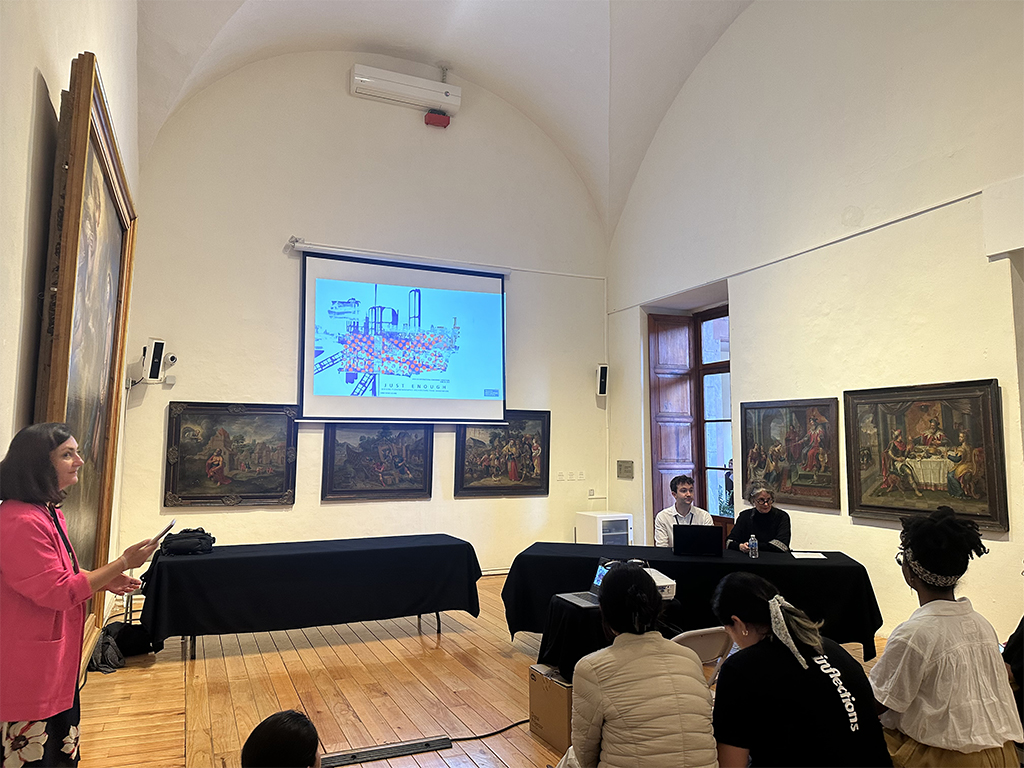
On June 27-29, M.Arch student Christopher Cleland was invited to present research from his thesis at the ACSA’s 2024 International Conference | INFLECTIONS in Querétaro, Mexico. The conference of the Association of Collegiate Schools of Architecture was hosted in partnership with the School of Architecture, Art and Design of Tecnológico de Monterrey and Asociación de Instituciones de Enseñanza de la Arquitectura (ASINEA), and involved over 200 participants from architecture programs around the world. The theme, Inflections: becoming what is yet to be, delved into the intersecting inflection points of environmental and social trends, innovative forms of practice, and artificial intelligence. The event began with a profound opening keynote presentation from renowned architect Tatiana Bilbao on the participation of people and nature in the design process, showcasing projects from Tatiana Bilbao Estudio.
“After the conference I’m thinking more about architecture as something we can do together with people, nature, and technology. I’m very grateful to have had the opportunity to present research that always seemed a little unorthodox, and I really appreciate how the conference has contributed to the way that I practice architecture.”
Alongside other practices yet to be (SLANT), Christopher presented “Just Enough: Deriving Phenomenographic Architecture From Inhabitation,” which explored the definition of an architectural phenomenography using gestalts of space and activity from lived experiences of existing buildings to speculate design. The process used Monocular depth estimation (zoedepth) and relational modelling to create digital landscapes that would in turn be translated into orthographics inspired by the chronophotography of Etienne Jules-Marey. These ‘chrono’-orthographics produced three alternative futures in the manner of Schminke, each based on a different spatial gestalt: physical play, learning and toys, and swimming and bathing. At every step, activities (lived experiences) are both technically and theoretically informing the definition of the design process so that design is more contingent on inhabitants than the designer’s biases. Design is predicated on being just prescriptive enough to give agency to the inhabitants. Christopher’s peer-reviewed paper will be published in the conference proceedings under the session “Experiments for Urban Futures | Slant.