Undergraduate Students Win Award for Sustainable Observatory Pavilion
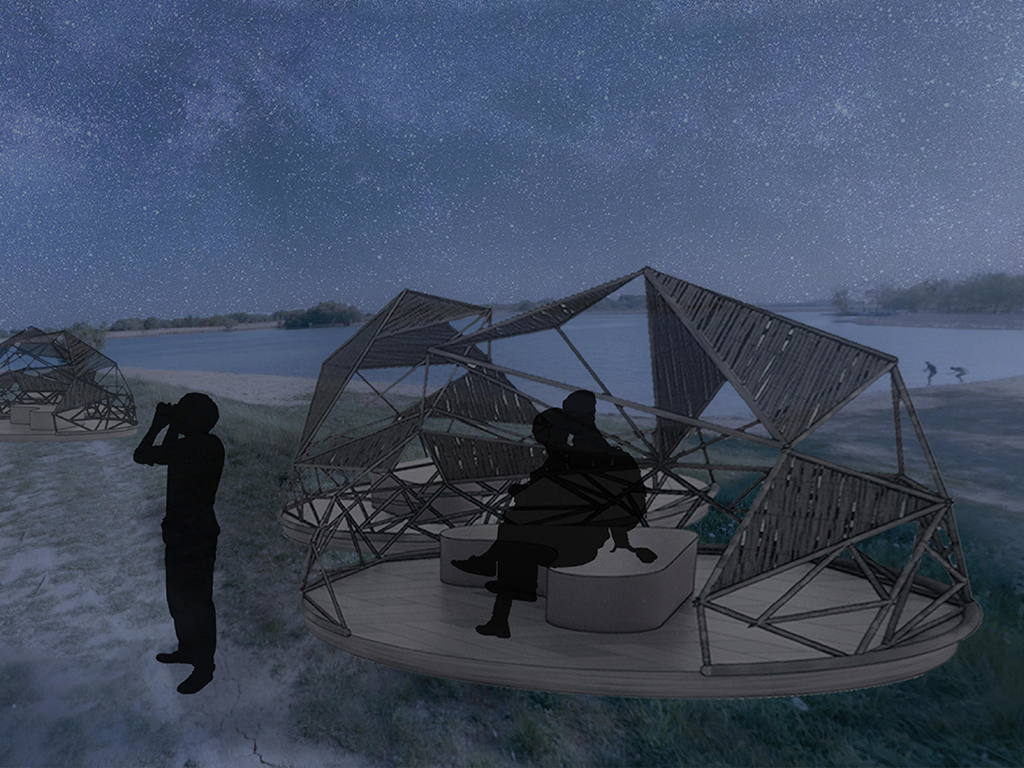
Second year students Christopher Chow, Jeffrey Zee and George Duo received the People’s Choice Award for their project Orion’s Pavilion for the Gaze Night Sky Pavilion design competition (external link) . We spoke to them about their process and what they’ve learned from the experience.
What inspired your design?
Chris: We knew we wanted a low carbon footprint, and something that would be super lightweight and deconstructable.
Jeffrey: The design also reflects astronomy, storytelling, and activities relating to stargazing, which you can see in the concept sketches.


Chris: Orion’s Pavilion speaks to the spiritual experience of stargazing, and community building as an intimate experience. Parts of each module are closed off via bamboo sidings to help with shading, and the openings “frame” the night sky and whichever constellation you are oriented towards.
Jeffrey: The concept sketch also speaks to the idea of resembling a series of constellations in how the modules are arranged. To draw invisible lines between the stars, we have wooden beams connected between all the joints that form the pavilion itself.
How did you collaborate on the project?
Jeffrey: This was our first competition and our first time collaborating together. It was interesting to learn how to do all these things not only in terms of working together as a team, but also figuring out how to work around the additional obstacle of using things like Miro and doing everything online.
George: I think our process was pretty similar to how we go about group projects in class - we divided up the work in the same way. We would meet periodically to run through sketches and ideas, look at what we like and don’t like, then build on that by combining ideas and going from there.


What were some of your design challenges?
Chris: Our biggest challenge trying to design around our initial intention while maintaining a level of design realism. This was because originally, we had a different idea: we wanted the pavilion to rotate towards different constellations in the sky, but then we had trouble figuring out the technical aspect. We also had to consider that since this is a lightweight outdoor pavilion, we couldn’t use that many resources. We wanted to keep the natural integrity of the park. Since it’s an outdoor pavilion, our priority was to make it very lightweight and sustainable - so this feature would have gone against that. What we did end up keeping from that design phase was this idea of combining multiple pavilions together in a cluster community, and that they would all be pointed in different directions.
Jeffrey: I think we also had a lot of varying ideas in how we wanted to shape the pavilion in terms of form, how we want to use materials. It was challenging to come together and choose the best part of each person’s idea and connect it to a main intention or concept.
George: To add to that, we were only given twenty square meters of space, so we were trying to figure out ways to maximize the space that was given, which resulted in the moving concepts we had.
How has the program at DAS helped you succeed in this challenge?
Chris: Our focus wasn’t so much on the drawings - the drawings are important, but what we’ve really learned as second year students is how site analysis contributes to creating a good intention for a project, and how it creates a really good foundation moving forward. It’s become my approach to both studio projects and competitions.
Jeffrey: This competition was right after our studio which emphasized intention and expression. A lot of our earlier meetings followed the same process we used in that studio, so, thinking of different intentions we thought were important, and going through precedents with similar intentions, and then listing out ways we expressed our intentions and ideas.
George: It is important for us to get a solid concepto down for developing and that everything about it made sense, and that it wasn’t just a purely theoretical design in the real world. If it was built, we wanted it to function as we intended it to. It’s something that associate professor Yew-Thong Leong really drove home when we were working with him. It’s something that really influenced my approach.
Jeffrey: I think in general, we also learn more about modeling. Chris used Grasshopper for a lot of the modeling as well as photoshop.
Chris: We also learn to use Rhino and Revit, but we tried to keep it really simple this time around.
Jeffrey: To just add to what Chris said, in the beginning we tended to over complicate the project. But our experience in studio gave us a more grounded approach which led to a more simplistic design in the end.
George: I think the nearly two years of being in architecture school really developed our way of thinking about the project. It’s hard to put the value of that into words. You develop better ideas and problem solving over time through studio projects. It’s exciting to see how we’ll improve two years from now.
Why do you think competitions are an important part of the student experience?
Chris: Outside of our classes, we don’t really get a lot of opportunities to design, or to have that collaborative experience. In the industry you won't ever be working on a project by yourself. You’ll always be working with other designers, architects. So it's a valuable experience to have.
George: Yeah, I think the collaboration aspect is definitely really big, and also just being able to work on a project outside of school is helpful. Competitions also add an aspect of the real-world industry. When we do studio projects, we are given a long amount of time to develop our projects until we’re satisfied, but with competitions we have a much shorter timeline, and we’re also competing with other schools - which is more similar to the real world in terms of architectural firms competing.
Chris: Just to add to the collaborative aspect, this is our first competition as a team. Everyone has different ideologies when they start off on a new project, and it’s interesting and important to know where everyone was coming from, and how we could all collaborate together to create a cohesive project when everyone’s ideas were so radically different.
Jeffrey: I also think competitions are helpful because it allows us to expand on the types of projects we work on. We’ve had studios that are very large scale, so having a wider range of types of projects was good. It helps us look at space in different ways and expand our mindset when working on different projects.
Can you touch on what your next steps and goals are?
Chris: We’re working to get into co-op, and since this is our first competition we want to do more of them. Gathering all of these experiences we need to get into the industry is important, and developing our skills when it comes to model making and software, but also broadening our creative intentions within every project.
George: I think we can use the experience and the knowledge we’ve built up to develop better studio projects.
Jeffrey: In general, I think we all want to do more competitions over the summer. All of the skills we’ve built up over the school year can be put into practice.
George: In my mind, the most valuable aspect of our program is studio - and my main goal is to keep putting out better projects that I’m proud of.