Significant Net Resident Outflows from the City of Toronto and Peel Region to Elsewhere in Ontario Continue in 2025
By: Frank Clayton, Senior Research Fellow, and Diana Petramala, Senior Economist
March 10, 2026
(PDF file) Print-friendly version available
Highlights
• The number of intraprovincial migrants in Ontario was relatively constant at 75,467 persons in 2025, despite the sharp drop in overall population growth
The annual movement of Ontarians between municipalities stabilized over the last three years (12 months ending July 1) following the pandemic-induced surge in 2021 and 2022. However, interprovincial migration was 35% higher than before the pandemic.
• Population outflows continue to be almost exclusively from the city of Toronto and Peel region
Toronto and Peel accounted for 97% of the net out-migration recorded by Ontario municipalities in 20205. Net outflows were small and infrequent in other municipalities.
• The net intraprovincial gainers were spread throughout the province
Most municipalities surveyed were net recipients of intraprovincial migrants in 2025 and over the mid-term. The top 10 recipients accounted for 62% of Ontario's municipal movers in 2025.
• The eastern GTA and peripheral municipalities to the GTA were the largest recipients of net migrants
Simcoe county and the regions of Durham and Niagara remained the largest recipients of net intraprovincial migration.
With the current price of ground-related housing in more central parts of the GTA unaffordable, households are moving away from Toronto and Peel and York regions to other parts of the Greater Golden Horseshoe and beyond to find ground-related homes they can afford. This net outflow is anticipated to continue in the foreseeable future, even with policies encouraging more missing-middle housing in existing neighbourhoods. These neighbourhood intensification policies will not provide sufficient numbers of low-rise housing types to meet demand. The production of more ground-related housing on greenfield lands is an essential component of an effective attack on housing unaffordability.
Background
Much attention has been focused on the surge in immigration into Canada and where new immigrants settle. Less attention is paid to the migration patterns of Ontario residents within the province and the factors behind them, including the desire of many households for more affordable forms of ground-related housing (singles, semis and townhouses).
This blog examines net intraprovincial migration flows between Ontario municipalities (Census Divisions, or CDs) in 2025 and preceding years back to 2019.[1] Net intraprovincial migration refers to the net flow (i.e., the difference between inflow and outflow) of Ontario residents between municipalities in the province.[2]
The focus is on net intraprovincial migration between Ontario municipalities in the 12 months ending July 1 of the years considered (e.g., the 12 months ending July 1, 2025, are referred to as 2025).[3]
CDs are labelled as municipalities (the terms are used interchangeably here). In Ontario, most CDs are large single-tier municipalities (such as Toronto, Ottawa, or Hamilton), regional municipalities (such as York, Durham, or Waterloo), or counties (such as Simcoe or Wellington). The county population estimates include separated municipalities within their borders (e.g., Wellington county includes the city of Guelph).
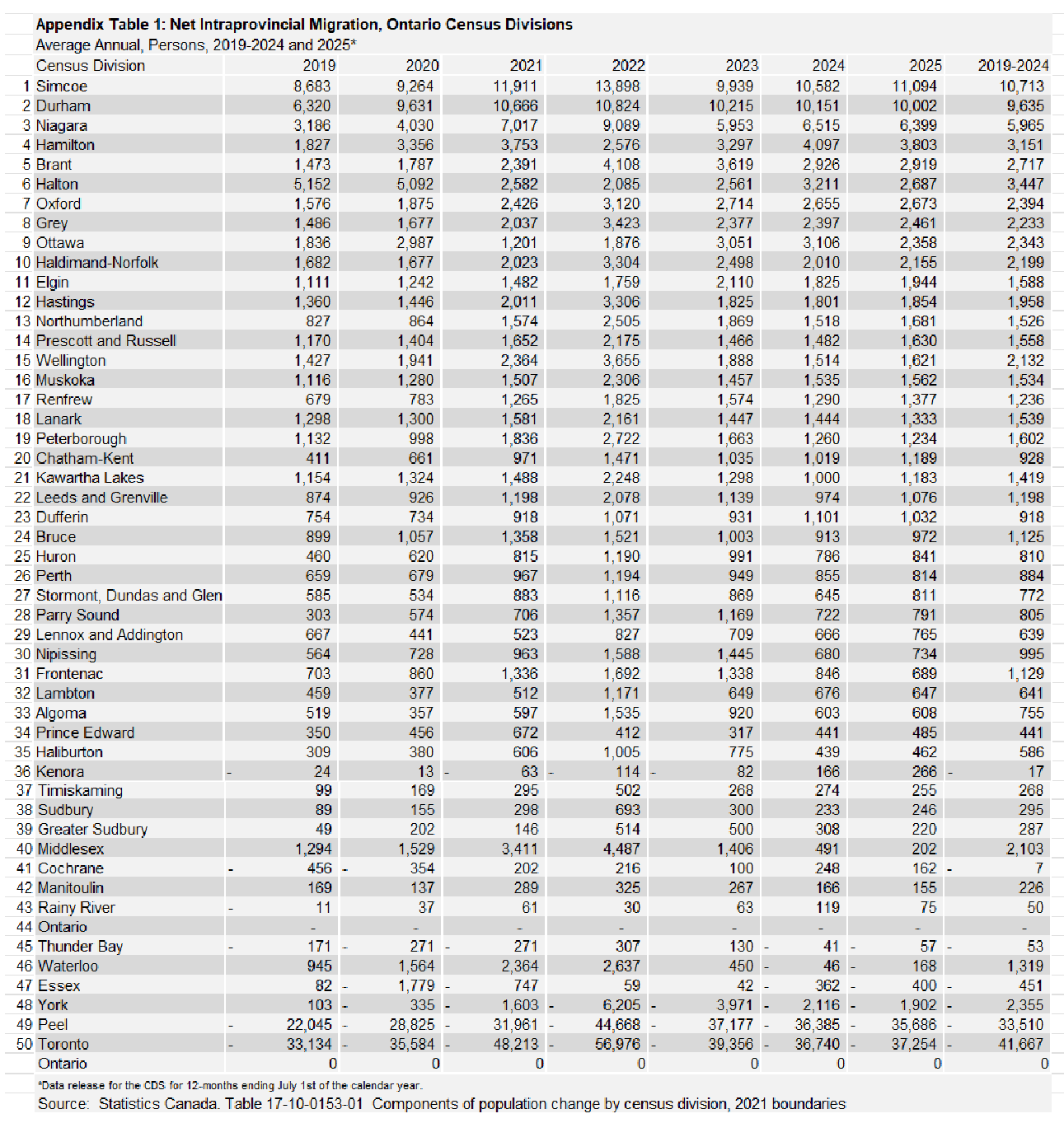
A table providing net intraprovincial migration estimates for each CD in Ontario by year from 2019 to 2025, and comparing 2025 with the annual average of the preceding six years (2019-2024), is in the appendix.
Total Intraprovincial Migrants in Ontario
Figure 1 shows the total number of Ontarians moving between municipalities in the 12 months ending July 1 from 2019 to 2025.
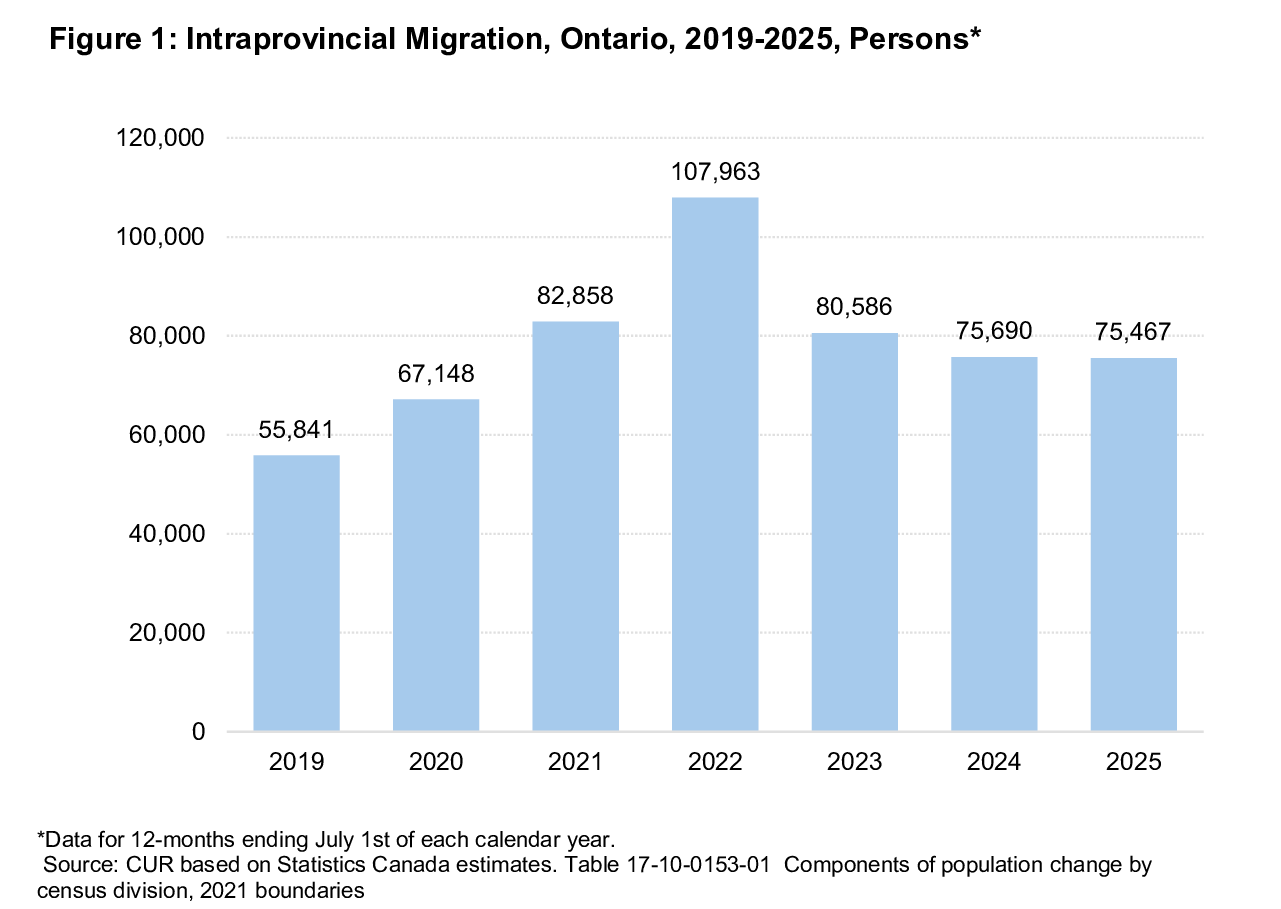
The number of intraprovincial migrants in Ontario was relatively constant at 75,467 persons in 2025
Following a pandemic-related surge that saw annual intraprovincial migrants almost double, the numbers have declined and remained relatively stable over the past three years, in the 75,467-80,586 range.
However, interprovincial migration was 35% higher than before the pandemic
The number of people moving between municipalities in the 12 months ending July 2025 (75,467) was 35% higher than the number in the 12 months ending July 1, 2019, the last 12-month period before the pandemic, which started in March 2020.
Municipalities With the Largest Net Out-Migration
Figure 2 shows the four municipalities with the largest net outflows of residents to other parts of the province.
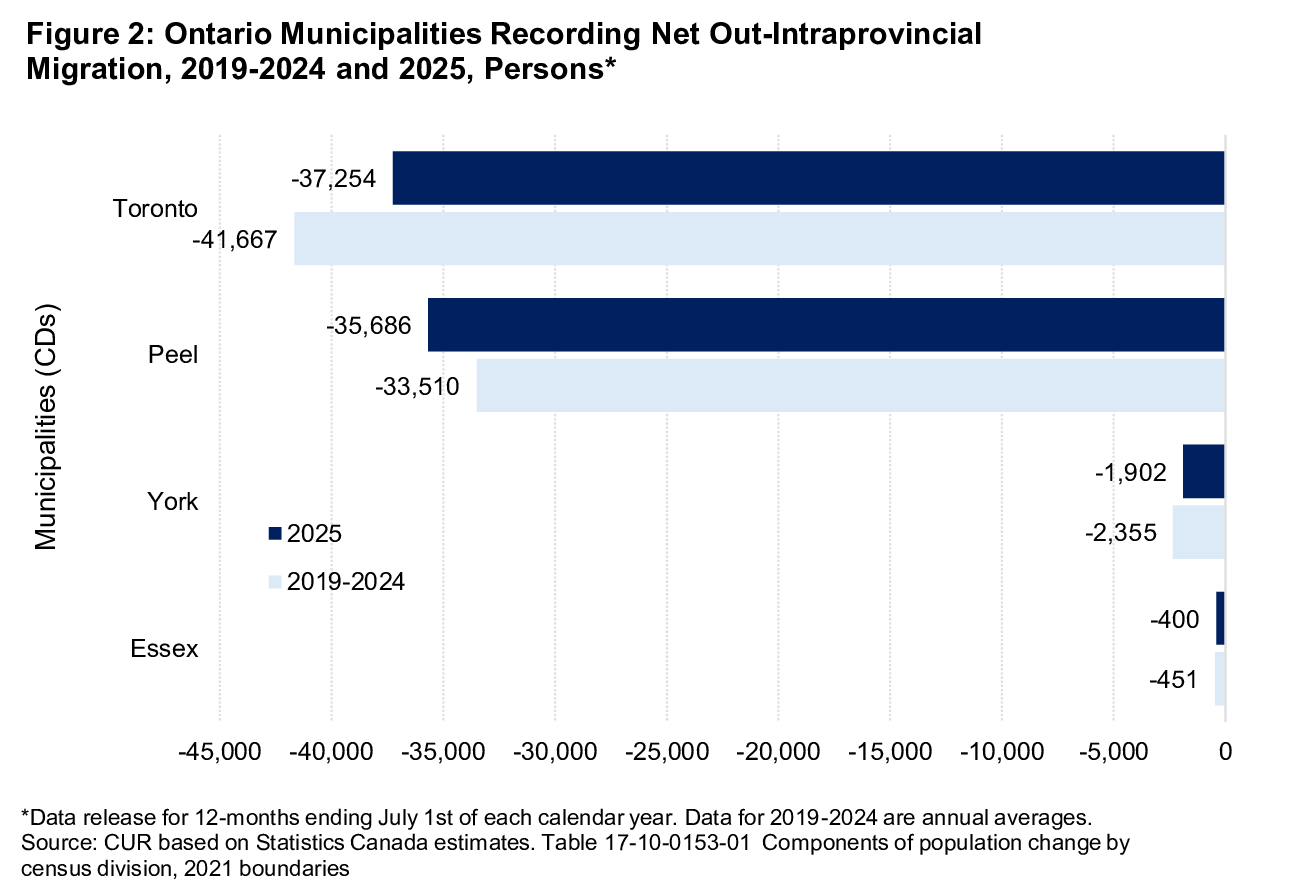
Population outflows continue to be almost exclusively from the City of Toronto and Peel Region
The city of Toronto and Peel region again experienced a sizeable net out-migration of residents to other parts of the province. The combined outflow in the 12 months ending July 1, 2025, was 72,940 residents, about equally divided among the two municipalities. These two municipalities accounted for 97% of net intraprovincial losses between Ontario municipalities.
Net outflows are small and infrequent in other municipalities
The two municipalities with net outflows after Toronto and Peel were York region (-1,902) and Essex county, including Windsor (-400). Waterloo region and Thunder Bay also experienced small net outflows in 2025 (-168 and -57 persons).
Municipalities With the Largest Net In-Migration
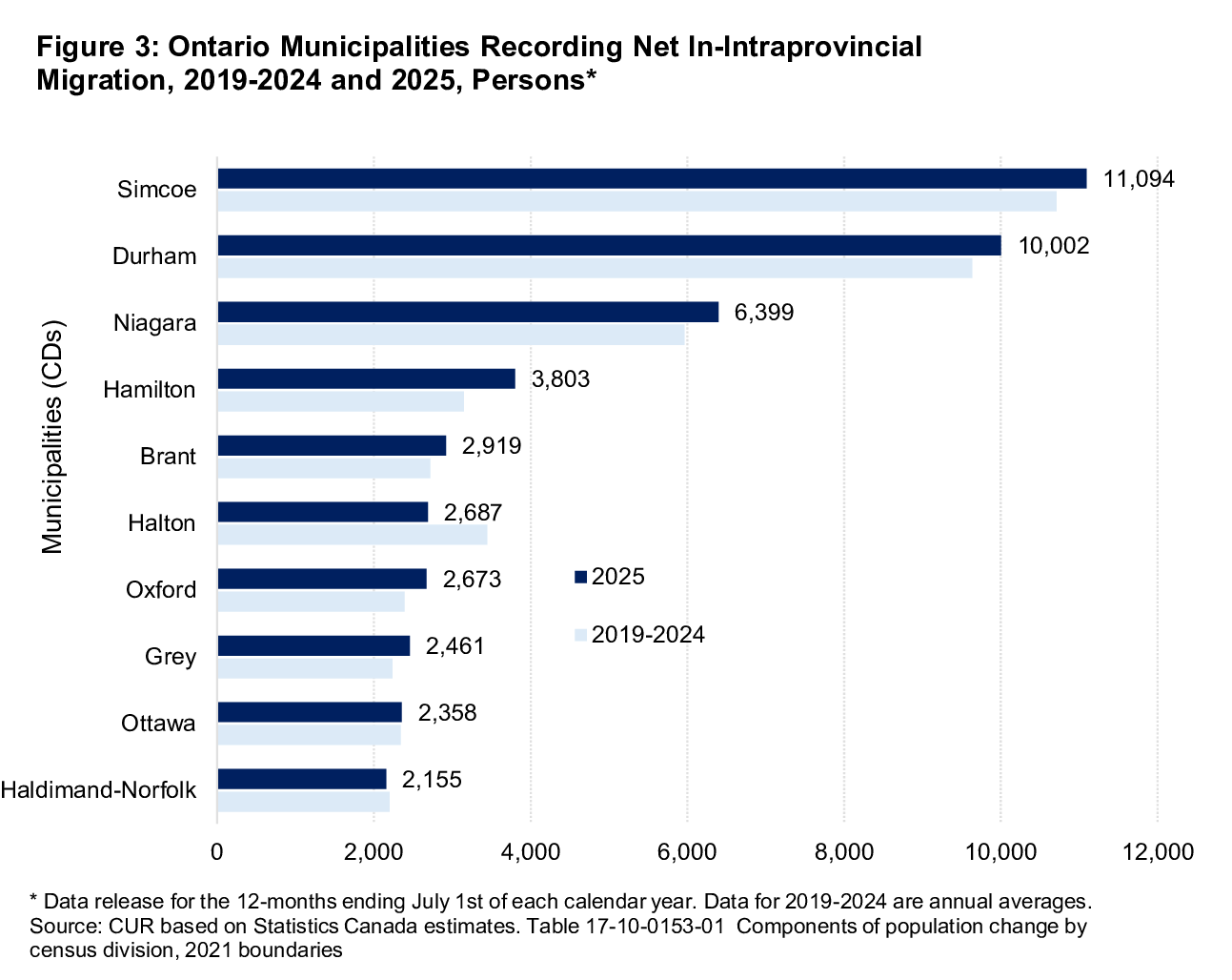
Figure 3 shows the top 10 municipalities (CDs) that recorded a net gain of intraprovincial migrants in 2025, benchmarked against the average annual net inflow over the preceding 6 years.
The net intraprovincial gainers were spread throughout the province
As documented in Appendix Table 1, most municipalities surveyed were net recipients of intraprovincial migrants in 2025 and over the mid-term. The top 10 recipients accounted for 62% of Ontario's municipal movers in 2025.
Simcoe county and the regions of Durham and Niagara are the largest recipients of net in-intraprovincial migration
Three municipalities – Simcoe county, Durham and Niagara regions – were once again the largest recipients of net intraprovincial migrants in 2025, with Simcoe county taking the top spot with 11,094 net intraprovincial migrants, followed by Durham region (+10,002 and Niagara region (+6,399). All three municipalities contain sizable greenfield land inventories for building ground-related homes.
Most of the top ten in-migration municipalities in 2025 exceeded their mid-term averages - Halton region being the main exception
Halton region was the principal recipient with 2025 net in-migration, lower than the average annual 2019-2024 (2,587 versus 3,447).
Since there are no detailed estimates of gross migration flows between individual municipalities, we can only surmise what is happening. It appears that the residents leaving the city of Toronto and Peel and York regions have mostly moved to other parts of the GTA and outer municipalities in the GGH in search of more affordable ground-related homes - but some have moved even farther afield. In turn, residents of many GGH municipalities have moved from the region to other parts of the province for their own housing affordability reasons.
A recent Statistics Canada report generally supports this scenario. At the Canada level, the most frequent reasons for moving given by intraprovincial movers between municipalities were to become a homeowner (22.1%) and to find bigger/better housing (20.6%).[4]
The lack of affordable homes is a significant factor in the net outflow of intraprovincial migrants from the GTA
Surveys of GTA homebuyers or intending homebuyers consistently show a robust propensity toward single-detached homes or a close substitute (semi-detached home, townhouse, or even a stacked townhouse). Homebuyers have an innate desire to be at or close to ground level, with an exterior entrance, a garage, and a plot of green space. Based on surveys conducted by Ipsos for the Toronto Regional Real Estate Board, between 70% and 80% of intending buyers plan to buy a ground-related home.[5] This preference is supported by demographic analysis.[6]
With the current price of ground-related housing in more central parts of the GTA unaffordable, households are moving away from Toronto and Peel and York regions to other parts of the Greater Golden Horseshoe and beyond to find ground-related homes they can afford. This net outflow is anticipated to continue in the foreseeable future, even with policies encouraging more missing-middle housing in existing neighbourhoods. These neighbourhood intensification policies will not provide sufficient numbers of low-rise housing types in demand. The production of more ground-related housing on greenfield lands is an essential component of an effective attack on housing unaffordability.
End Notes
[1] The 2024 net intraprovincial migration estimates were reviewed in: Frank Clayton and John Clinkard. “Movement of People Within Ontario Stabilizing at Pre-Pandemic Levels Including Net Outflows from Toronto and Peel.” CUR. April 2, 2025.
[2] Estimates of gross flows of interprovincial migrants (in- and out-migration separately) are not provided in the Statistics Canada estimates. For the province as a whole, the net change in intraprovincial migrants is zero.
[3] The 2024 net intraprovincial migration estimates were reviewed in: Frank Clayton. “Movement of People Within Ontario Stabilizing at Pre-Pandemic Levels Including Net Outflows from Toronto and Peel.” CUR. April 2, 2025.
[4] Gordon Song, Karl Chastko, Silvia Grueva, Patrick Charbonneau. “Why do people move within Canada? A study on the reasons for internal migration and mobility using the Canadian Housing Survey.” Statistics Canada. February 16, 2026. Note that the total responses can exceed 100% as respondents could identify more than one reason for moving.
[5] Frank Clayton. “What Kinds of Housing Are Homebuyers or Intending Homebuyers in the GTHA Choosing?” CUR. June 28, 2022. The report examined buy preference data for 2018-2021. Subsequent surveys for 2022-2024 show the same preference.
[6] Frank Clayton. “Demographics Foretell a Shift to New Single-Family Housing.” CUR. December 10, 2024.
References
Clayton, Frank and Clinkard, John (2025). “Movement of People Within Ontario Stabilizing at Pre-Pandemic Levels Including Net Outflows from Toronto and Peel.” CUR. April 2, 2025. [Online]. Available: https://www.torontomu.ca/centre-urban-research-land-development/blog/blogentry97-movement-of-people-within-ontario-stabilizing-at-pre-pandemic-levels/.
Clayton. Frank (2024). “Demographics Foretell a Shift to New Single-Family Housing.” CUR. December 10, 2024. [Online]. Available: https://www.torontomu.ca/centre-urban-research-land-development/blog/blogentry95-demographics-foretell-shift-to-new-single-family-housing/.
Clayton, Frank (2022). “What Kinds of Housing Are Homebuyers or Intending Homebuyers in the GTHA Choosing?” CUR. June 28, 2022. [Online]. Available: (PDF file) https://www.torontomu.ca/content/dam/centre-urban-research-land-development/CUR_Preference_Homebuyers_Intending_Hombuyers_GTHA_June_2022.pdf.
Song, Gordon, Chastko, Karl, Grueva, Silvia, Charbonneau, Patrick (2026). “Why do people move within Canada? A study on the reasons for internal migration and mobility using the Canadian Housing Survey.” Statistics Canada. February 16, 2026. [Online]. Available: https://www150.statcan.gc.ca/n1/pub/91f0015m/91f0015m2026001-eng.htm (external link) .
Statistics Canada (2026). Table 17-10-0153-01, Components of population change by census division, 2021 boundaries. [Online]. Available: https://www150.statcan.gc.ca/t1/tbl1/en/tv.action?pid=1710015301 (external link) .
Appendix: Net Intraprovincial Migration by Municipality (Census Divisions), 2019-2025