An ambition for compassionate collaboration
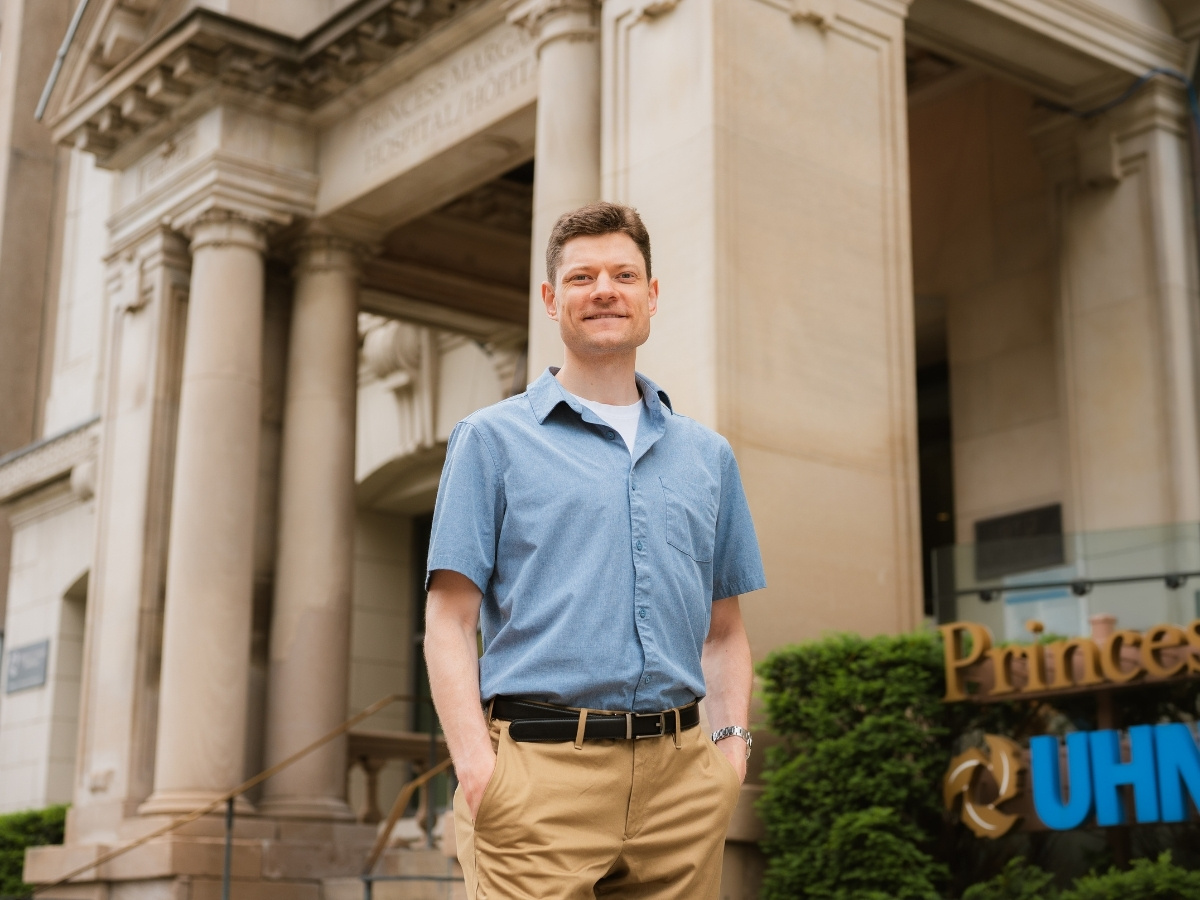
Andrew Zwaniga has always been intrigued by solving problems—that’s what brought him to the world of physics. But as he worked his way through an undergraduate degree in math and physics, a master’s degree in astrophysics, and finally his PhD in the CAMPEP-accredited medical physics program at TMU, he also discovered that he wanted to focus his skills on helping people. Today, he’s preparing to take the next step in that journey by starting as a new resident in radiation oncology physics at the Princess Margaret Cancer Centre in September 2026.
“I have this knowledge and this learning experience, but I'm also very good at working with people and collaborating. I want to use that skill to provide a service to people that's indispensable. Cancer is going to be with us for my entire lifetime in various forms, and I think that's the best place for me to contribute and use my physics knowledge in a way that excites me too,” says Zwaniga.
Zwaniga has already begun his contribution to cancer research with his doctoral dissertation. Most medical physics focuses on radiation therapy, he explains, and his interest is in a new form of radiation-based medicine that allows doctors to target individual cells rather than applying radiation from outside the body, as current treatments generally do. “You deliver this drug that contains a radiation source that's very potent and localized, and when it gets to the cell, it causes DNA damage to that cell and not to the surrounding healthy tissue,” he says. “It's a very targeted approach that can also be used for personalizing medicine, eventually allowing for doses that are better fitted to individual patients.”
Supervised by Physics professor Eric Da Silva, Zwaniga’s project has primarily investigated the potential of the radioactive element antimony-119 by conducting computational work to determine how to maximize its therapeutic benefit in targeted radionuclide therapy. This treatment is designed to target micrometastases, which are individual cancer cells or small clumps of cells a few millimetres in size that are often unseen on imaging, cannot be removed surgically, and are also hard to treat with external radiation because they are hidden in the body. Prostate, lung, gastrointestinal, and neuroendocrine cancers are among those that have strong potential to benefit from this form of targeted therapy.
“The idea is to look at cancers that have a specific feature on the cell, what's called an overexpressed gene or some other protein, and that protein can be targeted by the drug complex, which also contains the radionuclide,” says Zwaniga, noting that the treatment idea is still at the development stage, which is why his work focused on computational modelling. He’s mostly been using resources from the Digital Research Alliance of Canada to run his complex simulations, which can take anywhere from tens to hundreds of hours to process. In addition to antimony-119, he investigated seven other elements, including iodine-125. Zwaniga was inspired to focus on antimony-119 after reading about research at the TRIUMF lab, Canada's particle accelerator centre in British Columbia, where researchers have previously reported on the radiochemistry and production of this radionuclide for use in targeted cancer therapy.
Looking back at his time at TMU, Zwaniga says that he felt instantly comfortable as an incoming graduate student. “I was immediately impressed by the closeness of the community in the medical physics program. I had never experienced that sense of belonging,” he says. As he researched doctoral programs, he began to seriously consider TMU after reading about other graduate students' experiences.
“I was actually inspired by some of the news stories that I had read from the Faculty of Science about student success. That was so inspiring to me that I started looking more seriously at the researchers and the type of research going on at the university,” he says. Once he became a student, he began to get involved, serving as Vice-President of the Physics Graduate Student Union, participating in the academic search committee for a new Physics department chair, and playing beach volleyball with new friends from TMU.
While Zwaniga is excited that his new position as a medical physics resident still has close ties to academia through the University Health Network, he’s also keen to move towards a clinical service role. “I have this deep passion about physics and the nature of the universe and how things interact, but I'm also very passionate about doing something that's going to help everyday people. Being a helpful contributing member of society is really important to me,” he says.
He’s also looking forward to collaborating with other specialists. “In the clinical setting, it's very multidisciplinary. You have people who are medical physicists, you have radiation oncologists, radiation therapists; it's a large team of technical staff, and everyone has the same goal in mind: we want to deliver the highest quality of care to patients undergoing radiation therapy.”
He’s glad to have the opportunity to join in. “I'm super excited and really honoured that I was accepted to the program at the Princess Margaret Cancer Centre. It's really a once-in-a-lifetime opportunity for me and something that I've been dreaming of since I came to TMU.”