Knowledge building in the age of AI
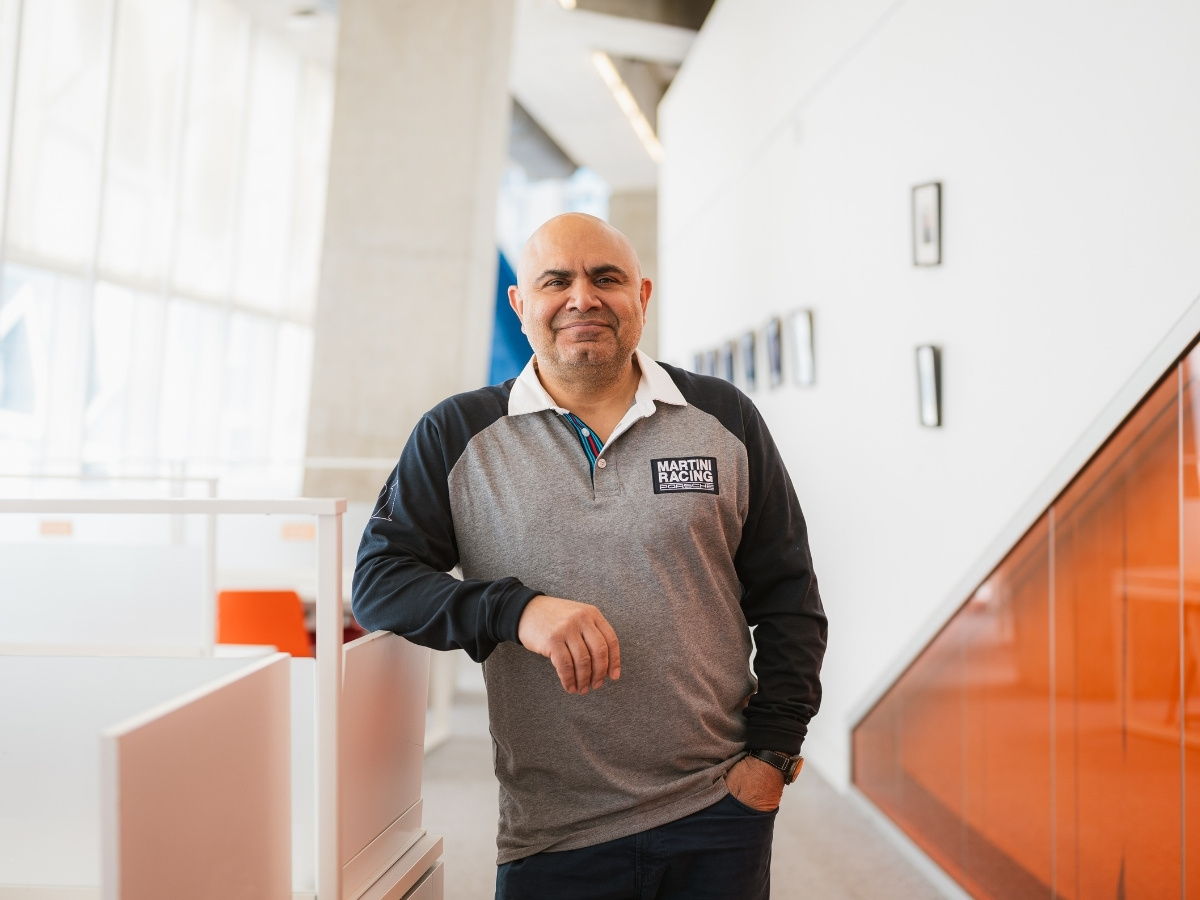
Atif Ahmad may have spent more than 30 years in the corporate world, but his connection to TMU has always been strong. First, as a member of TMU’s Curriculum Committee and the Program Advisory Council for the Raymond Chang School of Continuing Studies, and more recently as a TMU student senator.
That zest for educational advising makes Ahmad’s own turn towards academia a natural extension. Today, he’s a PhD candidate in Computer Science, a degree he turned to after completing his Master of Digital Media at TMU’s Creative School.
The research question at the centre of Ahmad’s doctoral dissertation focuses on how students have lost the productive challenges of the learning process in the emerging age of AI, in which large language models (LLMs) provide instant answers. “Over time, students have gotten instant gratification from getting an answer through LLMs. As we use tools like ChatGPT, what happens is students get an “illusion of competence”, they get the instant answer — but are they really learning?” asks Ahmad, noting that the instant win has disrupted the “friction” of previous approaches that included failure, and the need to puzzle through learning. His dissertation presents a framework that he’s developed to bring productive struggle back into learning.
In practical terms, Ahmad is testing his framework with first-year computer science students learning Python and Java, two programming languages which are already part of their courses. He developed and uses a pedagogical platform, an affect-aware system called Berry, to guide student learning through responsive coaching. “We ran a few tests with the students in March, and now I'm streamlining the data and trying to figure out if Berry was effective,” he explains. The student response has already been gratifying. “The feedback so far is great, to the extent that students, after the testing, sent me emails asking if they can use the same system at home,” he says.
Ahmad is keen to work on LLMs because he sees this era as a turning point in technology, and the corporate world as overly enthusiastic in their rush to adopt AI. "The pendulum has gone one way, where corporations are trying to save money, or under the guise of saving money, relying more on LLMs. But I think the actual results are yet to be seen," he says. Asked if he could venture a guess about those impacts, Ahmad laughs. “If I knew the impacts, I would be the Newton of this era.”
Although he’d completed his Bachelor of Commerce degree and an MBA and had been giving back as an advisor, re-entering academia was daunting. He praises his experience with the Master of Digital Media as a “good soft landing” that let him readjust to the new norms of university. He jokes about dating himself as he recalls using the 1990s internet protocol Gopher and library card catalogues, then marvels at how technological advancements allow him to use the latest databases and tools for his research. “All the papers are online, and it's very easy, and sometimes overwhelming as well. To be honest, it’s humbling all the great work that academics all across the world are doing,” he says. Ahmad credits Computer Science professor and Graduate Program Director Alex Ferworn for guiding him through this journey back into academia, saying his advice has been key to making the right choices.
The potential of this transformative moment is what pushed him towards further learning. “I thought it was an amazing time to get into academia, because clearly, a very important movement is happening in computer science, which is impacting the world. I think the next four or five years will define how the corporate world will change. I wanted to be part of that and get into not only improving my own knowledge, but also giving back to the corporate world and bringing the corporate world back to academia,” he says.
Ahmad is also grateful for the support of his PhD supervisor, Computer Science professor Preeti Raman. “She's very collaborative. I've had the best time working with her. I had heard it is difficult to get time with your supervisor, and that was one thing that I found very different. I get to meet her, she checks in on me, and it's quite a collaborative approach. I'm blessed.”
He enjoys being part of her lab, the Computational Innovations and Research for Care-centered Learning and Education (CIRCLE) lab, and values being included in weekly lab meetings, where graduate students share their research progress and support undergraduate students. “I work with many undergrads in the CIRCLE lab, mentoring them wherever they need my help. Attending the lab meetings where there's a discussion and input and output, I'm there for any support that I can provide,” he says. “That is very interesting, meeting the young people, and also my graduate colleagues for exchanging ideas or even asking for help.”
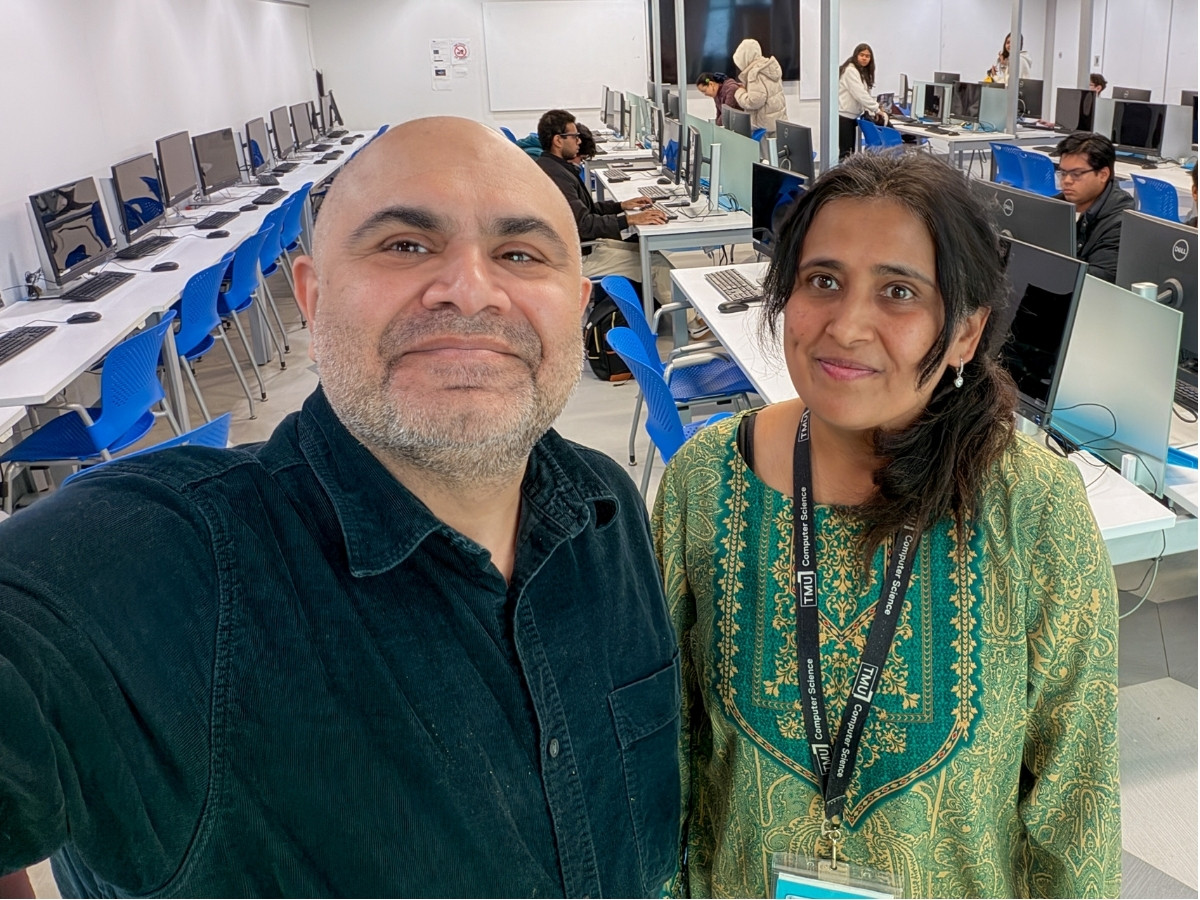
Atif with his PhD supervisor, Computer Science professor Preeti Raman