TMU students present leading-edge SRC projects at 2026 Undergraduate Research Opportunities Showcase
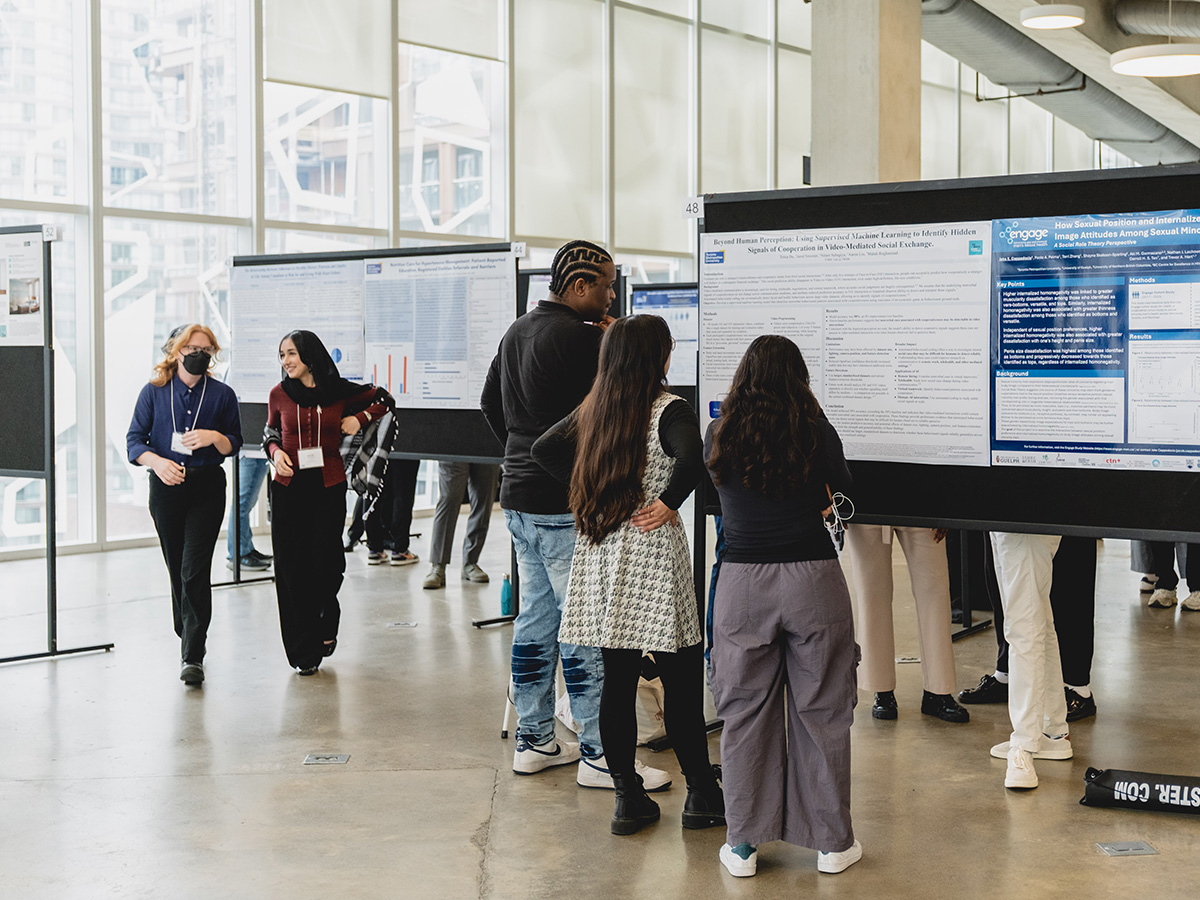
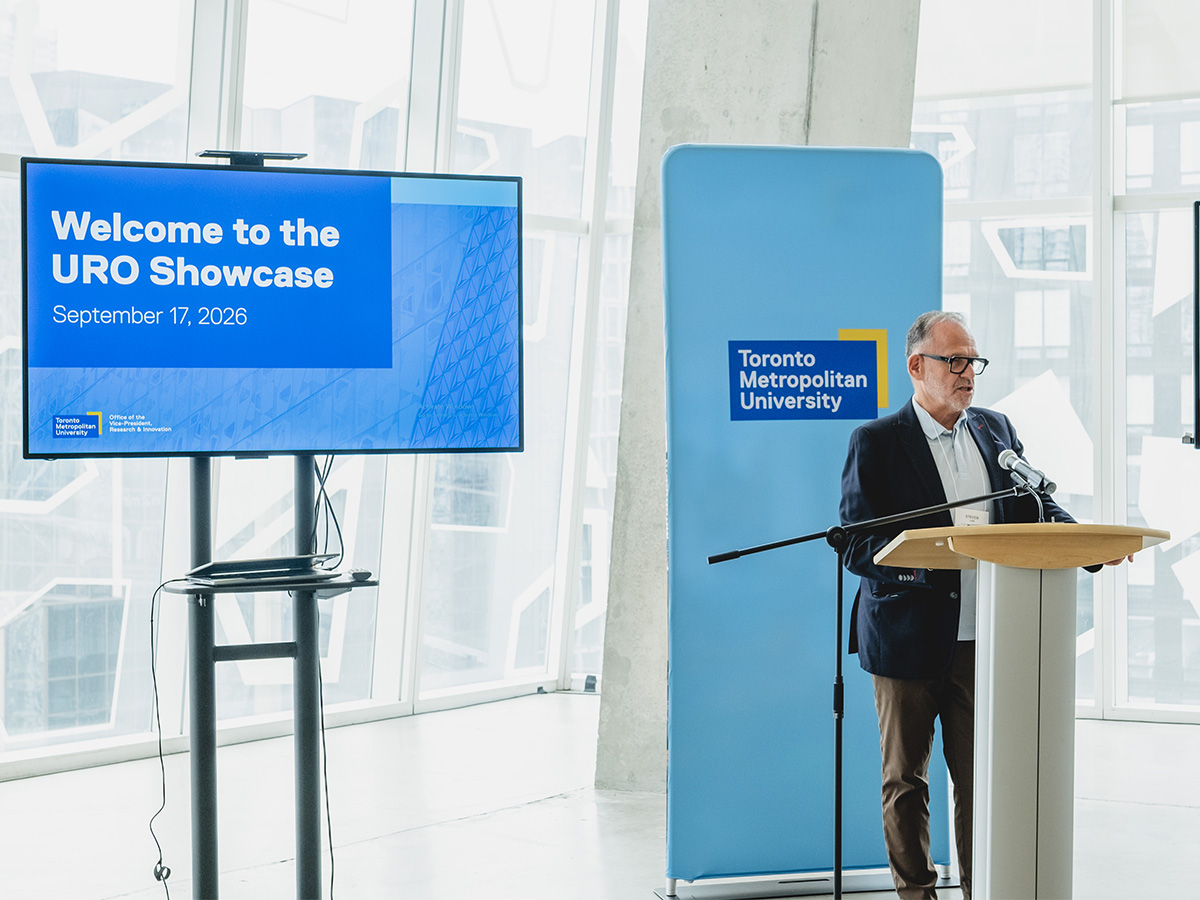
The 2026 Undergraduate Research Opportunities (URO) Showcase, held on September 17 in the Toronto Metropolitan University (TMU) Student Learning Centre, featured more than 55 student research projects from six faculties. The showcase helped students build key presentation and knowledge-translation skills as they presented their scholarly, research and creative (SRC) URO summer projects to students and faculty from across the university.
Student projects covered a wide range of research topics, from creating new construction materials that reduce waste and improving quantum software testing to developing robotic hands for remote surgery and examining the effects of math anxiety on siblings.
“Today’s event is a wonderful opportunity to come together to showcase the excellence of our undergraduate researchers and discuss their ideas and diverse projects,” said Steven N. Liss, TMU’s vice-president, research and innovation, during his opening remarks. “Each poster you see represents not just countless hours of effort, but also the insights and discoveries that contribute to our SRC enterprise.”
Dean of Libraries Mark Robertson praised the participating students for their efforts in contributing knowledge. “Research is about community,” he said. “It’s about participating in an ongoing scholarly conversation, challenging received ideas, building on the work of others and, most importantly, communicating your own findings.”
Since 2019, the Office of the Vice-President, Research and Innovation (OVPRI) has funded the annual, faculty-based, competitive URO program. The 14-week summer program includes poster presentation workshops led by TMU Libraries on key knowledge translation skills and culminates with the URO Showcase. For the third consecutive year, OVPRI funded five TMU students to participate in a program hosted by William Osler Health System, focused on health-related work. Applications for the next URO will open early in 2027.
URO Showcase select projects
Sibling Effects of Math Anxiety on Adolescent Achievement
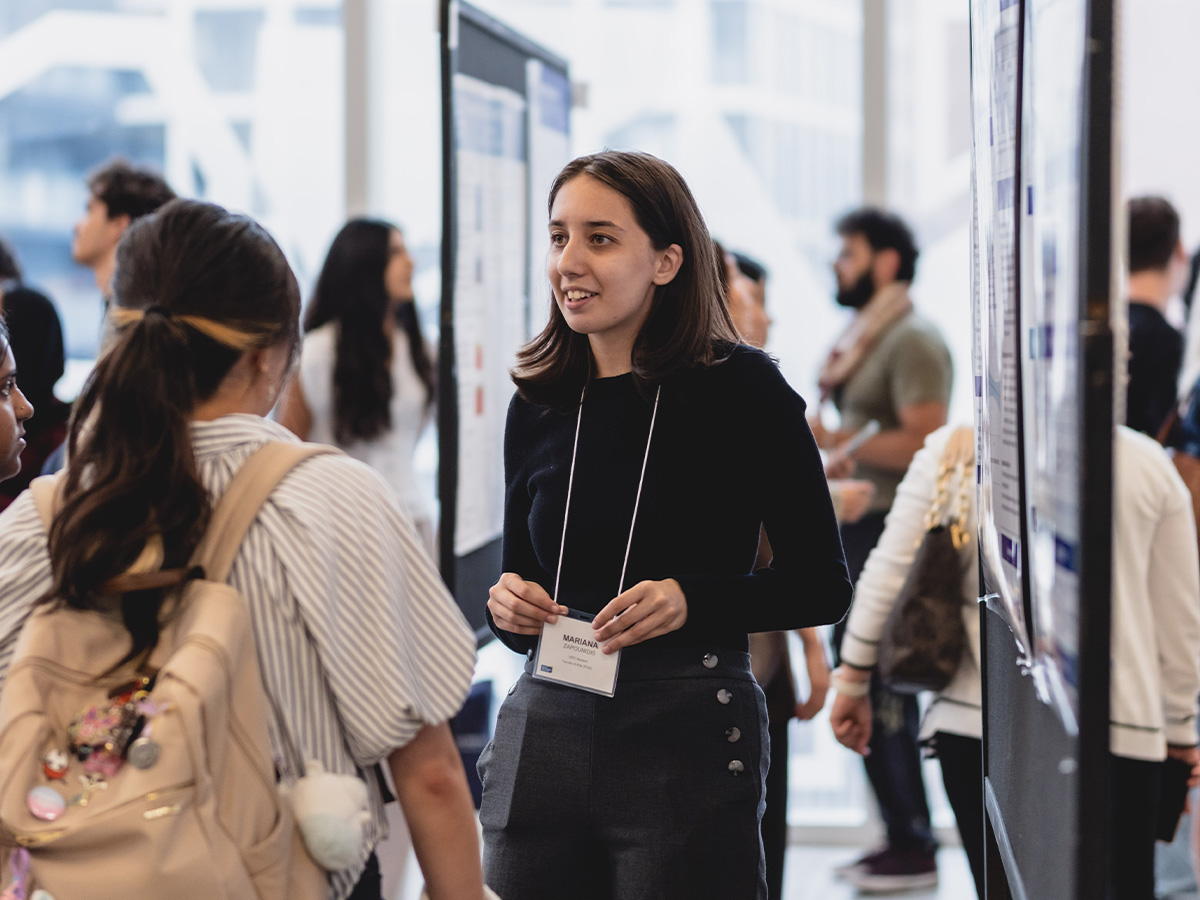
Mariana Zapounidis, who recently finished her undergraduate degree in psychology, worked with psychology professor Ryan Persram to study whether math anxiety is shared between siblings.
Zapounidis asked 76 young teens, all of whom had a sibling within three years of their own age, to rate their math anxiety level on a scale of one to five. Next, the test subjects tried to complete 14 complex arithmetic problems in three minutes, with the goal of measuring math achievement. In the final step, designed to measure math fluency, the teens had three minutes to solve 160 simple questions.
Surprisingly, the results showed that younger siblings who reported math anxiety were likely to perform better at answering the complex arithmetic questions than those who reported lower levels of math anxiety.
“I want to do work that picks this apart even more, because there are a lot of nuances in the sibling relationship that no one has considered before,” Zapounidis said.
Nutrition Care for Hypertension Management: Patient-Reported Education, Registered Dietitian Referrals and Barriers
Understanding whether people with high blood pressure receive appropriate nutrition guidance and specialized support is important toward improving hypertension management.
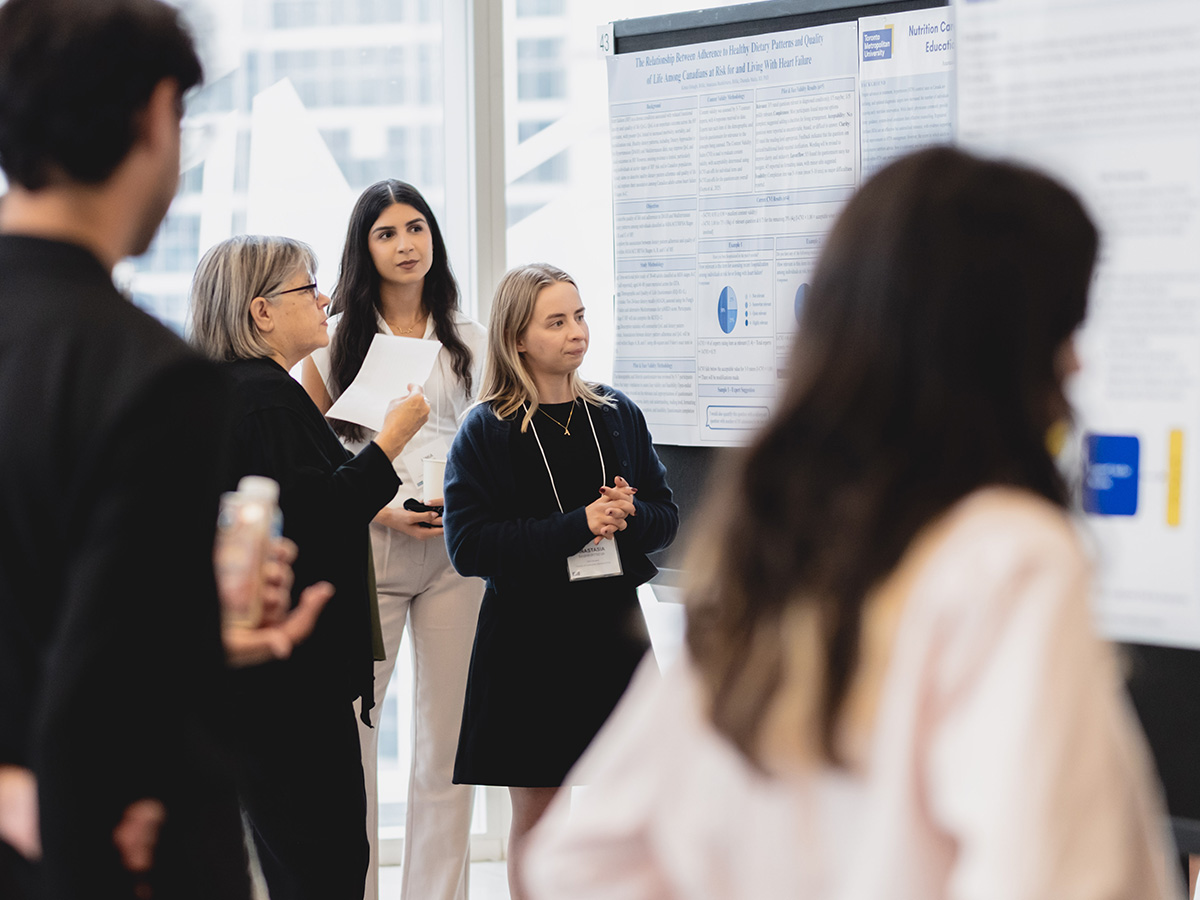
Anastasia Bashkirtseva, a graduate of TMU’s Nutrition and Food program, surveyed 350 participants online to learn whether Ontario adults with high blood pressure received nutrition education from their health-care providers and to identify barriers. Most participants were middle-aged (35–64), female, white and held an undergraduate degree.
The findings revealed significant gaps. Sixty per cent of participants reported receiving no nutrition information from any health-care provider, while nearly 80 per cent had not been referred to a registered dietitian. Of the 71 participants who received a referral, only 15 were referred specifically for blood pressure management.
“Registered dietitians are the experts in the field, so we would love to see more referrals,” said Bashkirtseva, who was supervised by nutrition professor Daniela Malta.
The main barriers to seeking dietitian care were not knowing how to find one, cost and lack of insurance. Bashkirtseva is now reviewing research on health-care providers’ attitudes and barriers to providing nutrition education and plans a national study to see whether these Ontario-specific findings apply across Canada.
Re:Source: Developing Circular Terracotta Composites Through KUKA Robotic Fabrication for Architectural Applications
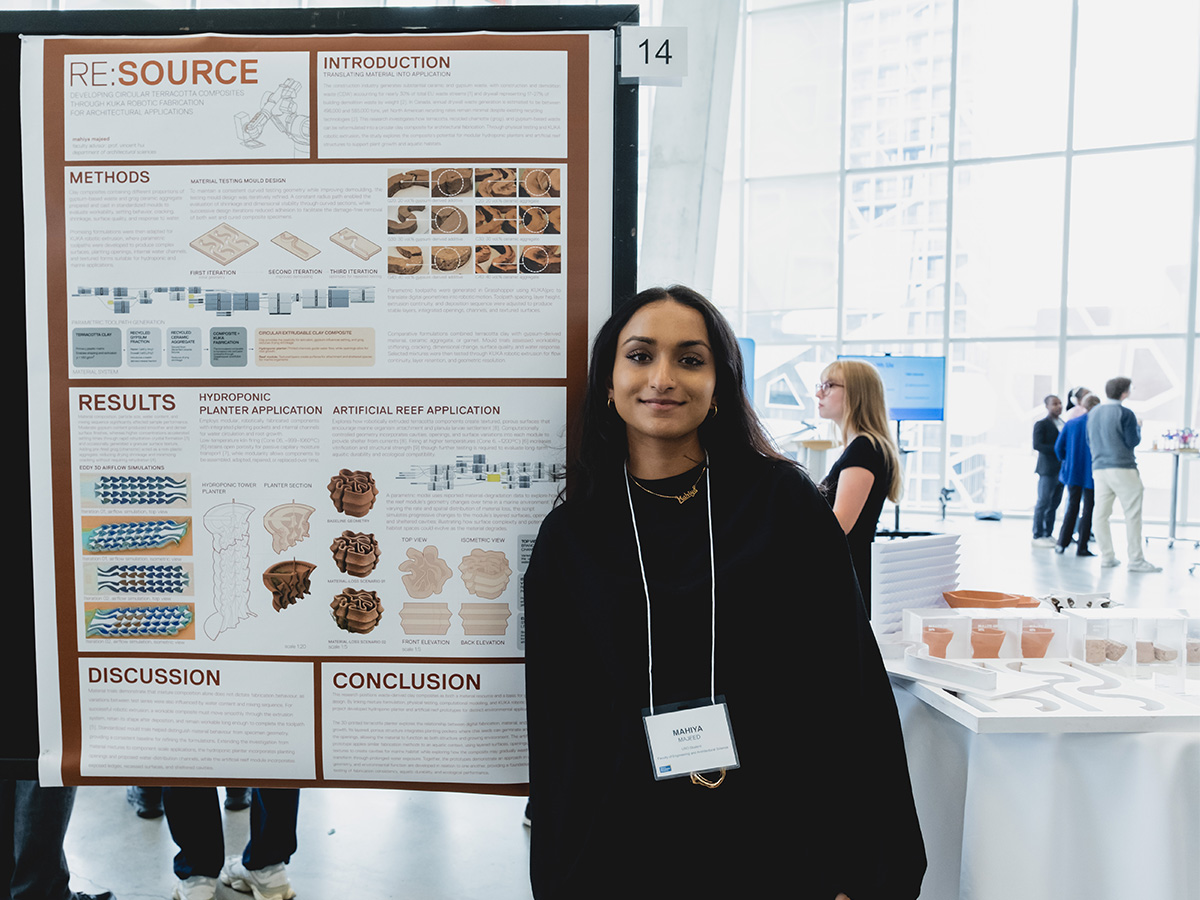
The construction industry generates significant waste. Third-year architectural science student Mahiya Majeed wanted to know whether some of it could be reused to create stronger, more sustainable building materials.
Working with architectural science professor Vincent Hui, she tested how adding varying amounts of ceramic and gypsum waste from drywall and plaster to extruded terracotta, a widely used building material, affected waste-derived clay composites.
In TMU’s Digital Fabrication Lab, the team used robotic extrusion to shape the prepared terracotta composites into custom forms, exploring components that are structurally strong and climate responsive. The approach could also be adapted to simpler machines, such as standard 3D printers.
The findings showed that certain waste materials enhanced the terracotta’s performance, suggesting opportunities for more circular building systems. The research also explored potential underwater applications, including hydroponic planters for year-round plant growth and artificial reef structures to support aquatic ecosystems.
“Through this project, I feel really confident in my design and research skills,” said Majeed. “I’m going to be presenting this project in Spain at the ICERI conference [International Conference of Education, Research and Innovation] alongside global Mitacs students from Hong Kong, Brazil and Taiwan.”
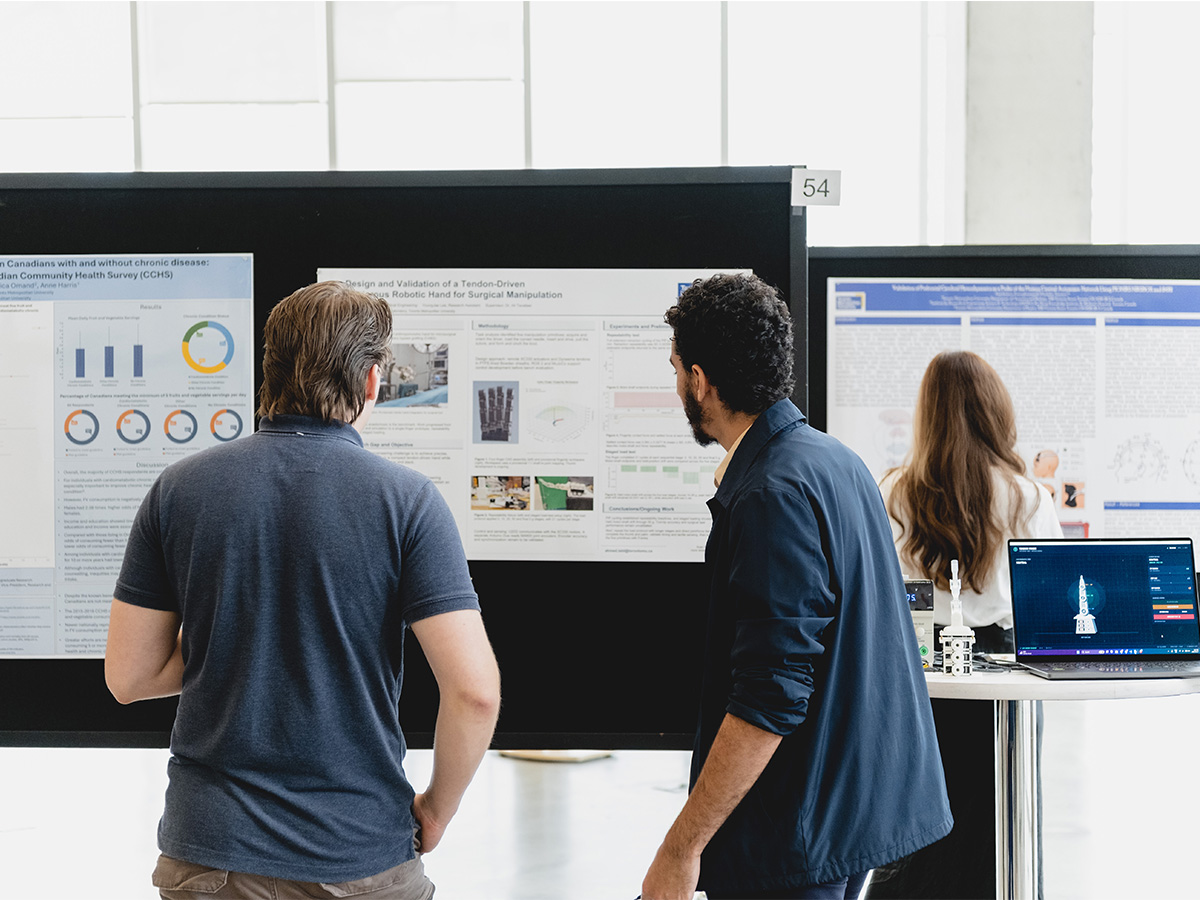
Design and Validation of a Tendon-Driven Dexterous Robotic Hand for Surgical Manipulation
Ahmed Tabl recently completed his undergraduate degree in computer engineering and is now pursuing his Master’s of Applied Science in Biomedical Engineering. Tabl worked with electrical, computer and biomedical engineering professor Ali Tavallaei to develop a robotic hand for surgeons.
“Surgical platforms already exist, but they’re very task-specific,” Tabl said. “The idea we have is more generalization. When you have an almost human hand in the room, you can perform a lot more than just one aspect of the surgery.”
For now, the team built a single robotic finger, with the goal of refining the design before building an entire hand. They tested how much load the finger could handle and checked that its movements remained consistent over 30 minutes. “In the surgical field you want extremely precise movement,” Tabl explained. “For example, an artery has a diameter of about three millimetres. If the hand is drifting over time, you can actually injure the patient.”
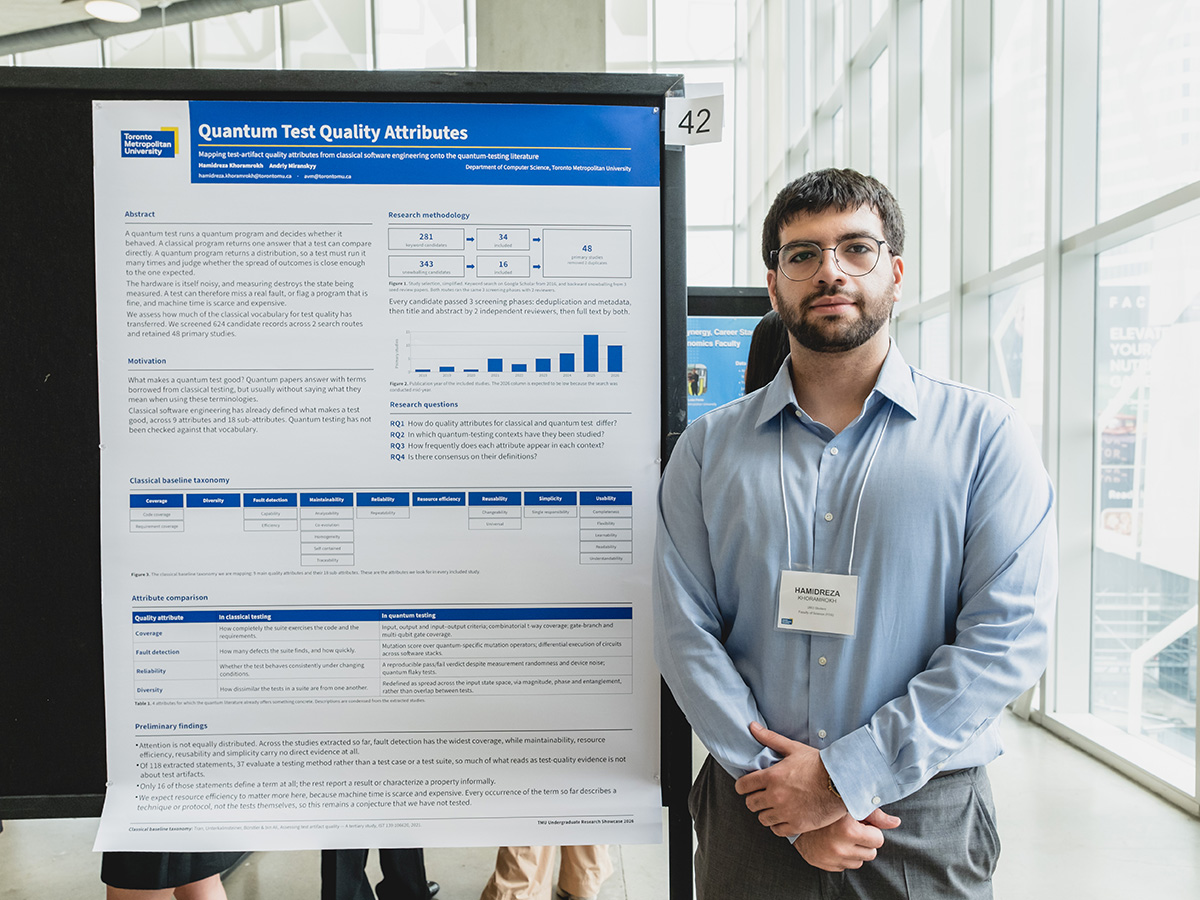
Quantum Test Quality Attributes
As quantum computing advances, reliable, efficient and trustworthy software will be essential to turn its potential into real-world applications. Fifth-year computer science student Hamidreza Khoramrokh is investigating what makes quantum software testing effective and how researchers assess test quality.
Under the supervision of computer science professor Andriy Miranskyy, Khoramrokh reviewed existing research to understand how developers test quantum software and measure its quality. The team aims to bring together current knowledge to help developers evaluate their software and build more reliable, efficient quantum applications.
Early findings suggest that testing quantum software is challenging because it requires significant computing resources and specialized knowledge of quantum physics. This highlights the need for testing methods that are both effective and practical for developers.
“There’s a huge barrier to getting started with quantum testing — you need to understand not just coding, but the physics behind qubits and quantum states, and there aren’t many simple, user-friendly tools to help students and new developers learn,” said Khoramrokh.
By synthesizing existing research, the team hopes to make quantum software testing more accessible and support the development of reliable quantum applications.
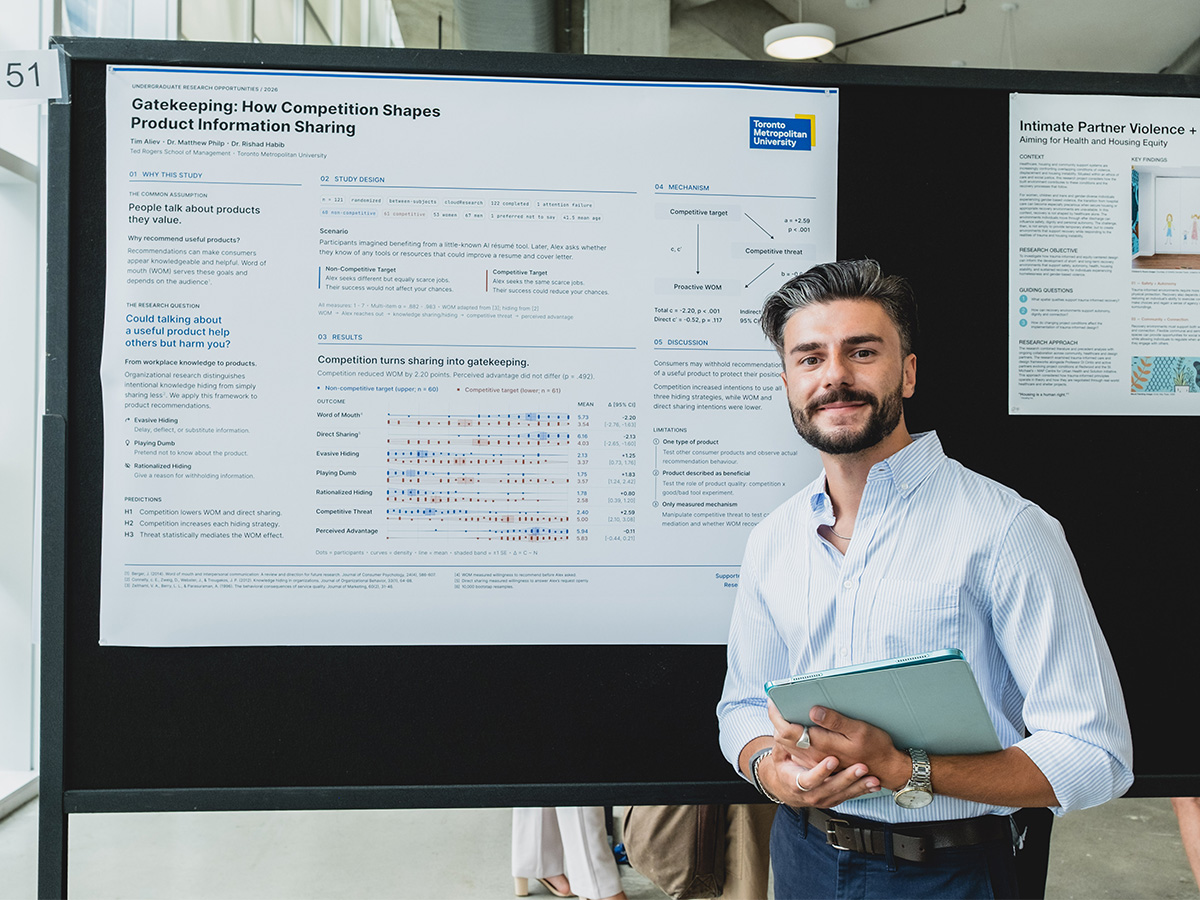
Gatekeeping: How Competition Shapes Product Information Sharing
Most people think of themselves as helpful, willing to share information with others about new products and services. Businesses count on this, because word-of-mouth marketing organically spreads awareness.
Are we all as eager to share as we believe? Fourth-year marketing student Tim Aliev wanted to learn whether people would let others know about a product they viewed as particularly beneficial, especially if sharing the information might lessen their own chances of success.
Working with marketing management professor Matthew Philp, Aliev designed a scenario where 121 people learned about a fictitious AI resume tool. Later, participants were told another job seeker had asked whether they knew of any resources that could improve a resume and cover letter.
“What we found was that in a scenario where you are sharing this product with a person who is in direct competition with you, not only are you becoming quieter but people are actually actively hiding the information,” Aliev said.
The Social World of Sloths
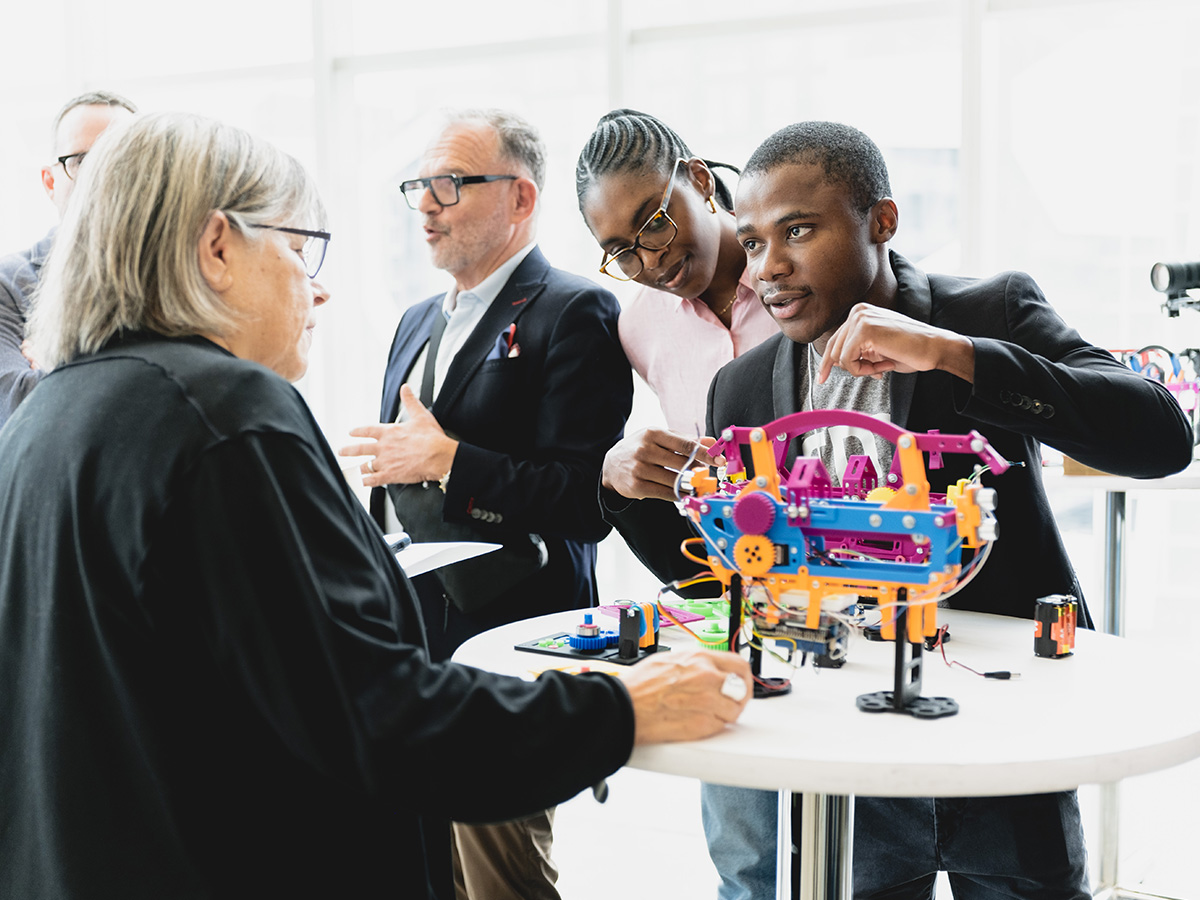
Kelvin Doe, who recently graduated from TMU’s New Media program, spent his summer building robots intended to mimic the behaviour of sloths, the slow-moving mammals who spend most of their lives hanging among the trees.
Under the supervision of new media professor Steve Daniels, Doe went through four iterations of his design, working each time to better duplicate a living sloth’s movements and behaviour. His fourth design incorporated light and sonar sensors so that two robotic sloths could approach each other while hanging from a suspended line, then move apart again.
“It was kind of finicky at the initial phase, so we added a bearing system, which stabilizes the mechanics of the sloth,” Doe said. “In the long term, we also want to reduce its length.”
The sloths are currently battery-powered, but Doe is investigating whether he can power his robotic creatures using renewable energy derived from moss.
Undergraduate students who participated in the 2025 URO Program and their projects
Canadian Citizenship Acquisition for Trans and Queer People from the U.S. as a Strategy for Seeking Refuge from Persecution
Oliver Bullington-McGuire
Supervised by Allison Petrozziello
How Sexual Position and Internalized Homonegativity Shape Body Image Attitudes Among Sexual Minority Men
Jake Cappadocia
Supervised by Trevor Hart
Navigating Multicultural Education in Clinical Psychology Doctoral Programs in North America: Insights from a Syllabi Synthesis
Alexandra Galvao
Supervised by Fiona Thomas
Discrimination, Sleep Health Disparity, and Insomnia in Sexual and Gender Minority Groups
Iqra Islam
Supervised by Colleen Carney
Maintained and Delayed Psychosocial Benefits at a 1-Year Delay Following an
Active Aging Training Program Among Older Adults
Tris Kinder
Supervised by Lixia Yang
Audiovisual Accessibility Study (ASAS): Effect of Mouth Looking on Audio-Visual Speech Perception and Confidence
Kareena Malhotra
Supervised by Brandon Paul
Obscenity to Oppression: Hate and Feminist Legal Reform in Canada, 1970-2017
Allison McCausland
Supervised by Jennifer Tunnicliffe
Policing ‘Hate’ and the Suppression of Palestine Solidarity Protests
Noor Othman
Supervised by Fahad Ahmad
Allostatic Load and Cognitive Function Across the Cognitive Continuum: Evidence from COMPASS-ND
Ilia Salimpour
Supervised by Alexandra Fiocco
Literary Arts Engagement Projects
Michael Savaglio
Supervised by Sarah Henstra
Sibling Effects of Math Anxiety on Adolescent Achievement
Mariana Zapounidis
Supervised by Ryan Persram
Development and Validation of Food Baskets to Measure the Cost and Affordability of Healthy and Sustainable Diets
Katherine Armstrong
Supervised by Jennifer Lee
Nutrition Care for Hypertension Management: Patient-Reported Education, Registered Dietitian Referrals and Barriers
Anastasia Bashkirtseva
Supervised by Daniela Malta
The Relationship Between Adherence to Healthy Dietary Patterns and Quality of Life Among Canadians at Risk for and Living with Heart Failure
Kimia Oshaghi
Supervised by Daniela Malta
Writing Ourselves Creatively: Trans Filipina Women in Contemporary Times
Mikaela Parila
Supervised by Fritz Pino
Journeys of Becoming at the Autism, Gender and Sexuality Nexus
Adeleine Perkins
Supervised by Elizabeth Straus
Inequities in Fruit and Vegetable Consumption in Canadians With and Without Chronic Disease: A Cross-Sectional Analysis of the Canadian Community Health Survey
Madison Stewart
Supervised by Anne Harris
WML Classification
Ahmed Aly
Supervised by April Khademi
CNC-Based Spray Coating Platform for Fabrication of Catalyst Coated Membranes
Mido Elgamal
Supervised by ChungHyuk Lee
Integrated 2D-3D Crack Detection and Georeferencing Using Deep Learning and LiDAR Point Clouds
Omar Elsisi
Supervised by Ahmed Shaker
Image-Based Estimation of Catheter Forces Using Machine Learning
Amir Hossein Halvachi
Supervised by Farrokh Janabi-Sharifi
Re:Source: Developing Circular Terracotta Composites Through KUKA Robotic
Fabrication for Architectural Applications
Mahiya Majeed
Supervised by Vincent Hui
Self-Sensing Property of Carbon Nanotube-based Multi-Functional Composites
Amartya Mishra
Supervised by Anwar Hossain
Nano-Enabled Absorption & Photocatalysis for Water Treatment
Hugo Russell
Supervised by Nariman Yousefi
VR Surgical Teleoperation with Depth Perception and Haptic Feedback
Rayan Shakeel
Supervised by Kourosh Zareinia
Design and Validation of a Tendon-Driven Dexterous Robotic Hand for Surgical Manipulation
Ahmed Tabl
Supervised by Ali Tavallaei
Dexterous Robotic Manipulation with Tactile Sensing
Aadil Tirmak
Supervised by Robin Chhabra
Investigating the Effects of Pile and Piled Raft Foundations
Brighton Zhou
Supervised by Jinyuan Liu
SlicerCineTrack: An Enhanced 3D Slicer Extension for Visualization and Validation of Rigid and Deformable Motion Tracking
Homa Ahmadinoori
Supervised by Elodie Lugez
Laser-Induced Graphene Electrodes for Lab-On-A-Chip Technologies
Lema Amiry
Supervised by Darius Rackus
It’s Hot, and my Genome is Killing Me! Describing How Heat Stress Changes DNA Replication Stability, and Heat Impacts on Cell Health
Matti Co
Supervised by Sarah Sabatinos
On the Existence of Non-Linear All-or-Nothing Transforms
Anantajeet Devaraj
Supervised by Navid Esfahani
Validation of Prefrontal Cerebral Hemodynamics as a Probe of the Human Central
Autonomic Network Using PIONIRS NIRSBOX and fMRI
Amirhossein Foroughianyazdi
Supervised by Vladislav Toronov
Quantum Test Quality Attributes
Hamidreza Khoramrokh
Supervised by Andriy Miranskyy
Analysis of Dnm1 Function in Organelle Fission in Replicatively Aging Budding Yeast
Cells
Aliyah Leano
Supervised by Mojca Mattiazzi Usaj
Investigating the Role of the CitAB/DpiAB Two Component Regulatory System in Virulence Plasmid Stability in Shigella flexneri
Emma Macgregor
Supervised by Joseph McPhee
Investigating the Effect of Ionizing Radiation on the Long-Term Cellular Uptake of Fluorescently-Labeled Dextran in Triple-Negative Breast Cancer Cells
Hovag Mangikian
Supervised by Raffi Karshafian
A Reproducible Security Evaluation Framework for Conflict-Aware Smart-Home
Automation Agents
Sayyada Aisha Mehvish
Supervised by Manar Alalfi
Investigating the Transcriptional Activation of Enteropathogenic Escherichia coli Type III Secretion System Effectors
Paniz Pour Abdi
Supervised by Dustin Little
Beyond Static Guarantees: Measuring the Static-Pass Dynamic-Fail Gap in Security-Sensitive and LLM-Generated Python Code
Jessica Pourleyli
Supervised by Glaucia Melo
From Origin to Adoption: How Country AI Preparedness Shapes Immigrants’ AI Use Intention
Massi Ahmed
Supervised by Sepi Sadeghi and Nancy Yang
Gatekeeping: How Competition Shapes Product Information Sharing
Tim Aliev
Supervised by Matthew Philp
Brain Tumour Detection, Segmentation, and Classification Using Deep Learning
Daniel Dabir
Supervised by Pria Nippak
Beyond Human Perception: Using Supervised Machine Learning to Identify Hidden
Signals of Cooperation in Video-Mediated Social Exchange
Erica Du
Supervised by Mahdi Roghanizad
Assessing the Digital Sovereignty Disparities in Canada’s AI Compute Strategy
Jonathan Lin
Supervised by Linying Dong and Nancy Yang
Comparative Analysis of Financing Costs: Project Financing vs Corporate Financing in Large-Scale Capital Investments
Huy Nguyen
Supervised by Yanfei Sun and Yuanshun Li
Collaborative Authorship Synergy, Career Stage, and Citation Impact Among
Economics Faculty
Luka Panic
Supervised by Sui Sui
Post-Domestic
Thalia Arkuszewski
Supervised by Evan Pavka
Fusibles: Designing 3D tutorials for learning crocheting in VR
Andrea Bobin
Supervised by Ali Mazalek
The Ourobourian Nature of Subcultural Historical Memory
Syd Deneau
Supervised by Kathleen Pierre Adams
The Social World of Sloths
Kelvin Doe
Supervised by Steve Daniels
RUNIK House of Culture. Designing Civic Repair: Repair, Reuse, Memory, and the Unfinished Interior
Simran Dosanjh
Supervised by Viola Ago
AquaProps: Ephemeral Prop-Based Tangible Interactions for Playful Encounters
with an Autonomous Aquatic Robot
Ruslan Galimov
Supervised by Ali Mazalek
Camp“Us:” a Multi-Player Local-Play Game for Enhancing Community and Learning
Madeline Hanitijo
Supervised by Mark Argo
Intimate Partner Violence + Interiors: Aiming for Health and Housing Equity
Rowan Ng-Lew
Supervised by Lorella Di Cintio
From Compliance to Comprehension: Developing a Practical Framework for High-Quality Alt-Text in E-Commerce
Sheilae Siagian
Supervised by Reem El Asaleh
Mapping the Interdisciplinary Performance Landscape: Creative, Academic, and Community Needs for Incubation in Toronto
Sydney Walker
Supervised by Owais Lightwala