TMU School of Journalism launches season 4 of award-winning student-made podcast
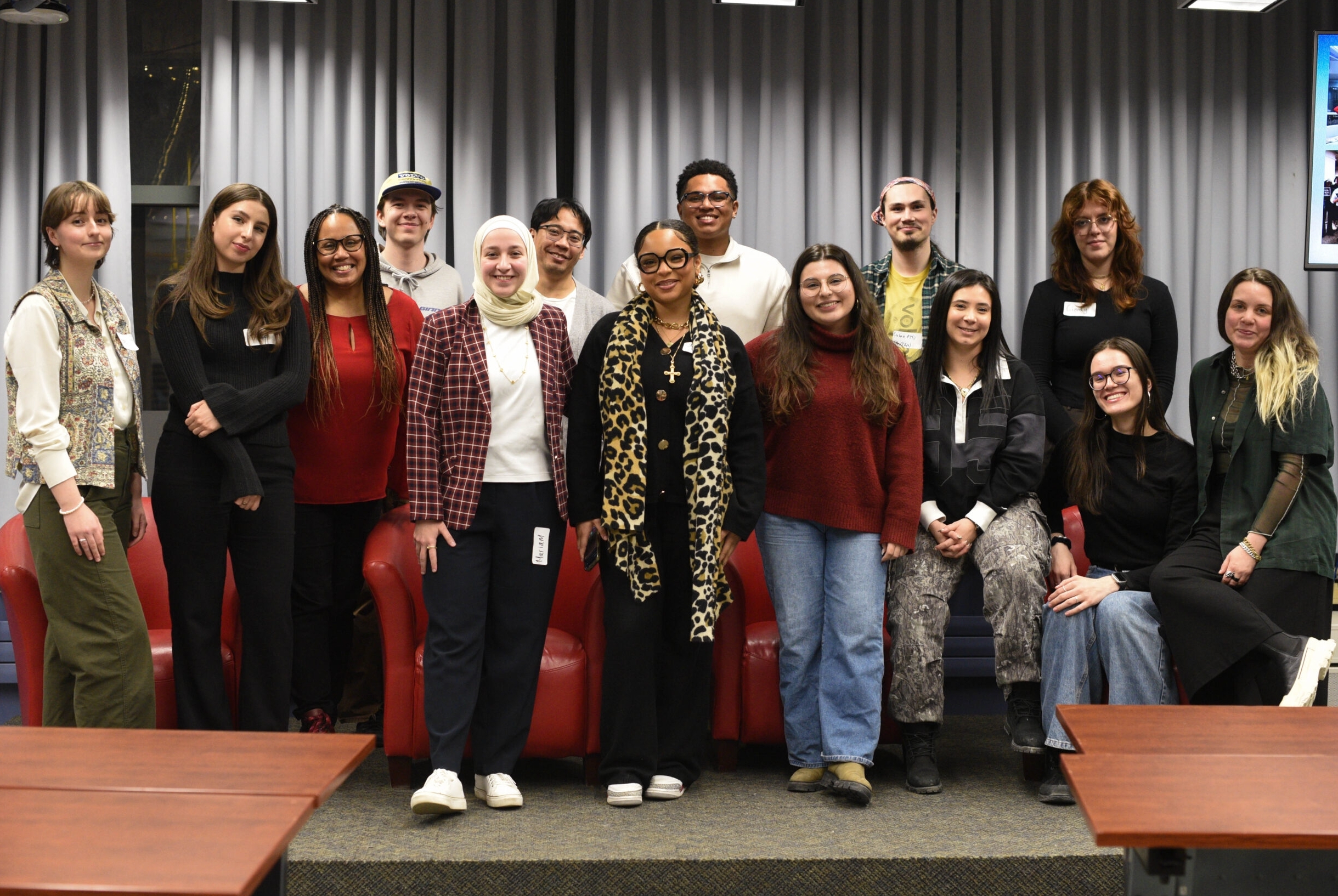
Toronto Metropolitan University (TMU) journalism students are taking on new challenges with the launch of season 4 of We Met U When (external link) …, a podcast that tracks down people from past news stories and explores how the journalism industry can do better.
Administered by the TMU Centre for Excellence in Learning and Teaching, the Learning and Teaching Grant (LTG) is funded by the Office of the Provost and Vice-President, Academic. The grant supported We Met U When… throughout the production process, including bringing in Steph Colbourn in the role of story editor. Colbourn is the founder and CEO of editaudio (external link) , a queer-led podcast company with a queer, woman, non-binary and trans team that specializes in uplifting voices that are often excluded. The grant also helped compensate community advisors for their expertise and guidance covering underrepresented communities.
To commemorate the new season, student producers, interviewees, industry professionals and journalism professors attended a launch party — a lively space to listen to the published episodes and soak in the hard work and effort students had put into each one.
[My co-producers and I] couldn't stop smiling. We're so stoked with how well it turned out,” said fourth-year journalism student James Bunga. “And it definitely started off sort of shaky. We weren't that good at narrating or adding music and cutting it together. So I think to hear the final version, where everything sounds really, really well mixed and mastered, was really special.”
Second-year master of journalism student Ariel Tozman co-produced Episode 4: Give Me 15 Minutes (external link) with classmate Sonia Goloubev. It highlights the work of DJ and competitive athlete George Quarcoo (also known as GQ Soundz) and his experiences talking to journalists.
Throughout the weeks leading up to the release date, she sought guidance from community advisor Michelle McQuigge, who is CEO of BALANCE for Blind Adults and a former Canadian Press journalist. McQuigge visited the class to discuss respectful ways to cover stories that involve people with disabilities.
“She encouraged me to think about how just because somebody has a platform does that really mean that they're in a position of power?” Tozman said. “If we’re thinking about the intersection of power and accessibility, what does that signal?”
One of the key takeaways from this discussion was fostering a solid relationship with sources. For Tozman, her connection with Quarcoo is one that she values. She has translated that to the production process, allowing her to produce the episode with a stronger level of care and attention to detail.
“The value of patience is important and spending a lot of time getting something right, rather than rushing into something and getting it half right and probably a little wrong,” Tozman said.
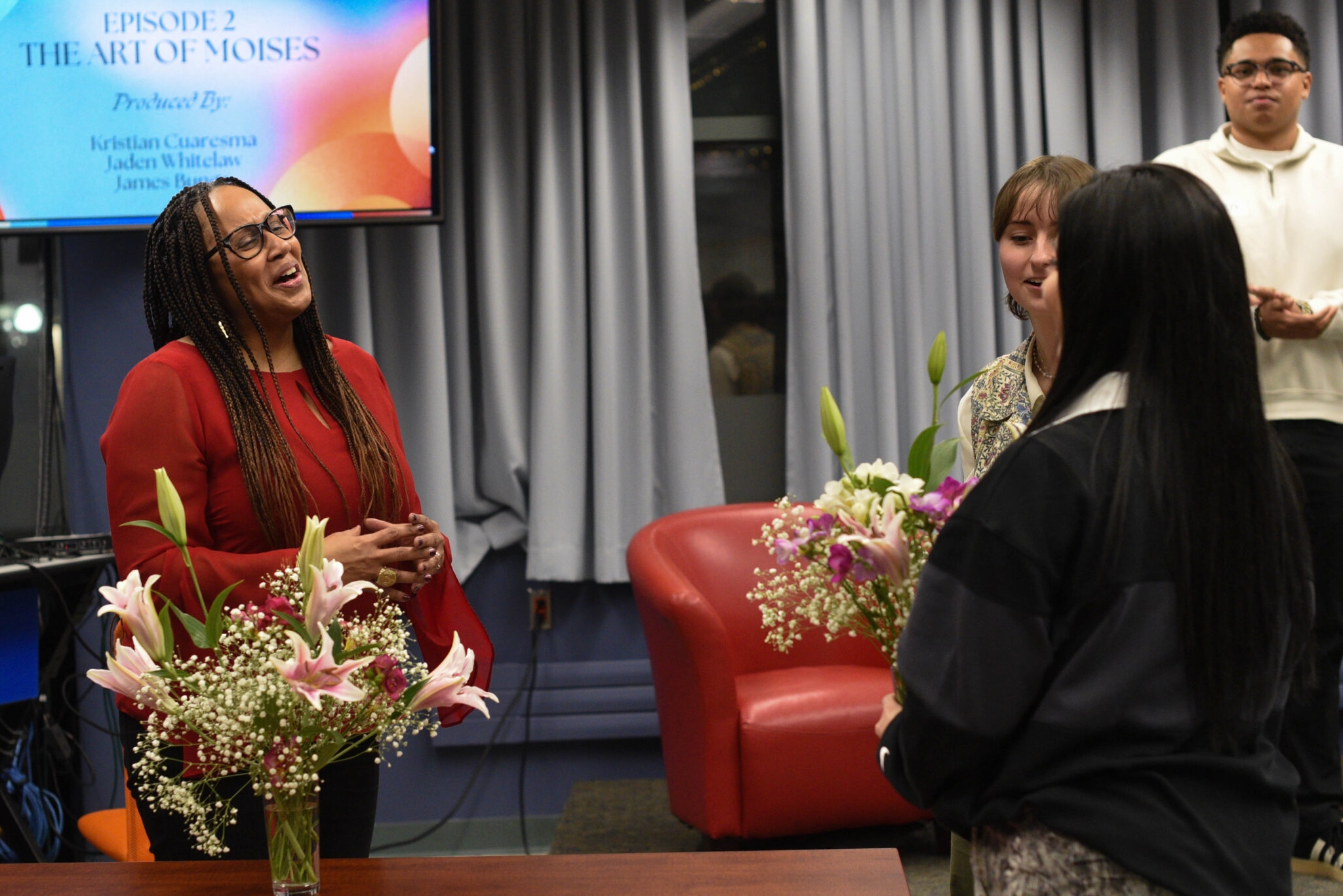
Professor Shari Okeke speaking with community advisor Gabrielle McMann (photo by elisejacob.com (external link) )
In the JRN 801/JN8407: Advanced Podcasting and Radio Documentary course, assistant professor Shari Okeke supports students to collaborate with each other to produce episodes of this documentary-style podcast. The course provides student journalists hands-on experience: recording interviews in the field, recording their own voices in studio, learning about sound design, and mixing audio to produce a complete episode.
The course emphasizes the importance of examining experiences that interviewees had with journalists in the past while also working hard to amplify underrepresented voices.
With four seasons produced, We Met U When… student producers are achieving success in and out of the recording booth – nationally and internationally.
Second-year master of journalism student Mariela Torroba Hennigen’s season 4 episode called Maybe I Can’t Do This? (external link) just won a 2026 Gracie Award from The Alliance for Women in Media (external link) in the U.S. in the student digital media category of podcast host.
She examines harassment faced by women journalists and reflects on her feelings about becoming a journalist at this time. The Gracies recognize exemplary programming created by women, for women and about women in all facets of media and entertainment. Other 2026 winners include Oprah Winfrey, Tina Knowles and Monica Lewinsky.
And the first episode of season 4 Schooled by Sekou (external link) also won an international award: 2nd Prize in the Student Audio – Narrative Audio Competition at the 2026 Broadcast Education Association (BEA) Festival of Media Arts. (external link)
The students who worked on the third season recently won a prestigious national award: Silver Prize at the Canadian Online Publishing Awards (COPA) for Best Podcast - Academic. (external link)
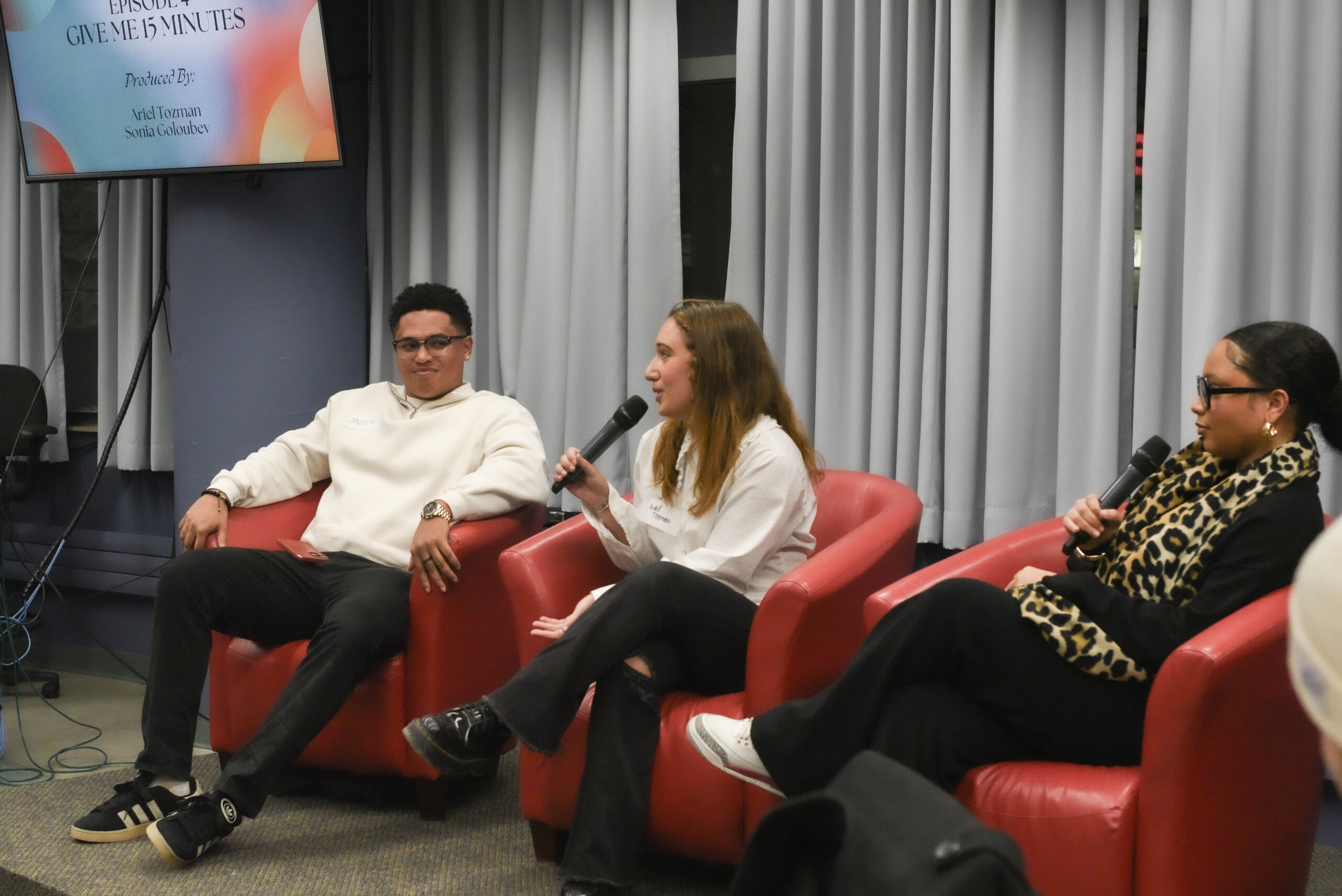
Ariel Tozman speaking at the Season 4 listening party (photo by elisejacob.com (external link) )
As a long-time listener of various podcasts, James Bunga initially took the JRN 306: Radio and Podcasting Workshop course to familiarize himself with the basics of audio journalism. The prospect of developing an entire episode from the ground up piqued his interest, inspiring him to take JRN 801 this year.
Bunga co-produced Episode 2: The Art of Moises (external link) . This episode takes listeners on a journey with graffiti artist and mentor Moises Frank (also known as Luvsumone or Luvs) who shares his passion for art. Frank also shares how he navigated loss, grief and his mental health.
To get the full scope of Frank’s story, Bunga and his co-producers Kristian Cuaresma and Jaden Whitelaw gathered audio from the unveiling of Frank's mural outside the Weston GO train station and to get the best quality sound they recorded the interview inside a janitor’s closet. Bunga expressed how important it was to immerse himself in the story and relay that dedication to the listeners.
“There were a lot of late nights doing the edits, doing the script writing to make everything really, really good. I have no idea how many different drafts we had by the end. The end of it was definitely pretty hectic with getting everything finished, but well worth it,” Bunga said.
With many sessions spent in the editing suite patching things up and re-recording different parts, Bunga appreciated the support of his fellow producers.
“It was really fun to set up to do something really ambitious and really challenging, but not going about it alone knowing that we had our teammates who had our backs and everything, and could give us feedback and could help us out,” Bunga said.
It was really fun to set up to do something really ambitious and really challenging, but not going about it alone knowing that we had our teammates who had our backs and everything, and could give us feedback and could help us out
Mariam Kourabi, a second-year master of journalism student, was hard at work juggling her roles as this season’s host and one of the co-producers of the fifth episode.
With that episode about to be published soon, Kourabi reflects on the advice of community advisors Gabrielle McMann and Na'kuset. Gabrielle McMann, who is mixed Ojibwe from the Mississaugas of the Credit First Nation, is a 2025 journalism graduate and the recipient of 2026 The Local Fellowship. Na'kuset, who is Cree from Lac la Ronge, Saskatchewan, is the executive director of the Native Women's Shelter of Montreal. They both helped the student producers in many ways, from answering questions, providing guidance, reviewing scripts, and offering best practices to report on Indigenous communities.
“[The advisors] really guided us throughout. I think without their support and without their kindness of knowledge sharing, I don't think we would have been able to put together what we did,” Kourabi said.
Kourabi is grateful she got the opportunity to contribute to the podcast and learn from so many people.
She recommended that anyone who is considering taking the course should keep an open mind and welcome challenges they may come across.
“To be able to gain all those pros you have to spend time, you have to put in hours, and you need to be prepared to actually want to learn and want to be challenged. Otherwise you're not going to come out with the full set of lessons that this class does offer,” Kourabi said.