TMU climbs the ranks in global computer programming competition
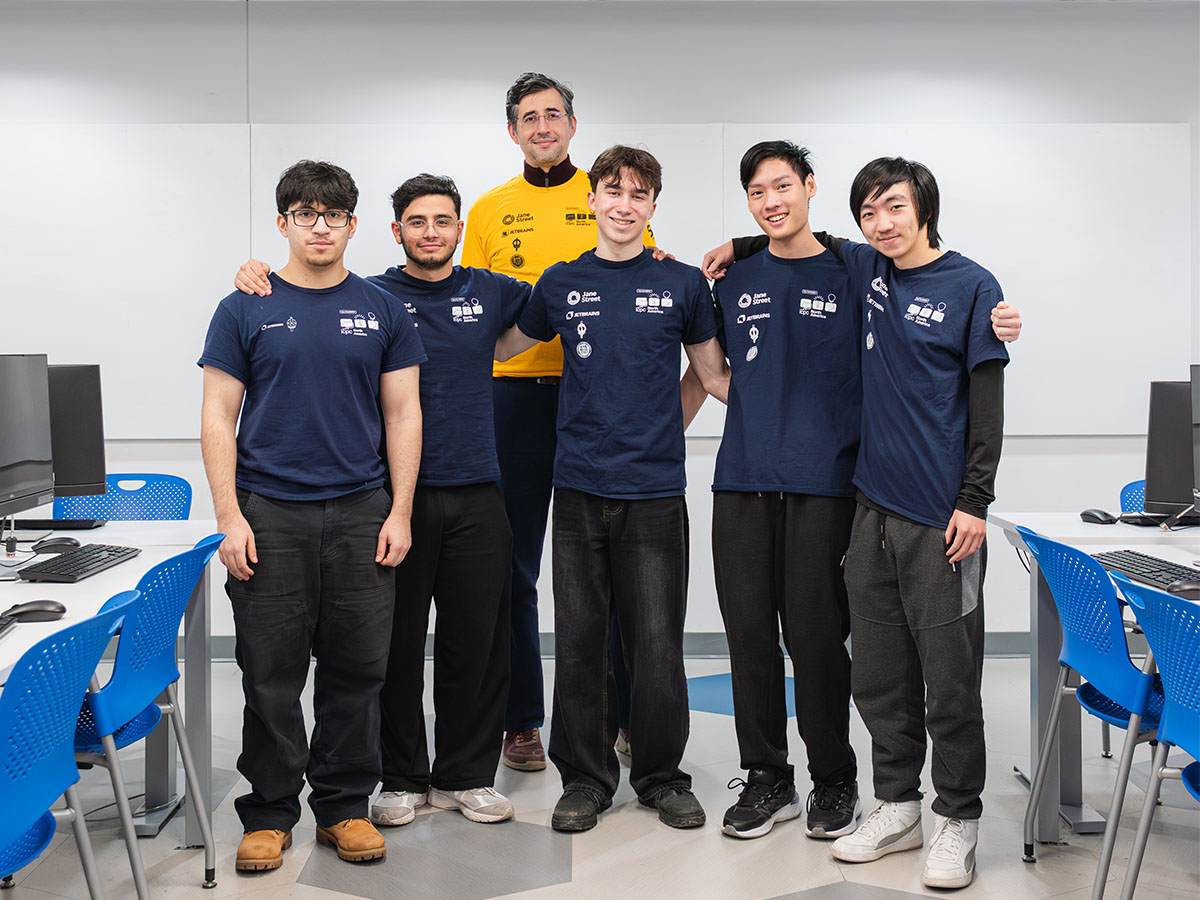
TMU is poised to become one to watch at the annual International Collegiate Programming Contest (ICPC), the world's oldest and largest global university-level programming competition.
Six TMU undergraduate computer science students, including fourth-year student and longtime competitor George Zhang, were among two teams sent to this year's East Central North America regional event in Windsor. Joining over 500 competitors from 182 teams, the students attempted to solve complex geometric, mathematical, and other computing challenges described in everyday scenarios. The problems must be solved within a time limit, demonstrating not only coding skills but also teamwork in determining the best approach. This year, TMU's Team Blue solved nine problems and ranked 13th among 86 teams, while Team Gold solved five problems and ranked 38th, for a total university ranking of seventh, third among Canadian universities.
The view from the coding keyboard
But what did the win feel like? Just ask Zhang, and he'll take you courtside with the TMU Blue Team: four hours and thirty minutes into the five-hour competition, he and teammates Peter Ton and Dennis Kaydalov are already seven problems into the set of 12. The leaderboard, typically updated with each team’s solved problems, has been frozen to add suspense to the final hour. Every team is eying what problems others have solved as a clue to which might be their next best bet. In the last six minutes, Team Blue figures out a new approach to one of their outstanding problems and solves it. Even more unexpected is the final problem, which they revisit and solve in the last two minutes of the competition.
“I just remember, after solving the one in the last six minutes, I was really happy. But after the one in the last two minutes? I was like, ‘Oh my God.’ My hands were shaking. It was a really memorable experience,” says Zhang. The excitement had come full circle, as TMU Blue was among the handful of competitors to solve the first problem in three minutes.
Zhang, who is also president of the Toronto Metropolitan Algorithms and Coding Club (external link) (TMACC), is a longtime participant in these competitions, having started entering them with his high school coding club. Now, as TMACC president, he’s eager to get more students involved and grow the club.
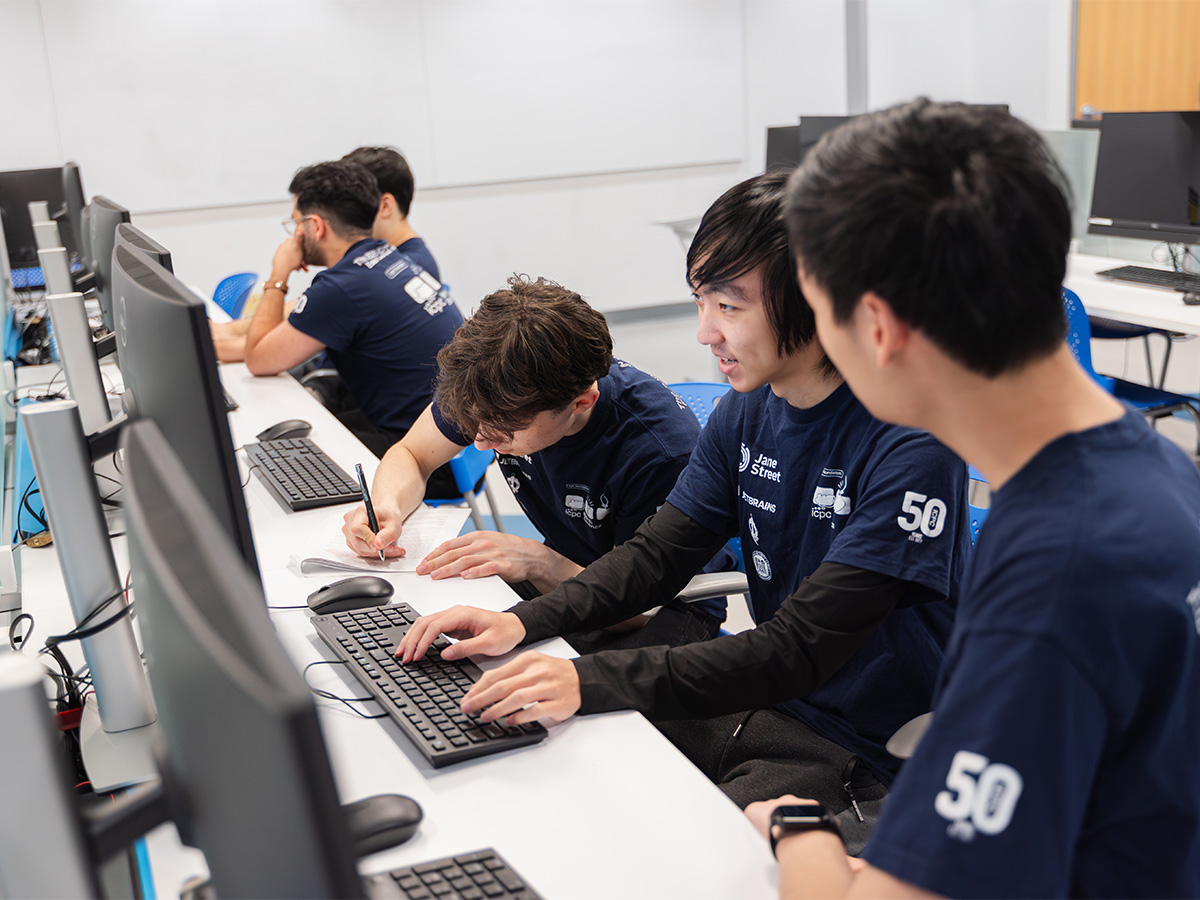
The TMU Blue and Gold teams practiced weekly in the George Vari Engineering and Computing Centre computer labs before the competition. George Zhang, pictured second from the right, types out possible solutions as he works with his teammates to solve a practice problem.
A new faculty coach boosts game
Led by coach and computer science professor Navid Nasr Esfahani, the teams have gotten a huge boost. Esfahani himself was motivated to coach the ICPC teams by his own positive experience with the competition as an undergrad. He offered to coach the team over the past year, holding weekly practices and coaching the players to work in teams, a routine that has already paid off.
“I'm really proud of both our teams,” says Esfahani. “They improved significantly since last year. As we go forward, we hope to have this pipeline of teams where in first year, they learn about the environment and practice, second year, they compete and do better, and the same with the third year. This year, they have already been working more systematically, with regular contests, practicing more intensely and as a team. Hence, they got really good results.” In addition to Team Blue’s performance, Team Gold, composed of Zachary Toye-Nakamura, Arshia Zakeri Rad and Habib Rahman, also achieved a higher ranking than last year.
Beyond the fun of competition, ICPC also offers the practical benefit of helping students hone skills that will benefit their careers. Teamwork and collaboration are at the top of the list. “Engaging with others, sharing ideas, you learn about different ways to look at the problem,” says Esfahani. “They learn how to program efficiently and practice writing code with as few errors as possible. That is what most companies test in their candidates, so these are all very helpful later on for them when they want to go to the job market and do interviews.”