A New Horizon for Climate Justice

Prof. Campbell-Duruflé’s research focuses on the role of law in responding to pressing global challenges including climate change.
Christopher Campbell-Duruflé, Assistant Professor at the Lincoln Alexander School of Law, originally planned to be a human rights lawyer. After completing his LLM, he interned at the UN Human Rights Office in Geneva and worked for the Inter-American Commission on Human Rights in Washington, D.C.
In the years that he worked on cases involving discrimination by security forces, wrongful detention of migrants, and Indigenous rights violations, major reports began to warn that climate change could provoke a regression in human rights - such as the right to health and the right to life - on a scale that would “be much worse than the worst dictator.”
With the protection of human rights remaining his core motivator, Campbell-Duruflé pivoted to climate change. He completed his SJD and post-doctorate in climate law before joining Lincoln Alexander Law in 2022. Today, his work centres on climate justice, an emerging concept in law. “Climate change is the problem,” Campbell-Duruflé explains. “Climate justice is the solution. It offers a more constructive and more hopeful way of thinking about the climate emergency.” Climate justice frames the issue as one of equity, politics and law, rather than simply an environmental or technological one.
His work explores, among other areas, how the law can allow different actors to hold states accountable for failing to adequately respond to climate change - for example, how municipal climate emergency declarations can translate into transformative policy action, and the extent to which the International Court of Justice can enforce measures in pursuit of climate justice.
“It’s the all-hands-on-deck approach that we need,” says Campbell-Duruflé, who notes that climate justice can come through legal frameworks at the municipal, provincial, national, and international levels, as well through the laws of Indigenous peoples. Campbell-Duruflé will serve as the guest editor for a special upcoming issue of the PKI Global Justice Journal (published by Queen’s Law), which will focus on assessing how climate justice is defined in different contexts and reflected in concrete cases.
Over and above urging governments to pass evidence-based policies and enforce environmental protections, Campbell-Duruflé says litigation is key to climate justice. As an example, he cites Mathur v. Ontario, a legal case involving young people who argued the provincial government’s repeal of stronger climate targets violates their Charter rights to life, security, and equality. In October 2024, the Ontario Court of Appeal overturned a previous dismissal of the case. “Litigation is really important, because climate change has become politically divisive. We saw how the U.S. joined the Paris Agreement under Obama, withdrew under Trump, joined again with Biden, and then withdrew again under Trump,” he says. “Judges have the autonomy, the independence, and the rules-based mandate to give answers that go beyond political cycles,” Campbell-Duruflé says.
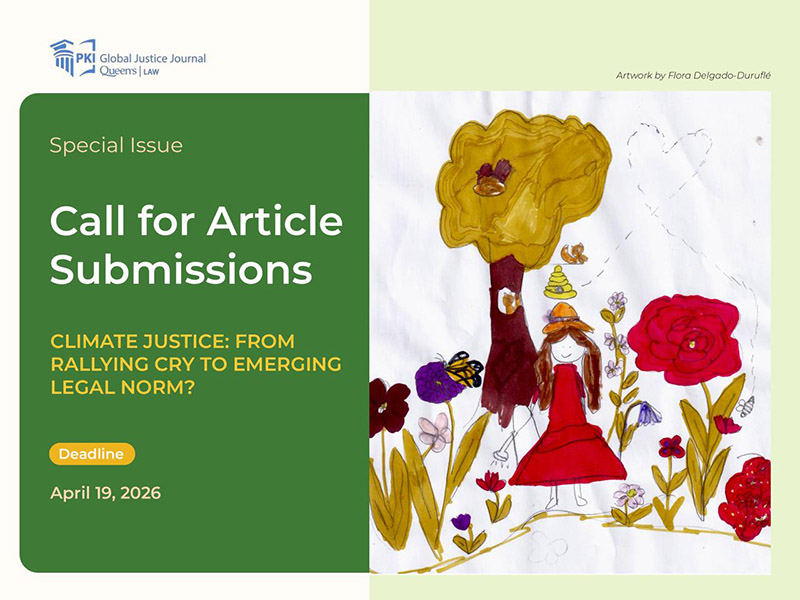
Campbell-Duruflé will serve as the guest editor for this special climate-related issue of the PKI Global Justice Journal (Queen’s Law). (Submissions will be accepted until April 19, 2026.)
Inspiring the next generation of lawyers with real-world climate justice challenges
Campbell-Duruflé encourages his students to see how legal advocacy can lead to transformative change, even if that impact isn’t immediate.
He recently published a paper on the International Court of Justice’s advisory opinion on climate change, which affirms that states have a stringent due diligence obligation not to cause harm to the global climate system. The origins of that opinion, he explains, can be traced back to a group of law students at the University of the South Pacific who campaigned at the Pacific Islands Forum to advance the ICJ request. “The fight began with a group of students in a classroom much like mine and grew into a clear opinion that is now trickling back into domestic contexts, as we consider, how can this be applied in Canada?”
He adds that this kind of legal development is iterative. “The next time there’s a court hearing in a climate case like Mathur, judges will look to the ICJ advisory opinion and to regional human rights systems. There’s an ongoing dialogue between the judiciary of all countries that also moves back and forth between the local and the global level.”
Campbell-Duruflé invites his students to engage in this dialogue with real-world assignments. For example, in his Class Actions class, he partners with the non-profit Ecojustice Canada to answer specific confidential questions on points of law that are relevant to the non-profit’s work, Campbell-Duruflé explains. The students research the questions in different groups and write legal memos in response. “It becomes more than an assignment. They really care about providing the best legal answer possible and so do I,’ he says.
For his Climate Change and the Law course, students are tasked with identifying legal arguments to make the case to the TMU administration for a climate justice-centred approach for the new law school building, at 277 Victoria Street. “The students have been inviting various guests to our classroom to help inform their memos, including a climate design firm, the energy manager from TMU’s Office of Sustainability and staff from TMU’s Urban Farm,” he says.
Veronica Kiang, a third-year law student and research assistant for Campbell-Duruflé, has learned how to apply sustainability to various concepts of justice - from public health law to Indigenous rights. She also appreciates the way Campbell-Duruflé connects these concepts to local communities. “Areas like Scarborough have less soil permeability, which means they’re more prone to flooding, and they have less green space,” she explains. “Prof. Campbell-Duruflé helps us to understand that climate injustice exists everywhere.”
Grace McColl, a third-year student at Lincoln Alexander Law, says “getting to work on real matters in law school has been a game changer. Working with Ecojustice Canada, rather than having a fictional client or scenario, has been meaningful because the work they do is so impactful. It pushes us to engage more deeply with the case law and pay closer attention to the legislation,” she says. “Prof. Campbell-Duruflé really inspires students by showing us that climate justice isn’t too big for us, as aspiring lawyers, or for the courts, to take on.”
The inspiration goes both ways. “My students ask insightful questions about how the Charter works and about how climate law works – it’s clear that they want to work for their communities and work for people who are at risk of suffering from the climate emergency,” he says.
Campbell-Duruflé is also motivated by the activists and lawyers who have brought climate cases forward, with increasingly promising outcomes. When he first started in climate law in 2012, he remembers feeling like “it was impossible to litigate climate change. It felt like trying to fit a square peg in a round hole,”
But now, “the fact that courts and litigants have had the courage to bring cases forward gives me a lot of hope. I would compare it to previous watershed moments in Canada, like the recognition of marriage equality or the clarification of the rights of Indigenous peoples to free, prior, and informed consent. Once this happens again with climate litigation, a new legal consensus will be formed to reflect the demands of a major social movement, and this will open up a new horizon for solutions.”