Prof. Effoduh empowers law students to tackle TTC fare evasion
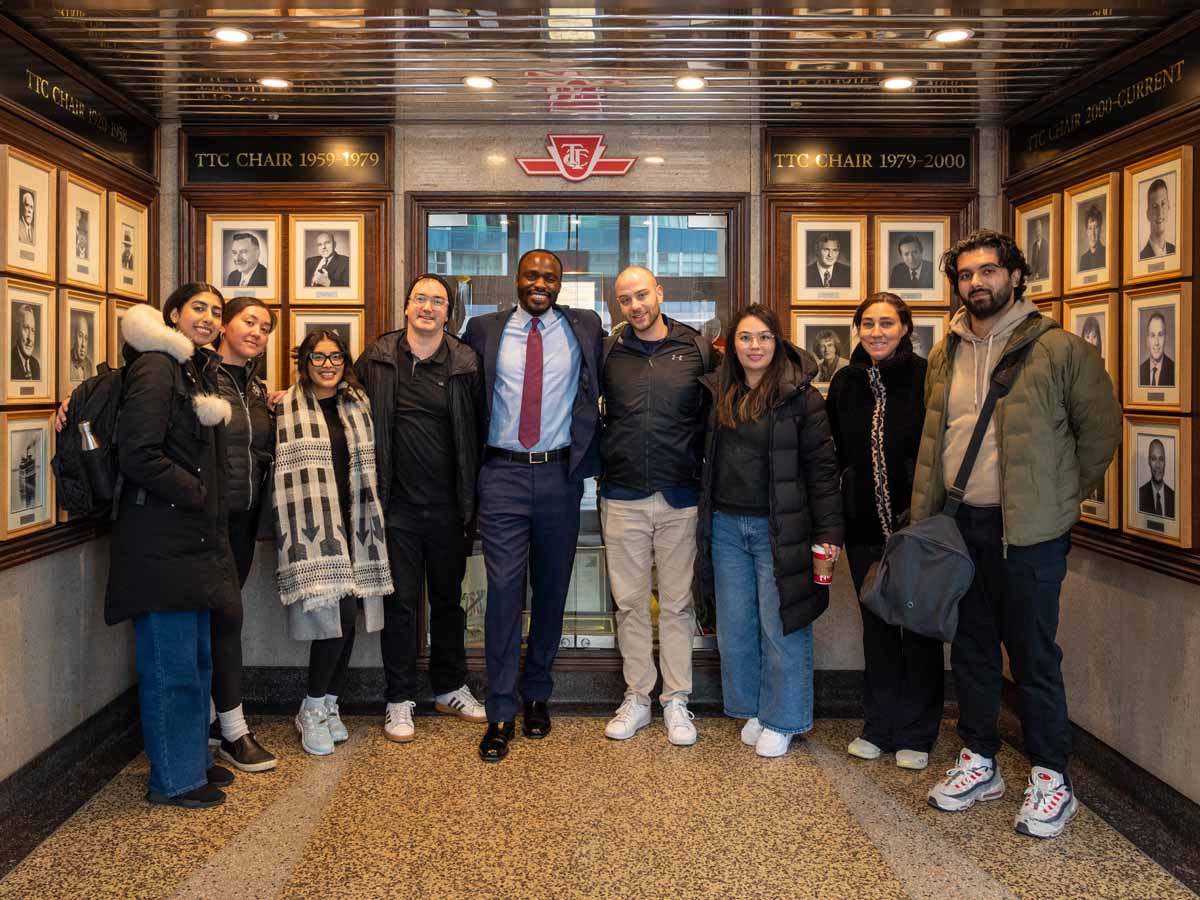
Under the guidance of Prof. Effoduh (pictured at centre), Lincoln Alexander Law students pitched their bold solutions to senior transit officials at Demo Day, which was held on March 24, 2025.
Transit fare evasion raises questions about equity and fairness, as well as concerns over technology and privacy, and the effectiveness of law enforcement practices. Described as a 'wicked problem' due to its complex and multi-dimensional nature, Jake Okechukwu Effoduh, Assistant Professor at the Lincoln Alexander School of Law, sees fare evasion as an ideal opportunity for law students to apply their learning.
When Effoduh reached out to the Toronto Transit Commission (TTC), suggesting his students propose potential solutions, the TTC welcomed the opportunity to bring in new perspectives. About 40% of the TTC’s revenue is generated from fares, a higher proportion compared to many major cities that receive more generous government subsidies. According to a TTC compliance study, approximately 12% of fare revenue is lost because people don’t pay. Examples of fare evasion include bypassing gates, using a child’s pass as an adult, or entering a bus or streetcar without tapping with a payment card. But addressing the issue is tricky – the TTC doesn’t want to unfairly target low-income people with hefty fines – and it’s too costly to have inspectors at every gate.
The collaboration began with Effoduh and students from his Technology, Law and Society class visiting the TTC’s Head Office. There, they met with representatives from the payments, enforcement, and technology design teams and were invited to review internal data and policies. They examined questions such as: “Which parts of the city see the highest rates of fare evasion?”, “What insights can be drawn from the demographic data?”, and “At what times of day is fare evasion most common?”
Over the next four weeks, students analyzed the data and relevant laws to develop practical solutions. Law student Aliesha Arndt expressed that the exercise pushed her to think critically about how to stay true to her values as a lawyer when choices are limited. “I’m generally anti-enforcement,” she explains. “Especially when it comes to young people, I’m very opposed to having them interact with the courts in any way.” Her proposed solution would temporarily deactivate a PRESTO card after fare evasion, with a 24-hour suspension for the first offence and progressively longer suspensions for repeat offences. The solution: encourage compliance without burdening the courts.
For Arndt, the experience challenged the notion that fare evasion can be addressed with a simple, tech-based fix. “There are administrative law questions, like ‘What is the appeal mechanism?’ There are also privacy and property law concerns, and one must consider the Youth Criminal Justice Act,” Arndt notes. “It really falls on the lawyer to consider the different areas of law that are implicated and conduct a thoughtful analysis.”
The project culminated at a Demo Day where students presented their solutions to senior transit officials from the TTC, Presto and Metrolinx at the Centre for Urban Innovation. After each presentation, the judges interrogated the proposed solutions, posing challenging questions like, “What if an individual gets flagged wrongly due to a glitch in the facial recognition software?” and “What about the potential for data theft?”
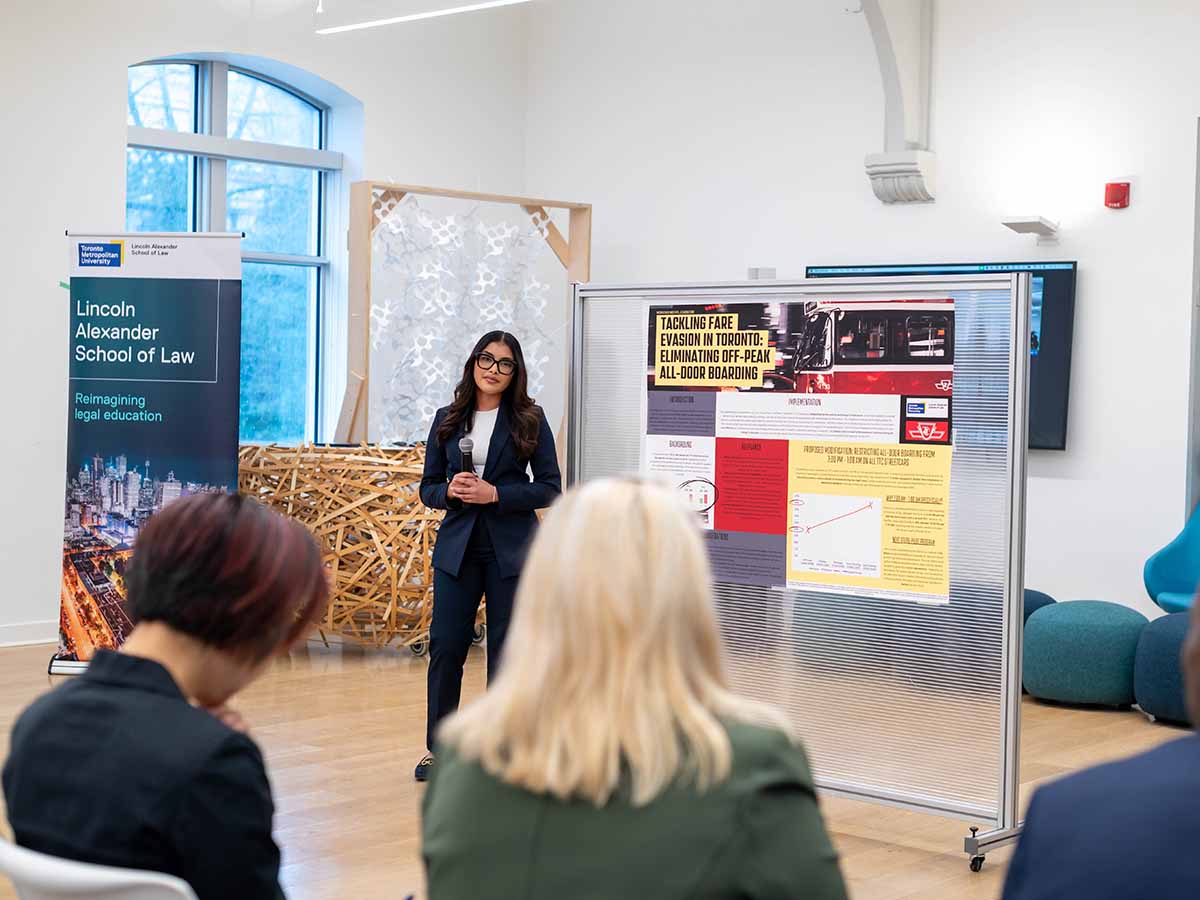
Angeli Patel was among eight Lincoln Alexander Law students who tackled the TTC fare evasion challenge and pitched their solutions to transit leaders at Demo Day.
When a few students expressed apprehension early on in the process, Effoduh reassured them that this project was a low-stakes way to hone their critical analysis and presentation skills. “In your legal practice, operations will approach you with questions – not only will you have to provide answers from the law, but you have to understand how the law intersects with society and impacts different communities.”
He also reminded the students that it’s important to practice presenting in front of astute audiences. “Whether you feel confident or whether you feel jittery, you’re a lawyer. Lawyers must speak,” Effoduh says. TTC representatives were impressed with the students’ solutions, noting how they aligned and differed from their own internal proposals. An idea that was sparked at Demo Day even came up at a subsequent TTC Board meeting.
Another law student who participated in Demo Day was Spencer Maurice Jarvis-Gaum, who explored how TTC fare evasion trended upward after the introduction of all-door boarding on new streetcars. Postulating that riders might feel less inclined to pay for transit when they don’t think a driver has noticed, Jarvis-Gaum’s solution included halting all-door boarding, increasing the visibility of TTC personnel and fare inspectors, and developing transparent enforcement policies to build community trust, among other measures.
“I’m very grateful to Professor Effoduh. He created this project from scratch. He cultivated relationships with folks at the TTC, Metrolinx, and Presto so we could have this next-level experiential learning opportunity,” says Jarvis-Gaum. “I loved getting a chance to exercise my creative and legal thinking.”
Angeli Patel’s solution also tackled the all-door boarding problem by suggesting an automated system that would disallow all-door boarding during off-peak times. The project made her realize that many factors, in addition to legal reasoning, contribute to one’s success as a lawyer. “Everyday problem-solving, along with being empathetic, resourceful, and creative, all contribute to becoming a successful lawyer,” she says. “Those are skills that the Integrated Practice Curriculum at Lincoln Alexander Law has really enhanced for me.”

Robert Thompson, Director of PRESTO Customer & Channels at Metrolinx (pictured at left), asks a question to better understand a student’s solution to the fare evasion challenge.
Effoduh’s teaching approach is one that combines critical thinking with technological expertise. He requires students to acquire online certificates in various software, such as Adobe Acrobat Pro, Microsoft 365, and OneNote, as well as legal applications like Westlaw, Fastcase, and Lexis+. Not only can lawyers be more effective by employing tech solutions, but understanding various technological applications can help lawyers successfully litigate cases that involve technology.
Arndt, who joined Lincoln Alexander Law after working as an educator, is deeply impressed by Effoduh’s approach to teaching. “As a law student, I’ve learned a lot from him, but I’ve also learned a lot as an educator – the way he engages with his students and his approach to experiential learning. He’s just so good at what he does.”
Patel describes Lincoln Alexander Law’s Technology, Law and Society course as “unconventional in the best way possible.” By encouraging “open dialogue, creative thinking and practical engagement,” Professor Effoduh has made the course material “more accessible and deeply relevant.”
Having trained in Nigeria, the US, Canada, and the UK, Effoduh looks back on his own education when considering his pedagogical approach. “What were the classes that worked for me? What helped me to improve my skillset?”
For Effoduh, while it’s indisputable that technology is transforming the legal field – streamlining research, reducing administrative work, and lowering costs – human judgment will always remain essential. He highlights the legal consequences of poorly regulated technology, citing examples like the lack of employment rights for Uber drivers and the lawsuit filed by Rohingya against Meta for failing to stop the online hate speech that preceded genocidal attacks in Myanmar.
To stand up to Big Tech, Effoduh encourages his students to interrogate ideas and assumptions, and to explore new frameworks. “Critical feminist theory, Indigenous relations, queer literature, disability inclusion – these topics come up in every course,” Effoduh explains. “Students must understand that no matter how advanced technology becomes, it can never replace the critical thinking required to succeed as a lawyer.”