Lincoln Alexander Law holds Canada’s first law competition focused on Women’s Sports
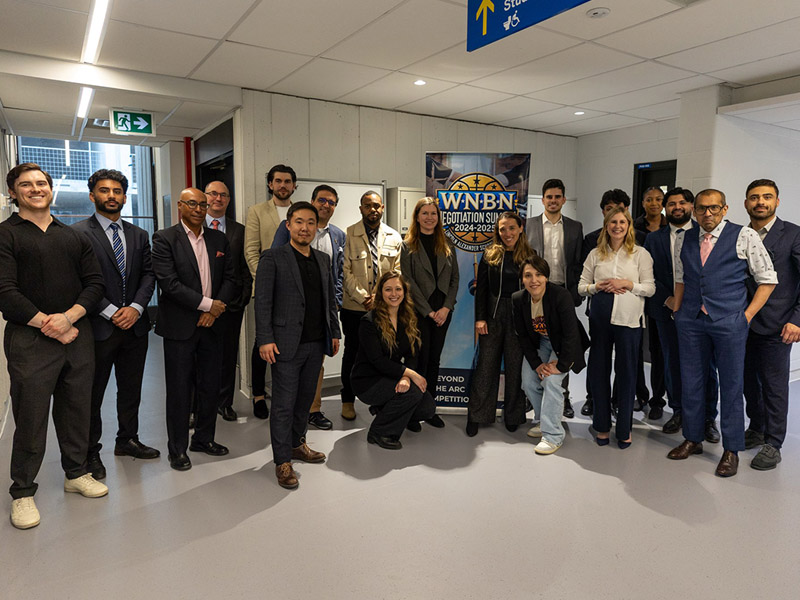
Lincoln Alexander Law is grateful to the sports lawyers and agents who volunteered as judges for the inaugural Women’s National Basketball Summit on March 29, 2025.
Imagine you’re working for the Toronto Tempo – Canada’s first-ever women’s pro basketball team. Your job is to negotiate draft picks, player contracts, and brand partnerships. That’s exactly what second-year law students Sehij Kang and Sehej Matharoo asked of competing teams at Beyond the Arc: The Women’s National Basketball Negotiation Summit.
Held on March 29, 2025, the competition was open to Lincoln Alexander Law students and attracted 16 sports lawyers and agents who served as volunteer judges. Among them were Jeffrey Orridge, founding general counsel for USA Basketball’s Dream Team; Aarij Wasti, former director of Legal and Compliance for the FIFA World Cup; and Amanda Fowler, an award-winning sports lawyer who has represented Olympic and national athletes in Canada.
Beyond the Arc is the first sports law competition focused on women’s sports in Canada. Kang and Matharoo came up with the idea after trying to find existing sports law competitions, however, the only one available was strictly focused on salary arbitration for hockey players. The two friends thought they could create a Canadian branch of an existing competition south of the border, but they found U.S. competitions to be too narrowly focused as well. Kang approached Sheetal Nanda, who teaches Sports and Entertainment Law at the law school, and she said, “Well, why don't we build something here?”
Choosing to centre the competition around Toronto’s first Women’s National Basketball Association (WNBA) team, Kang and Matharoo met weekly with Nanda, as well as Landon Shein, Manager of Mooting, Advocacy Skills and Student Learning at Lincoln Alexander Law, for about six months. The student co-founders spoke daily about the competition to refine the rules and perfect the instructions for teams. They also test-drove their approach with students who weren’t part of the competition.
The organizers invited 16 teams of two (32 students in total) to compete in the day-long event. During the first round, teams negotiated draft picks. Students could trade their own players and negotiate “future considerations” or players who will be available in the future. They could also specify protection levels for their players who cannot be drafted. In the second round, teams negotiated a free agency deal which involved hypothetically pitching for basketball star Breanna Stewart. Students negotiated for both Breanna Stewart's camp and the Toronto Tempo. In a test run, Matharoo recalls that students “ended up signing Breanna Stewart for a much lower price because one of the teams didn’t realize that she was the best player.” The experience helped Matharoo and Kang realize the importance of providing more background information.
For the final round, the teams negotiated a brand deal for a rookie player. Each team was provided with facts that were only known to them. For example, the team negotiating for the rookie was told that she would be willing to partner with the brand for free, while the opposing team was told that they were permitted to give the rookie a $750,000 maximum. For each round, there were four negotiations occurring simultaneously, with four judges in each room.
“This competition is an important part of our broader effort to build a dynamic, hands-on sports law program at Lincoln Alexander Law and become a leader in sports law education across Canada,” says Nanda, the students’ mentor in the project. “Beyond the Arc isn’t just a competition – it’s proof of what’s possible when we empower students to lead, innovate, and shape the future of sports law in Canada. Watching this vision come to life has been incredibly rewarding.”
"Being able to practice negotiations when the stakes are at a friendly competition will help lawyers perform when the pressure is on," said Matharoo. “A lot of times, negotiations don’t go the way people expect them to,” he explains. “You have to be able to think on the spot and use your critical thinking skills to come up with solutions.”
While the mainstream view of negotiations is “to get the best deal possible and not care about the other side,” in law school, students learn the importance of considering long-term relationships when negotiating. Matharoo explains, “If I get labelled as someone who is looking to take advantage of the other side, the next time, that party isn’t going to want to deal with me… negotiating is about finding a middle ground where both sides can win.”
Students who were at the bottom of the leaderboard nonetheless enjoyed themselves. “Even if they lost, they said, that was the best competition I've had in my life. I can’t wait to come back next year and do better,” says Kang. “It’s an opportunity to practice advocating for your client when the stakes don't seem as high as a moot court.”
The 16 judges who volunteered their time were also impressed and requested to come back next year. Many wondered why this competition wasn’t created sooner. Next year, Kang and Matharoo hope that the manager of the Toronto Tempo can be involved in judging as well.
This year’s competition was only open to Lincoln Alexander Law students, but in the future, Kang and Matharoo hope to work with law students and sports law experts across Canada to build a national competition. “It’s not only an opportunity to gain experience in sports law, but also to advocate for women’s sports,” says Kang. “There is so much that needs to be addressed, including issues with the collective bargaining agreements, wage gaps, and underrepresentation.”
The two students – who hope to one day be sports lawyers themselves – greatly appreciated the help from Nanda and Shein. “At already established schools, it’s a little harder to make your own impact,” says Matharoo. But at Lincoln Alexander Law, “we’re given opportunities to be trailblazers, to try new things and be innovative.”
Lincoln Alexander Law is grateful to the sports lawyers and agents who volunteered as judges for the inaugural Women’s National Basketball Summit: Dr. Emir Crowne, Amanda Fowler, Shawn Hunt, Michelle Kropp, Jonathan Kyriacou, Lewis Sukkyun Lee, Alexandria Matic, John Mikhail, Erika Misasi, Bronwyn Newell, André Nowakowski, Jeffrey Orridge, Max Russo, and Aarij Wasti. We would also like to extend our deepest thanks to Sheetal Nanda and Landon Shein for supporting our students on this groundbreaking initiative.