Undergraduate mathematics student finds her passion and career pathway
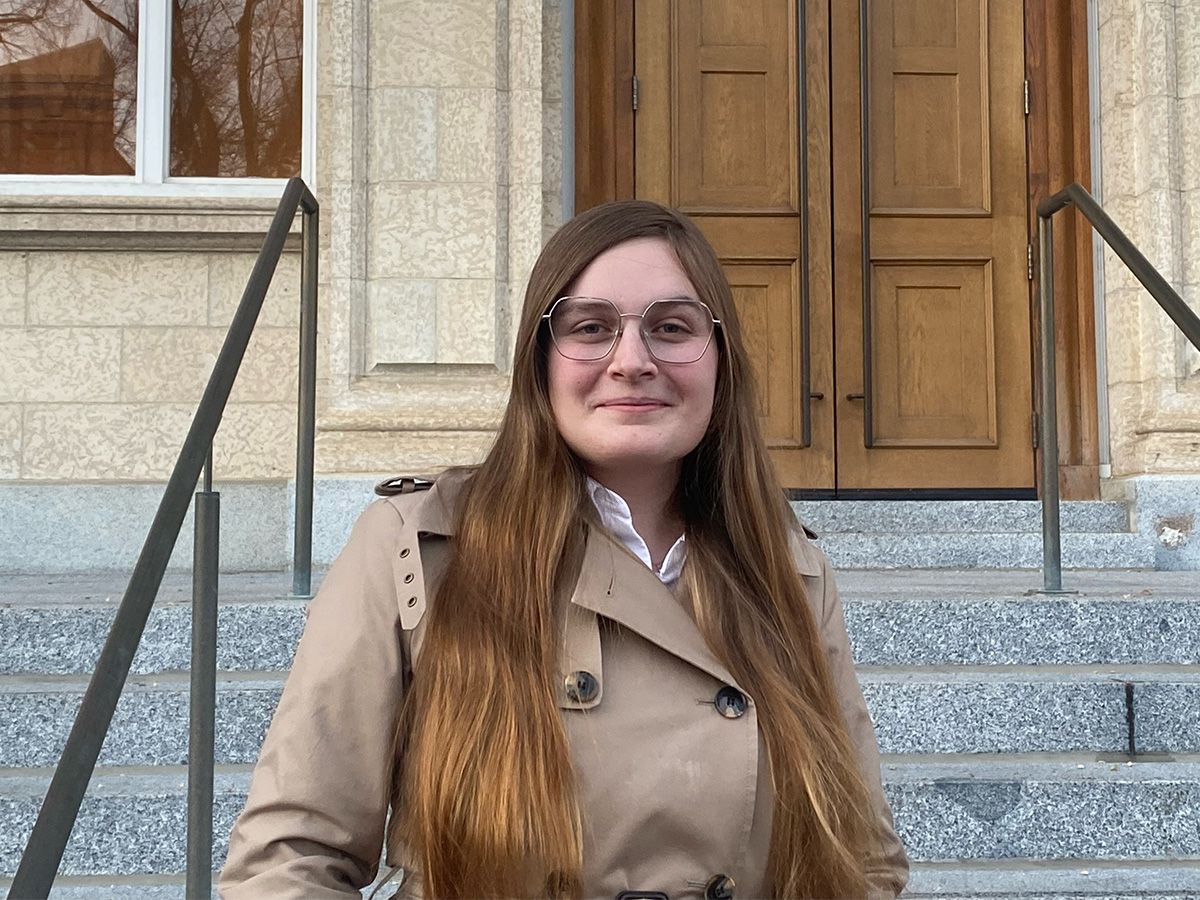
Quinn Kiervin Starkey's academic trajectory is proof that even if you don't find your pathway immediately, you can always reroute. Freshly graduated with her Bachelor of Science degree from TMU's mathematics and its applications program this fall, she is now a master's student on scholarship at the University of Alberta, contemplating a career in academics.
But this success did not come on the first attempt. Starting out in a different program (biophysics) at another university, Kiervin Starkey came to realize after a year that the field wasn't a great fit. She left and worked as a cook for about five years before realizing during the pandemic that she wanted to try again to navigate post-secondary education.
"I applied to a few different schools, and I had some friends who were in Toronto, so I thought TMU would be a good option. I liked their job-oriented focus because at the time I thought I would try to just do a degree so I could get a job," says Kiervin Starkey.
She also appreciated that TMU gave her a chance. "I feel like they have a very holistic approach to admissions, which definitely helped me because I had not gotten great grades during my first time in university, so it was nice to have a place that would look beyond that and give me another shot," she says.
Discovering an interest in mathematical analysis, Kiervin Starkey received a National Sciences and Engineering Research Council (NSERC) Undergraduate Student Research Award to complete a summer position with TMU Mathematics professor Foivos Xanthos. From that research, which focused on regular operators on vector lattices, she developed her undergraduate thesis, ultimately resulting in a publication co-authored with her mentor, earning her the 2024 Geoff Boyes Undergraduate Research Award.
Vector lattices are a special class of mathematical space, which combine the properties of a vector space with an order structure, that is, a definition that tells us how to determine that one element is “larger” than another. This allows us to compare many different types of vectors, which can be much more complex than standard numbers. Practical applications include complex comparisons, for example, if one restaurant has great service, lousy food, but good delivery, and the other has great food but slow service and no delivery, it's hard to say which is the better restaurant. However, using vector lattices, we can determine a unique minimum set of services which a restaurant would need to be a better option than both. Kiervin Starkey's research tackles the vector lattice problem, as posed in a research paper from the 1990s, to determine when linear operators satisfy a specific condition when mapping into a particular vector lattice. "We were able to show it for that space. And we're actually able to show it for a whole class of other spaces as well, things that are called discrete vector lattices," says Kiervin Starkey, noting that the equations her work was exploring are laid out by the Riesz-Kantorovich theorem.
For Kiervin Starkey, the research project also confirmed that pure mathematics was the field for her. In high school, she thought she liked physics best, but she says that while taking calculus, Fourier analysis and linear algebra classes in her first and second years with professor Lawrence Kolasa, she discovered this passion by watching him teach. “He was just going through, in a rigorous way, the hardest math problems I had ever seen. And they were really challenging, but they were a lot of fun. I was like, ‘Wow, it's just so much fun solving problems in math!’”
She also credits professor Xanthos with helping to point her in the right direction after she'd discovered this interest. "He was teaching algebra one year, and I went to ask him some questions during office hours. As soon as I came in, he asked, 'Have you thought about doing the thesis option? Because you seem really engaged in the material." As she continued to move forward, Kiervin Starkey found even more professors to advise her in navigating the world of academia and research. "Having professors who are very excited about the things they were teaching and were giving me that invitation in was a really big thing for me," says Kiervin Starkey.