Translating theoretical problems to real-world solutions

Computer Science professor Yeganeh Bahoo straddles the worlds of theory and industry in her field. She loves the former but always keeps her eye on the latter to develop real-world applications, no matter how far into the future. This drive recently resulted in a four-year Ontario Research Fund – Research Excellence (OFR-RE) grant worth over $600,000 to advance a project that will improve 3D printing approaches for computer-aided design (CAD) files, benefiting industries from automotive to aerospace to medicine.
At TMU’s Geometric Computing lab, Bahoo leads her team of postdocs, PhDs and Master’s students in weekly meetings focused on computational geometry problems. “We’re not only covering the theory of algorithms and data structures, but also taking it further into the application world. I'm creating that bridge between theory and application to ensure that what I'm developing won't stay on the shelves for years until someone finds a solution. Instead, I go and take the problems to the application myself,” she says.
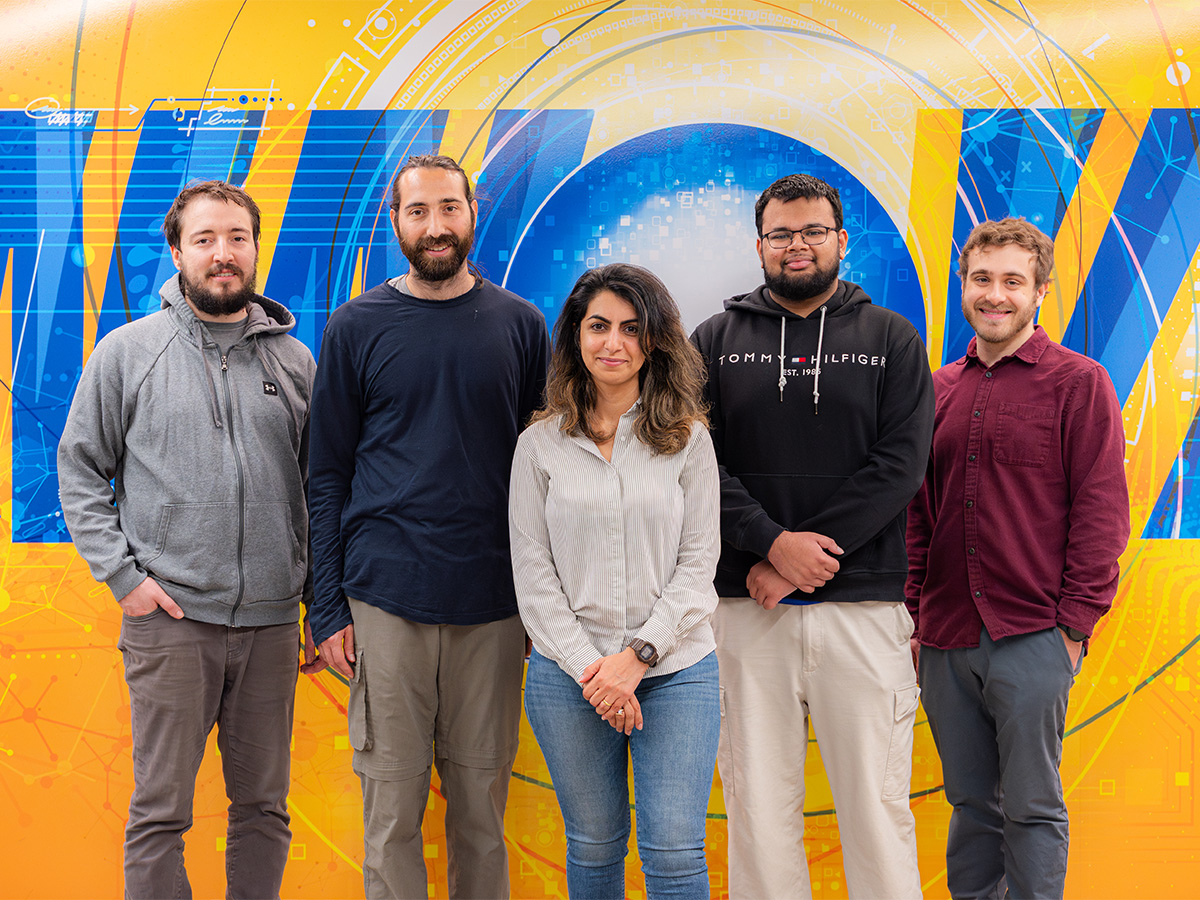
Bahoo leads TMU’s Geometric Computing lab, which includes postdoctoral researchers, PhD and Master’s students, focused on solving computational geometry problems.
Collaboration with industry leads to idea sharing
In her quest to refine 3D printing approaches, Bahoo is collaborating with both the University of Windsor and a Windsor-based industrial partner called CAMufacturing, helping the global firm to optimize its software for additive manufacturing. Already in use by the automotive industry, additive manufacturing is a more complex form of 3D printing. While 3D printing creates layers on top of each other, these machining toolpaths use a robot arm, allowing for more complex structures with a greater degree of freedom of movement. The technique is used to create complex parts that could be better and stronger than what traditional manufacturing produces. For example, it allows for printing one part as a stronger whole where traditionally three were needed, or even prototyping parts.
In the future, there is potential to use the additive approach for complex human parts, like making a kneecap to fit an individual’s specific bone structure; Bahoo is quick to note this research is still experimental, but the application is definitely on researchers’ minds.
Having collaborated with CAMufacturing since her postdoc, Bahoo says the relationship is at the point where the idea sharing goes both ways. “Our relationship is now entering its seventh year, so we are in continuous collaboration. I talk to them and get their feedback. Sometimes they have a problem that they need more expertise, so they reach out to me,” she says, adding that she also reaches out when a student needs a project to work on.
Partnering overseas to combine computational geometry with robotics
In another project, Bahoo is collaborating with professor Steven LaValle at the University of Oulu in Finland (an early founder of the Oculus VR company acquired by Facebook). Their ongoing collaboration has resulted in three published papers and focuses on a project called the “bouncing robot,” where they are developing algorithms to program inexpensive, minimalist robots that "bounce" when they hit a boundary and explore a new direction. “If you have an area full of land mines you want to explore, you don't want to use an expensive robot and you don't want to use a human either,” says Bahoo. Another future application in the nanotechnology world could be in delivering medicine to a specific part of the body.
Bahoo says she feels very supported by her department at TMU, where her current teaching in areas like research, data structure, algorithms, and computational geometry aligns perfectly with her field of expertise. This allows her to share a glimpse of her research and perhaps even spark students’ interest in developing future applications. Her own future ambitions include expanding her collaborations internationally, especially in Europe. “I want to just expand and find more applications, more partners, more industrial partners, and then see what we can develop into real-world applications.”
Related stories: