TMU undergraduate shares research at Canadian Cancer Research Conference
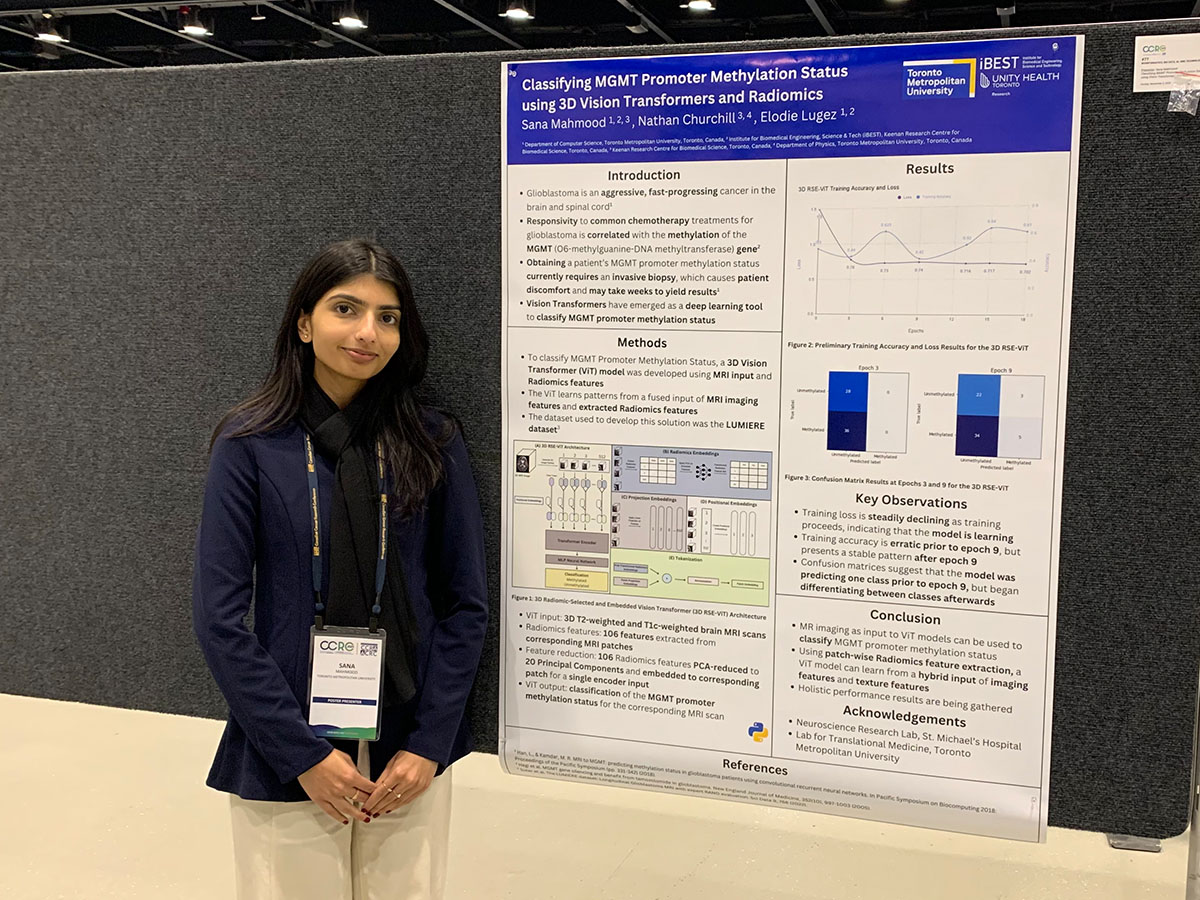
Sana Mahmood presented her research that uses AI to improve outcomes for glioblastoma patients at the Canadian Cancer Research Conference.
Computer science student Sana Mahmood has been bitten by the research bug. After trying out co-ops in industry as a systems analyst for Softchoice and an angular framework developer at CGI, where she worked on an AI product in a partnership with Microsoft, she was selected for the iBEST Women in STEM research assistantship program (external link) (funded by the Leacross Foundation) to work with computer science professor Elodie Lugez and adjunct physics professor Nathan Churchill, affiliated with St. Michael’s hospital.
Today, she’s continuing in the lab with Lugez and Churchill for her undergraduate thesis. “It's been a lot of different roles, but I'm doing this thing that I love, which is research,” says Mahmood.
The research presented by Mahmood at the Canadian Cancer Research Conference utilizes AI to identify a particular biomarker for glioblastoma patients. With a median survival time of 15 months post-diagnosis, glioblastoma is an aggressive, malignant brain tumour. As a result, doctors caring for these patients face a tight timeline in deciding on the right treatment. Patients with the genetic biomarker MGMT promoter methylation tend not to respond well to standard chemotherapy drugs, providing useful information for treatment planning. Currently, the only way to identify the gene is through a biopsy, which typically takes one to two weeks and is also an invasive procedure. MRI imaging is already part of the diagnostic process and is non-invasive, so it is a better alternative.
“If we can reduce the amount of testing and also find a non-invasive method of predicting this information, that would be ideal,” says Mahmood, adding that this problem has been previously investigated, but that her research adds 3D images rather than 2D and embeds further features that are equivalent to a whole new approach. “We're hoping that we can get a model that might actually be able to be used by clinicians. We're trying to give them tools to make their work easier.”
Building AI models from scratch
As a computer science researcher, Mahmood is building her own models from the ground up rather than working with the familiar standards like ChatGPT or Gemini. One of her biggest challenges is controlling for bias. In practical terms, that means Mahmood needs to incorporate a balanced representation of the condition so that her model does not develop a bias in predicting the biomarker. She also ensures that her samples are balanced in terms of gender and other factors, and that her training and test sets are completely separate. “It's about being very careful in terms of what you're putting into the model and how you're training it to try and maximize objectivity,” she says.
At the Canadian Cancer Research Conference, Mahmood not only got to share her presentation poster but also field questions from keen clinicians, who were the main attendees. “It was received very well. A lot of people are fascinated by how we can use AI to help clinicians. I was able to engage in a lot of very interesting dialogue with different people who might actually want to use this,” says Mahmood.
Today, Mahmood continues to do research with AI for her undergraduate thesis. This time, she’s using the same models but applying them to predict the risk of mortality in neurodegenerative diseases, something that aligns with co-supervisor Nathan Churchill’s work. “There is a wealth of questions in that space that have not been solved yet. And we have a working model, so we want to see how to translate this to a different field,” she says. She hopes to continue working in research, whether in industry or academia.
A satisfying journey with stellar supervisors
Poised to graduate next year, Mahmood is enthusiastic to declare that she’s experienced everything on offer in her program and at TMU at least once. In addition to her various co-ops, she served as a first-year crash course exam tutor for TMU’s Undergraduate Science Society (USSTM). She has been a teaching assistant for a second-year data structure course for three years, a role that has helped her explore her passion for teaching. She was also involved in the Practical Applications of Computer Science (PACS) student group as a research coordinator, where she organized a hackathon. “The goal that I had coming into undergrad was to try everything and see what I liked. And the things that really stuck were TA’ing and then research. So, I hope to continue those,” she says.
As research has emerged as a focus for her own career, Mahmood also realizes her gratitude for those who supported her through that realization: Lugez and Churchill. “I can't say enough good things about my supervisors. I'm immensely grateful for them. Especially when I was first starting out, they would be willing to answer any question. They gave me so many resources. Even now, if I'm stuck on a problem, they will help me figure it out. But most of all, they allowed me a lot of opportunities for growth. I didn't think that presenting at a national conference was a possibility for an undergrad, but they fully supported me. They are completely supportive and help me achieve my goals. I could not be more grateful to continue to be supervised by them.”