Preparing for a career in financial risk management
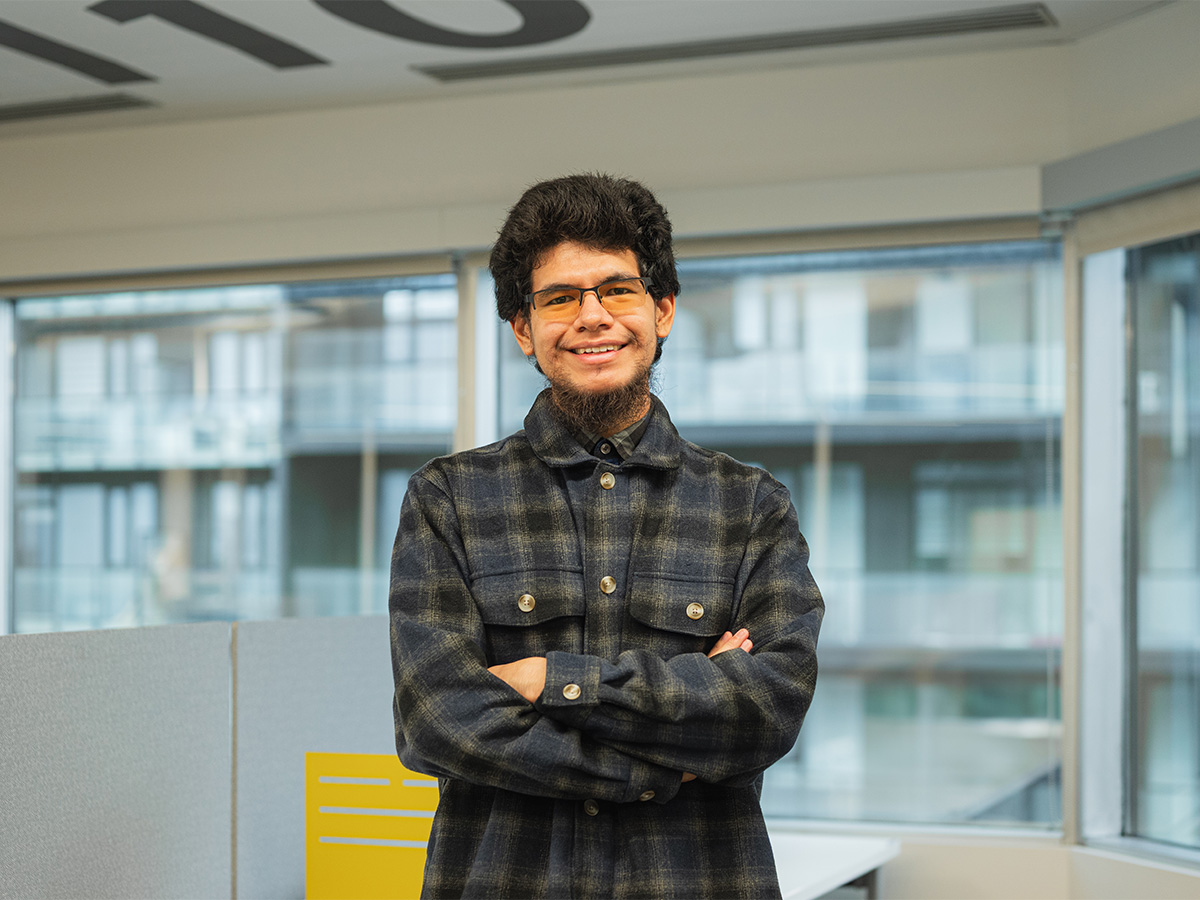
Assignments and dissertation-writing may be solitary pursuits, but TMU master’s student Samuel Reano has discovered that he gets into the zone when working independently alongside others. The low buzz of chatter and the thrum of fellow students coming and going on their way to classes provides just the right amount of distraction and focus.
While pursuing his undergraduate degree in mathematics and its applications, Reano could often be found sitting at one of the long tables in the George Vari Engineering and Computing Centre, his favourite study spot on campus. Now that he’s a graduate student and teaching assistant (TA), he hangs out more at Atrium on Bay, where he can chat with his fellow TAs and other math graduate students. When he graduates and moves into financial risk management, whether at a financial firm or a bank, it seems likely that these spaces will bring back some nostalgia for him.
Reano had chosen the mathematics and its applications program at TMU for its applied courses and streams, such as computer science and economics. He had the same practical reasons for continuing on to his master’s in applied mathematics: looking at the job postings, he could see that many of the positions where he aspired to work required a graduate degree. By this point, he already knew that he also wanted to join TMU’s Financial Mathematics Research Group.
Making his contribution to financial analysis
Today, Reano is a second-year applied mathematics master’s student, finishing his thesis. He’s examining how to approximate risk measures using a combination of numerical methods and probability theory. He is working on an algorithm related to a class of financial risk measures called Spectral Risk Measures, examining the probability distributions of data received by financial or insurance companies and uses them to inform practitioners' next financial decisions. While he expects initial applications to be useful to risk management practitioners, the work will also be useful in the future for insurance companies and, later, for portfolio management.
In practical terms, Reano works out his equations on paper and then programs computer models. He says what’s different about his work is that many people use numerical methods but don’t care how randomness affects the distribution of the data, whereas he focuses on an algorithm that provides that added insight. “The question I became curious about during the transition from finishing my undergrad to entering my master's was, ‘Is there a way to measure how risky it is to make a financial decision before it affects everybody?’” says Reano.
He initially sought out professor Foivos Xanthos as his supervisor while taking his undergraduate complex analysis course (MTH 640), then professor Sebastian Ferrando came on board as co-supervisor when Reano took his financial mathematics graduate course (AM8201). “We get along really well. I came to his office hours asking some questions, and then we discussed other topics in financial math during the course,” says Reano.

Samuel Reano is currently working on his thesis, which focuses on an algorithm that estimates Spectral Risk Measures to inform financial or insurance companies' financial decisions.
Inspiration from undergrad
Reano credits a good experience with his undergraduate courses with solidifying his interest in mathematics. In particular, he remembers professor Lawrence Kolasa, who taught him calculus and numerical analysis courses, for being really funny and encouraging him to go deep in his thinking. Retired professor Pablo Olivares made MTH 500 really applicable by using examples from the pandemic, temperature forecasting and stock forecasting. In MTH 617, he really connected with a teaching assistant named John Marcoux. “He actually motivated me, encouraged me and gave me advice,” he says, adding that the course was also a good pathway to abstract mathematical thinking that he uses in his thesis now.
Reano also completed an undergraduate thesis in a more theoretical area. While his focus is different in his master’s program, he says the experience is in refining his process. “The undergrad thesis helped me understand how to formulate proofs in a specific topic in math,” he says. In all, Reano recalls a really positive experience with his professors, whom he met with during office hours and even emailed for book recommendations when he wanted to expand his knowledge on a new area. “It was really a great place to nurture your abstract thinking in mathematics, and be able to explore different topics in math outside of your courses,” he says. He also recalls a case competition with the Metropolitan Data Science Association (external link) as a really positive experience.
Today, Reano is paying the collegiality forward as he connects with his own students as a TA in his courses. “I really enjoy talking to them, that's one of the things I like about being a TA and also being a graduate student at TMU.”