Advancing optical research in blood

From left to right: Physics Department Chair Pedro Goldman; Faculty of Science Associate Dean, Research, Innovation and External Partnerships Michael Kolios; Physics professor Alexandre Douplik; Provost and Vice-President, Academic Roberta Iannacito-Provenzano and Faculty of Science Dean David Cramb.
The understanding of various illnesses by clinical researchers, medical physicists and biomedical engineers will be enhanced by a forthcoming publication on blood optics, edited by Physics professor Alexandre (Sasha) Douplik from the Faculty of Science at TMU.
Douplik is the editor-in-chief of The Optics of Blood: A Handbook, which will be published later this year by the Institute of Physics (IOP) Publishing as part of IOP Science’s Series in Advances in Optics, Photonics and Optoelectronics (external link) . The book connects the physiological properties of blood to its interaction with light — knowledge that is critical for those involved in the research and development of medical applications in blood and cardiovascular-related imaging, diagnostics and therapeutics.
TMU celebrated Douplik’s accomplishment at a book launch on Sept. 26 at Oakham Lounge, hosting colleagues and students from the TMU Photonics Group, Physics Department, Faculty of Science, Faculty of Engineering and Architectural Science and industry and clinical professionals. The event began with greeting speeches from TMU Provost and Vice-President, Academic Roberta Iannacito-Provenzano, Faculty of Science Dean David Cramb, Faculty of Science Associate Dean, Research, Innovation and External Partnerships Michael Kolios, Physics Department Chair Pedro Goldman and UHN surgeon Alexandra Easson, who has closely collaborated with Douplik for many years.
In his speech, Douplik spoke about his early career experience in clinical practice at a hospital as a medical school graduate, where he used lasers to treat patients with chronic wounds caused by X-ray radiation. To understand a certain inconsistency in the results of his intervention, Douplik used optical methods to study the dosimetry (the amount of radiation energy absorbed by an object) of laser radiation for patients during treatment, which led him to investigate the optical properties of blood. Eventually, Douplik realized that information in an individual’s unique blood’s optical signature significantly affects the efficiency of optical treatment and diagnostic accuracy. These efforts shaped what became his primary research area: biophotonics, laser medicine and medical optics.
His PhD was in medical physics, followed by his habilitation — a rigorous post-doctoral qualification in Germany that is a prerequisite for a full professorship — in biomedical engineering. Reflecting on his 25-year experience in biophotonics, Douplik’s handbook is the first to organize blood optics knowledge within a single resource, which he says will support the efficacy of clinical scientists, medical physicists and biomedical engineers.
“This book gathers the pieces of knowledge I wish I’d had in the hospital years ago — tools to connect physics with clinical technologies towards novel developments of blood physiology and circulation monitoring technologies,” said Douplik, who leads the TMU Photonics Group, which develops optoelectronics tools, software and data analysis for biomedical purposes.
This comprehensive handbook features an international and multi-institutional collaboration of global leaders from top universities in Canada, Germany, Japan, the United States and more, offering a truly global perspective on the optics of blood. Douplik began working on the book four years ago and contributed four out of the 12 chapters. Douplik collaborated with fellow TMU physics adjunct professor, Guennadi Saiko, and also recruited five of his TMU students to assist with the project: Vanja Dvekar and Meiyun Cao from the physics master’s program, and Tim Burton, Faraz Sadrzadeh-Afsharazar and Leah de Vos from the Faculty of Engineering and Architectural Science biomedical engineering PhD program. This handbook is a testament to TMU's commitment to experiential learning, as Douplik provided his students and collaborators with an invaluable opportunity to participate in this project alongside global experts and leaders in biophotonics, directly aligning theory with real-world, practical experience and preparing them for their future careers.
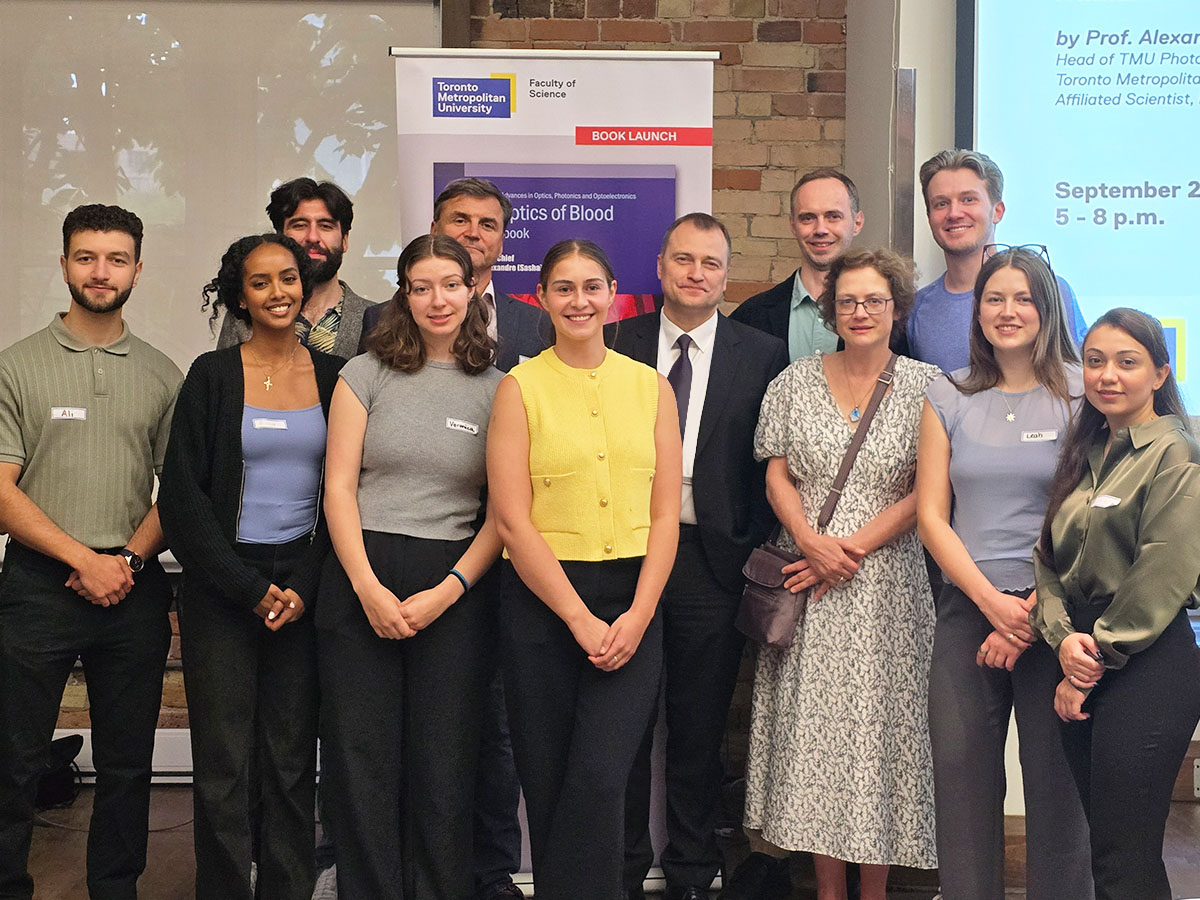
Douplik’s students and collaborators came to celebrate the book launch.
The handbook will also contribute to a topic Douplik says has the potential to advance equity in health-care delivery. For example, the pulse oximeter, which measures blood oxygen levels by shining light through the fingertip, can inaccurately read the oxygen saturation level in individuals with Black or dark skin tones. This is because their melanin (the pigment responsible for darker skin) absorbs light, which interferes with clinical measurements.
“This is a big problem that contributes to racial bias in medicine,” Douplik says. “The information in this handbook can help with creating optical devices that work with all skin types.”
At the book launch, David Cramb, Dean of the Faculty of Science and a professor in the Department of Chemistry and Biology, commended Douplik for successfully facilitating a collaborative effort to create a robust resource on a vital topic in medicine.
“Blood is such a complex system to study that I really appreciate that a guide on how to better study it has evolved out of Douplik’s work,” Cramb said. “It’s also really challenging to organize several physicists to produce great science by a deadline, so that is a fantastic accomplishment.”
Roberta Iannacito-Provenzano, TMU’s Provost and Vice-President, Academic, lauded Douplik for making such a valuable contribution to TMU’s institutional mission to advance cutting-edge research that achieves real-world impact.
“This book is an inspiration to colleagues and students alike. It reinforces TMU’s place in advancing the frontiers of physics, biophotonics and interdisciplinary science,” Iannacito-Provenzano said.
Alexandra Easson, a surgeon of Mount Sinai & Princess Margaret Hospitals and a professor in the University of Toronto's Faculty of Medicine, gave a prospective view of this book for clinicians and interdisciplinary collaboration.
“This is always an interface between two different worlds, and sometimes it is very challenging to find common points… but when it works, the results are amazing,” Easson said.
In Douplik’s concluding words, “what started many years ago at the patient's bed in the hospital... ended up in this book now, which hopefully will be used by clinicians and researchers to improve patients’ lives”.