Recognizing honorary science student's dual commitment to research and Indigenous advocacy
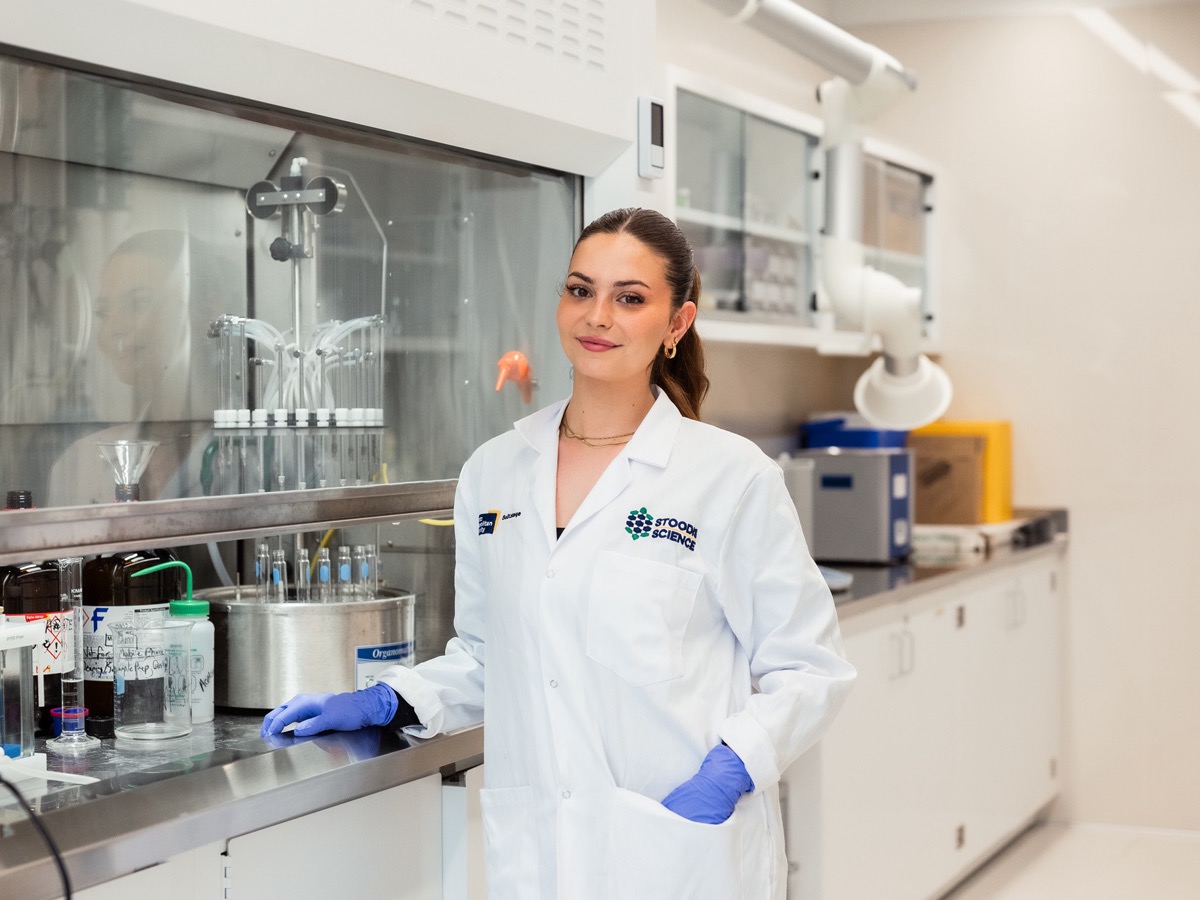
Sommerly Grimaldi-Ertl is a third-year undergraduate student who, despite pursuing a non-science degree, was drawn to science through her open electives, taking any science courses she could and double-minoring in biology and chemistry. This fall, she will be transitioning to the Faculty of Science to fully pursue her passion for scientific research, building on the science courses she took and the lab experience she gained along the way.
Driven by an interest in research and a passion for her Indigenous heritage, Grimaldi-Ertl organized an event during her second year called “Medicine in the Garden” at the TMU Urban Farm to encourage discussions with the community about integrating Indigenous medicine into Western pathways. At the event, she met Chemistry and Biology professor Roxana Suehring, and they connected over Suehring's research on plastic additives in Northern Indigenous communities. Grimaldi-Ertl joined Suehring's lab as an intern and quickly excelled, earning her a part of the larger project – and a position she still holds today.
“Sommerly's work was instrumental in completing a project on contaminants in seabirds for the Nunatsiavut government,” said Suehring, who is the principal investigator for the Emerging Contaminants Lab. “Her work has contributed directly to a report on the contamination status of the birds in different areas of Nunatsiavut that will contribute to food safety for the local communities.”
In addition to her research, Grimaldi-Ertl is deeply involved in her community. As a Student Support Worker, she helps connect Indigenous students with resources on campus.
We connected with Grimaldi-Ertl to learn more about her TMU journey:
What interested you in pursuing science, and how did you become involved in professor Suehring’s lab?
I became interested in research when I first entered TMU and held positions in various research initiatives that surrounded conversations discussing Indigenous health, education and opportunities. One of these initiatives was “Medicine in the Garden,” an event I organized during Indigenous Education Week. During this event, I met Faculty of Science professor Roxana Suehring, who was conducting analytical chemistry research with Northern Indigenous communities. Driven by a desire to gain hands-on wet lab experience and focus my research on Indigenous health, I was immediately drawn to professor Suehring's work. Our discussions revealed how her research directly addresses long-term health determinants in Indigenous communities through food-related studies. Inspired and eager to contribute, I sought to become involved in her project.
Can you explain the research you do in professor Suehrings’ lab?
My primary focus revolves around Arctic animals, where I conduct analyses to detect plastics in various organs and tissues. These findings play a crucial role in assisting Indigenous communities in making informed decisions regarding animal consumption. Many of these animals are fundamental to the diets of these communities, and the presence of plastics and OPEs (Organophosphate Esters) is detrimental to their health and to Arctic ecosystems. The findings also inform decisions and advocacy efforts concerning environmental issues in the Arctic.
You are quite involved in the Indigenous community at TMU – why is this so important to you?
I feel very strongly about Indigenous advocacy in academic spaces because historically, Indigenous Peoples have not been welcomed and represented in these spaces. I have found myself in positions where there has been under-representation, tokenism and burnout in community spaces. Because of this, I felt it was imperative to speak on behalf of my student experience when others have often felt the need to speak for me. I am currently the president of the TMU Premedical Society, president of the TMU Indigenous Student Association, vice president of marketing for both the TMU Literary Club and the Rare Disease Club, and I sit on numerous board meetings regarding Indigenous education and Truth and Reconciliation. I also hold a position at the university under Indigenous Student Services as a Student Support Worker. I recognize the importance of identity and positionality in these spaces, knowing that I am providing incoming students with the opportunity and advocacy I had to create for myself when entering university.
What do you envision for your future?
My future goal is to attend medical school with a clear mission to graduate and dedicate myself to providing accessible healthcare for Indigenous Peoples. My vision merges Western medical practices with traditional forms of medicine, ensuring equitable care that respects Indigenous knowledge systems. Looking ahead, I aspire to expand my impact through research and publications that introduce Indigenous perspectives and medicinal practices to a broader academic audience. Throughout my journey at TMU, I have been fortunate to receive unwavering support from professors, advisors, colleagues and staff who have supported all my endeavours and never sold me short of my dreams. I hope to honour and carry that support into my future work.
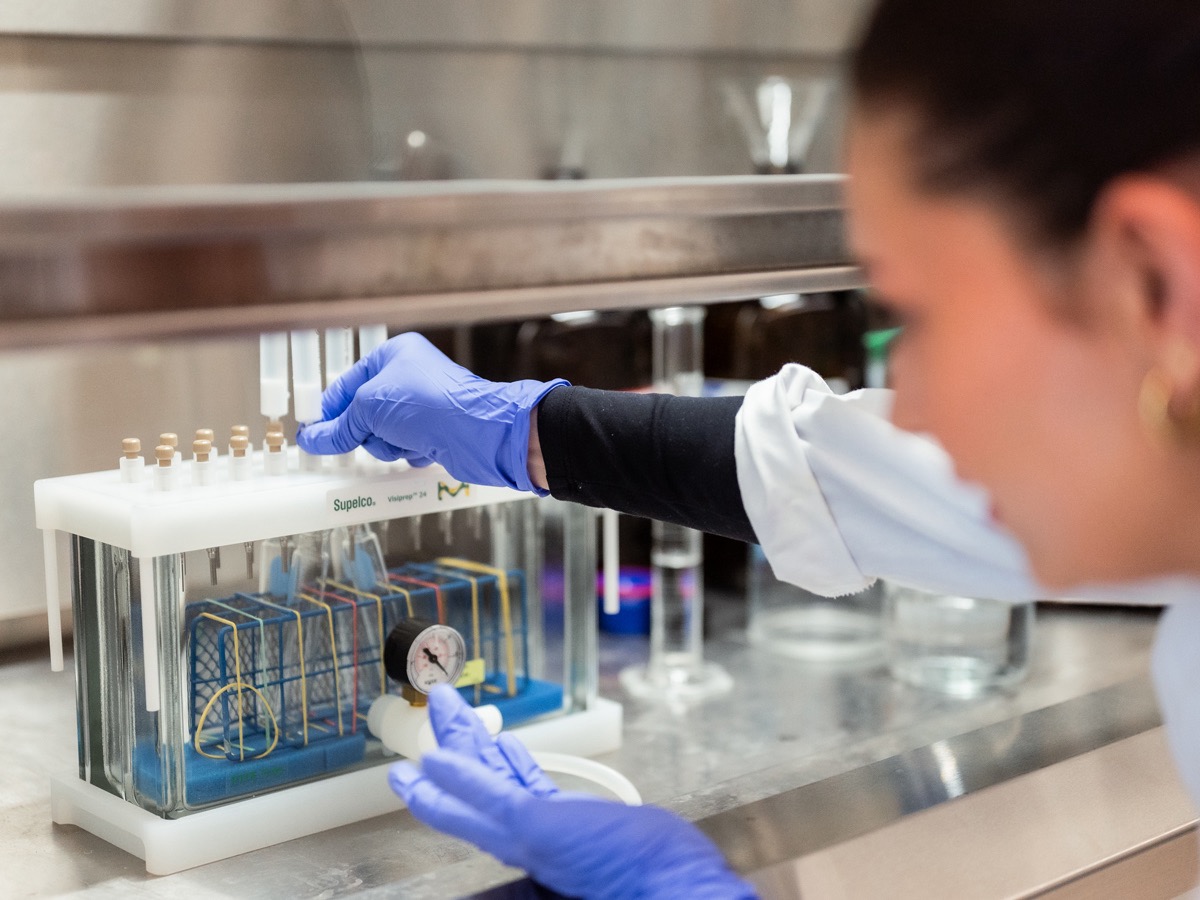
Sommerly Grimaldi-Ertl demonstrating how she uses solid phase extraction in the lab. Solid phase extraction (SPE) is a sample preparation technique using a solid adsorbent contained most commonly in a cartridge device or on a disk to adsorb select species from the solution. SPE is used to isolate a species in a sample or to clean up a sample before analysis.
Sommerly Grimaldi-Ertl's story is one of passion and a deep commitment to making a difference in Indigenous communities, and she shows remarkable qualities as a student and community leader. Her academic journey at TMU is not only marked by her community involvement but also by her academic achievements. In recognition of her accomplishments, she received the Presidential Scholarship and Entrance Scholarship in 2021 and the Bennett Equity Scholar Award for First Generation Students, the Sheila (Angus) Cecchetto Award and the Aaron Biren Award in December 2023.
Grimaldi-Ertl has integrated well within the scientific community, and her advocacy for implementing Indigenous perspectives in science aligns with the faculty’s ongoing efforts to decolonize science education. The road to science can be non-linear, and the Faculty of Science is proud to welcome her to the medical physics program this fall.
Learn about the Faculty of Science’s efforts to decolonize science education: