Nursing Advanced Entry Program (BScN)
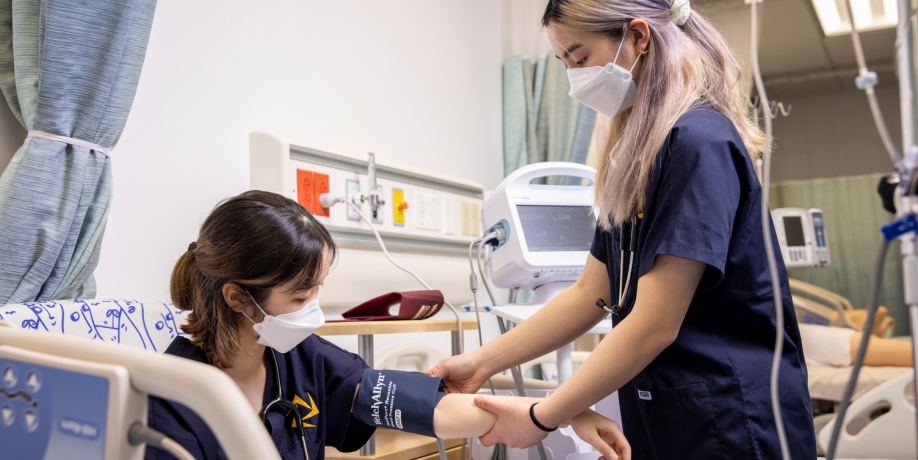
Ready to launch your nursing career on a faster timeline? Eligible students can earn a Bachelor of Science in Nursing (BScN) in just 2.5 years and prepare for RN licensure in Ontario.
50%
Less time compared to a traditional 4-year BScN
1224
Clinical hours engaged in experiential learning
300+
Placement partners across the Greater Toronto Area
At a Glance
Pathway
- Full-time, five semesters (2.5 years)
Start date
- September
Degree
- Bachelor of Science in Nursing (BScN)
Experiential Learning
- Mandatory clinical placements each semester
Tuition and Fees
Accreditation
- Canadian Association of Schools of Nursing
Professional Designation
- Registered Nurse (RN)
Are you committed to a future career in nursing and want to get there faster? The Nursing Advanced Entry Program (NAEP) compresses the required nursing curriculum and placements to five semesters.
This format is designed for strong students with a solid foundation in science and social sciences.
Applicants commonly come from programs such as:
- Biomedical Science
- Biology
- Kinesiology
- Psychology
- Health Sciences
- Other science- or social-science-based undergraduate programs
Length
Full-time, five semesters (2.5 years)
Eligibility
This program is intended for:
- Those with a completed or partially completed undergraduate degree (minimum 20 university credits).
- Those who have completed the required science and social science prerequisites within the last five years.
- Those who are new to nursing and wish to enter the profession through an academically rigorous and accelerated pathway.
Exclusions
- Those with prior nursing education, domestically or internationally.
- Those who require a study permit. (This policy may be reviewed after the first two years of the program.)
Our curriculum prepares you for career success. As a student in the NAEP, you will graduate with knowledge and practical skills needed to:
- Deliver ethical, person-centred, evidence-informed care
- Integrate theory and practice across health-care settings
- Use digital tools and technologies in nursing practice
- Demonstrate leadership and innovation
- Meet all requirements for BScN degree completion and eligibility for RN licensure in Ontario
Overview
Year I: Foundations of Professional Nursing Practice
The Nursing Advanced Entry Program – Year I is designed around the theme of professional socialization and the integration of foundational nursing knowledge and practice. During this year, students are introduced to the roles, responsibilities, and expectations of the nursing profession. Emphasis is placed on developing core competencies through classroom learning, simulation, laboratory experiences, and clinical practicums. These practice-based experiences support the development of essential assessment, clinical judgment, and communication skills. Year I also provides a strong theoretical foundation, focusing on the principles that guide nursing practice and the role of the profession within the broader health care system.
Year II: Leadership and Specialized Nursing Practice
Year II builds upon the foundational knowledge and competencies developed in Year I, with a focus on specialized knowledge and the advancement of leadership capacity in nursing practice. Students further refine their assessment skills in working with community-based and complex populations while deepening their engagement with evidence-informed practice. Core concepts of ethics, leadership, quality improvement (QI), and patient safety are integrated throughout the curriculum. In Semester Five, students participate in an intensive clinical practicum centered on the professional practice domains of leader, advocate, educator, and scholar. This culminating experience emphasizes care for individuals, families, and communities with complex health care needs and provides opportunities to follow care transitions across sectors.
Clinical Placements
| Semester | Placement | Requirements |
| First | Clinical I – Foundational Knowledge/Chronic Illness Across the Lifespan | Lab + 72 clinical hours |
| Second | Clinical II – Mental Health/Addictions/Gerontology | Lab + 144 clinical hours |
| Third | Clinical III – Perinatal, Pediatrics, or Community | 288 clinical hours |
| Fourth | Clinical IV – Acute Care/Tertiary Care | 288 clinical hours |
| Fifth | Clinical V – Final Preceptorship is Across Care Transitions | 432 clinical hours |
All placements follow TMU's Central Placement Office requirements.
When you apply to the Nursing Advanced Entry Program you must:
- Meet the program’s admission requirements, including minimum grade thresholds and prerequisite courses
- Submit your online application by the stated deadlines
- Provide supporting documents as part of your application (upon request)