Renewing Human Rights
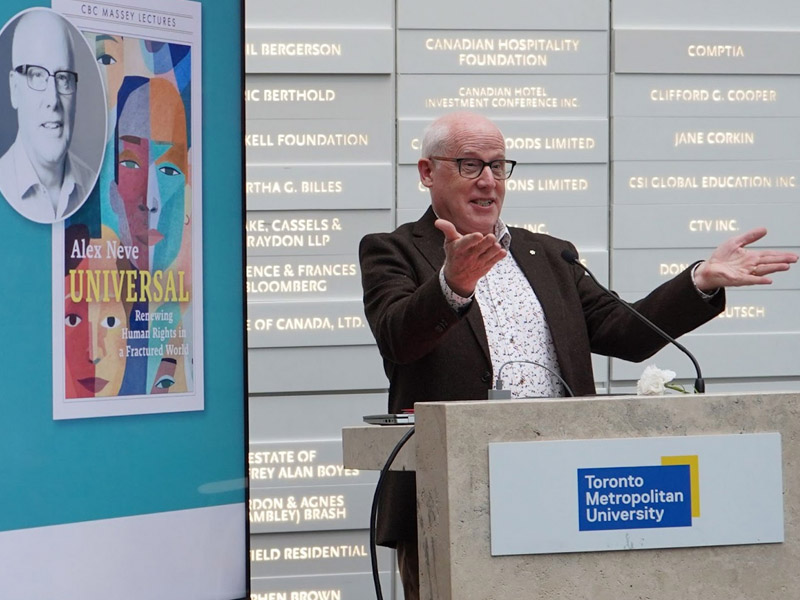
Prof. Alex Neve inspired audience members to seize their own individual and collective power in creating positive change.
Alex Neve, an international human rights lawyer and professor, didn’t mince words when describing the state of human rights in 2025. “We live in a time of what feels to be unprecedented global turmoil, hate and division. Truth is under siege,” Neve said, addressing a room filled with students, faculty, staff, and community members at Toronto Metropolitan University. “Legal and democratic norms and institutions are under attack. On a rapidly warming planet, we face the greatest ever threat to our wellbeing – and even our very survival.” As the 2025 CBC Massey Lecturer, Neve has been travelling across the country this fall sharing five public lectures on CBC’s Ideas. In November, he joined the TMU community for a special lecture presented in partnership with the Lincoln Alexander School of Law’s International Law and Global Justice Initiative.
Neve’s remarks drew on key themes of his recently published book Universal: Renewing Human Rights in a Fractured World, and from his decades-long career in human rights advocacy. He served as Secretary General of Amnesty International Canada for 20 years, participated in more than 40 human rights research and advocacy delegations throughout Africa, Asia, and Latin America, and was appointed an Officer of the Order of Canada in 2007 for his human rights advocacy work.
The global community has fallen short of its promise, post World War II, to uphold the universality and inalienability of human rights, Neve told the audience. “Human rights have become an exclusive club steeped in white, moneyed, patriarchal privilege,” he explained. Neve provided numerous, ongoing examples of the global community’s failures to respond to large-scale human rights violations, including the genocide in Gaza, the unlawful invasion of Ukraine, and “the wrenching crises in Sudan, Afghanistan, Myanmar and elsewhere.” Quoting award-winning journalist and author Omar El Akkad, who wrote, “One day, everyone will have always been against this,” Neve argued that “universal human rights were never intended to be left for that eventual one day, they were [meant] to be the starting point.” The Universal Declaration of Human Rights describes “human rights as the foundation of freedom, justice and peace in our world, not the leaky roof that we've allowed it to be,” he said.
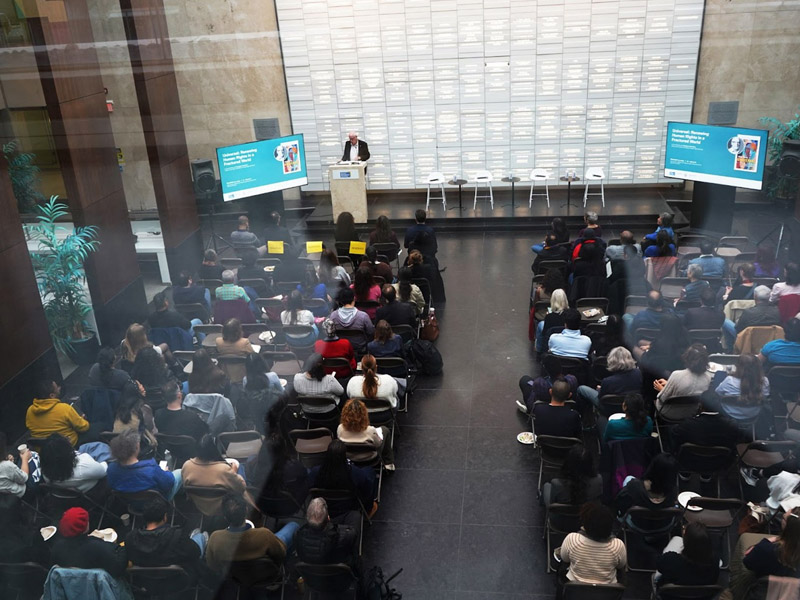
The former Secretary General of Amnesty International Canada delivered a powerful address to a packed audience at Toronto Metropolitan University.
Still, Neve argued it’s not naïve to champion universal human rights at this juncture. In fact, the civilian-targeting conflicts, climate catastrophes, and refugee crises show that the approach that national governments have increasingly adopted – in which human rights is subjugated to the demands of markets, geopolitics and securitization – “has failed colossally.” The widescale implications of this failure should serve as an impetus to drive a new era of human rights.The only way out of dystopia, Neve contended, is to “fully and completely give human rights their turn.”
Inspiring the audience to seize their own individual and collective power, Neve recalled the adage that “change always begins with one person, one person who demands that it be so.” He shared the story of Monia Mazigh, whose husband, Maher Arar, a Canadian citizen, was subjected to extraordinary rendition via a CIA ghost plane in 2002. Arar was unlawfully detained and tortured in a Syrian prison for more than a year. Mazigh’s courage and persistence in speaking to media, government officials, and advocates led to her husband’s release, a public inquiry, and measures to strengthen the oversight of Canada's national security and law enforcement agencies.
Individuals can inspire change in unforeseen ways, Neve emphasized. He described how, 20 years ago, Sheila Watt-Cloutier, an Inuit environmental and human rights activist, joined forces with Inuit hunters and elders to bring a groundbreaking complaint to the Inter-American Commission on Human Rights. They argued the United States’ failure to curb emissions was causing rising sea levels and shrinking sea ice, devastating Inuit livelihoods. Though unsuccessful, the complaint emboldened a group of older Swiss women to challenge Switzerland’s weak climate policies, as heat waves, wildfire smoke, and other effects of climate change endangered their health. In a landmark ruling, the European Court of Human Rights ordered the Swiss Government to set a carbon budget aligned with the 1.5ºC goal. Afterward, the women told Watt-Cloutier that they quoted from her original complaint in their submission. “There was this beautiful moment across the virtual world, of the women in Switzerland reaching out in thanks to Sheila and essentially saying, ‘It all began with you,’” Neve told the audience.
Neve also described his six-point framework to revitalize human rights. His calls to action include implementing an international human rights action plan, launching a national plan to protect human rights defenders (especially vital with governments in China, India, and Iran targeting human rights defenders in Canada and elsewhere), and ratifying the optional protocols to the International Covenant on Economic, Social and Cultural Rights and the Convention on the Rights of the Child so that individual complaints of rights violations under those treaties can be taken to the UN. He also spoke passionately about the need to adapt human rights-based law to curtail the harms of social media and AI and to protect the environment.
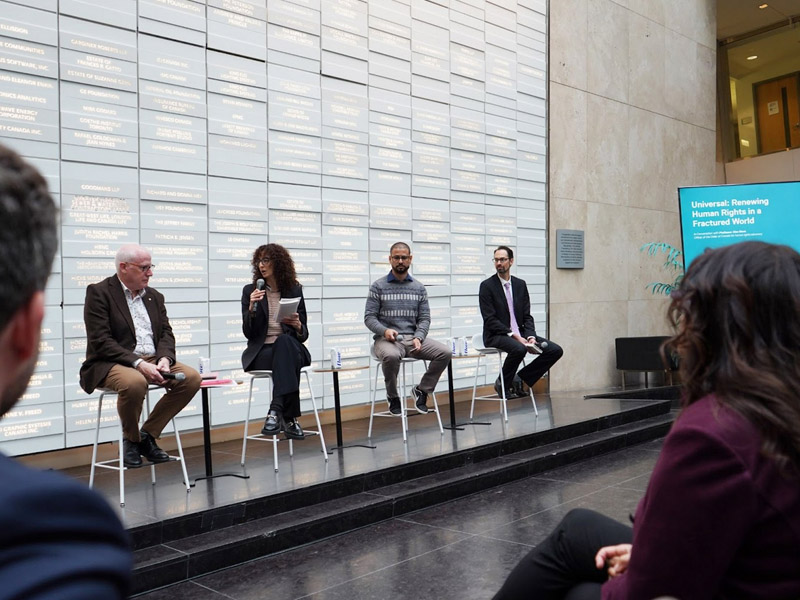
L-R: Prof. Neve was joined by Prof. Michele Krech, Judge Anderson Santos da Silva, and Prof. Christopher Campbell-Duruflé for a panel discussion.
Following the lecture, Neve answered questions from audience members and panelists including international law experts and professors Michele Krech and Christopher Campbell-Duruflé at Lincoln Alexander Law, as well as Anderson Santos da Silva, a sitting Federal Court Judge in Brazil and visiting scholar at the law school. The event concluded with an informal meet-and-greet with the author.
Maya Chwilkowski, second-year law student and President of the International Law Society at the Lincoln Alexander School of Law, said the talk reminded her of “the agency that we each have as individuals.” She was inspired by Neve’s call to expand human rights protections to nature, as the Innu Council of Ekuanitshit and the regional municipality did in 2021 when they granted legal personhood to the Magpie River in northern Quebec. “I think that’s a really beautiful approach to respond to the climate crisis,” she said.
Monica Kahindo, a Master of Science in Global Health student at McMaster University, attended the lecture at TMU and reflected on the courage of those who challenge entrenched systems. Neve’s talk “reminded me of all the individuals who felt at the time like they were up against massive forces, but they did it anyway,” she said. “Today, we probably have more tools, more resources, and better ways to build solidarity across the world.”
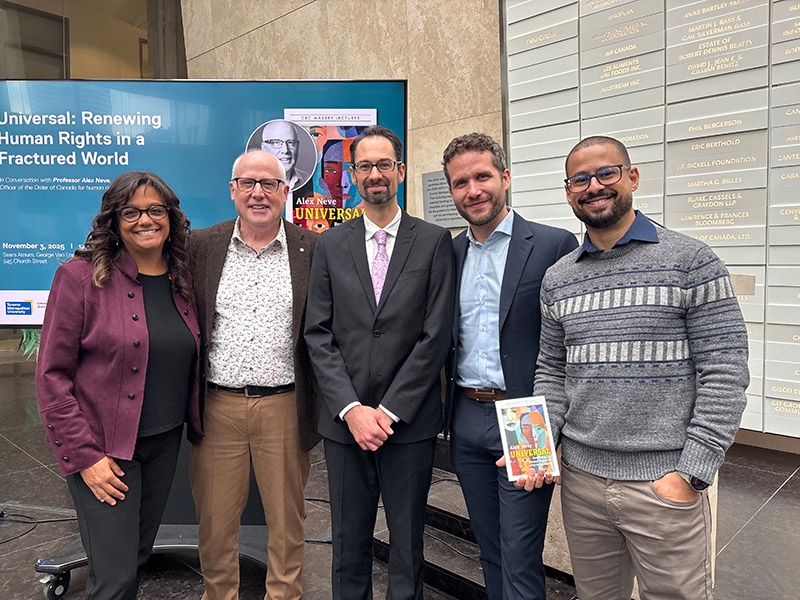
L-R: Dean Donna E. Young thanked Prof. Alex Neve, Prof. Christopher Campbell-Duruflé, Prof. Ed Béchard-Torres, and Judge Anderson Santos da Silva for creating a space for meaningful dialogue and reflection.
For Jasmine Ashfield, a first-year student at Lincoln Alexander Law, the talk underscored the urgency of overcoming fear when confronting rising facism and human rights abuses by powerful regimes and corporations. “We need to educate people on how to stand up for themselves and others safely – and not be bystanders, because bystanding is violence.”
Prof. Campbell-Duruflé noted that Neve’s lecture profoundly resonated with him and many others in the audience. “The reason many of us are here at Lincoln Alexander Law is because we want to be part of the renewal, to be part of the next chapter that fulfills the promises of the Universal Declaration of Human Rights,” he said.
“Sometimes we feel defeated when we see so much war and violence around the world, and so much poverty and inequality in our communities. Having someone like Alex Neve remind us of our mission is deeply energizing.”