This startup is teaming up with energy companies to reduce greenhouse gas emissions in Canadian homes
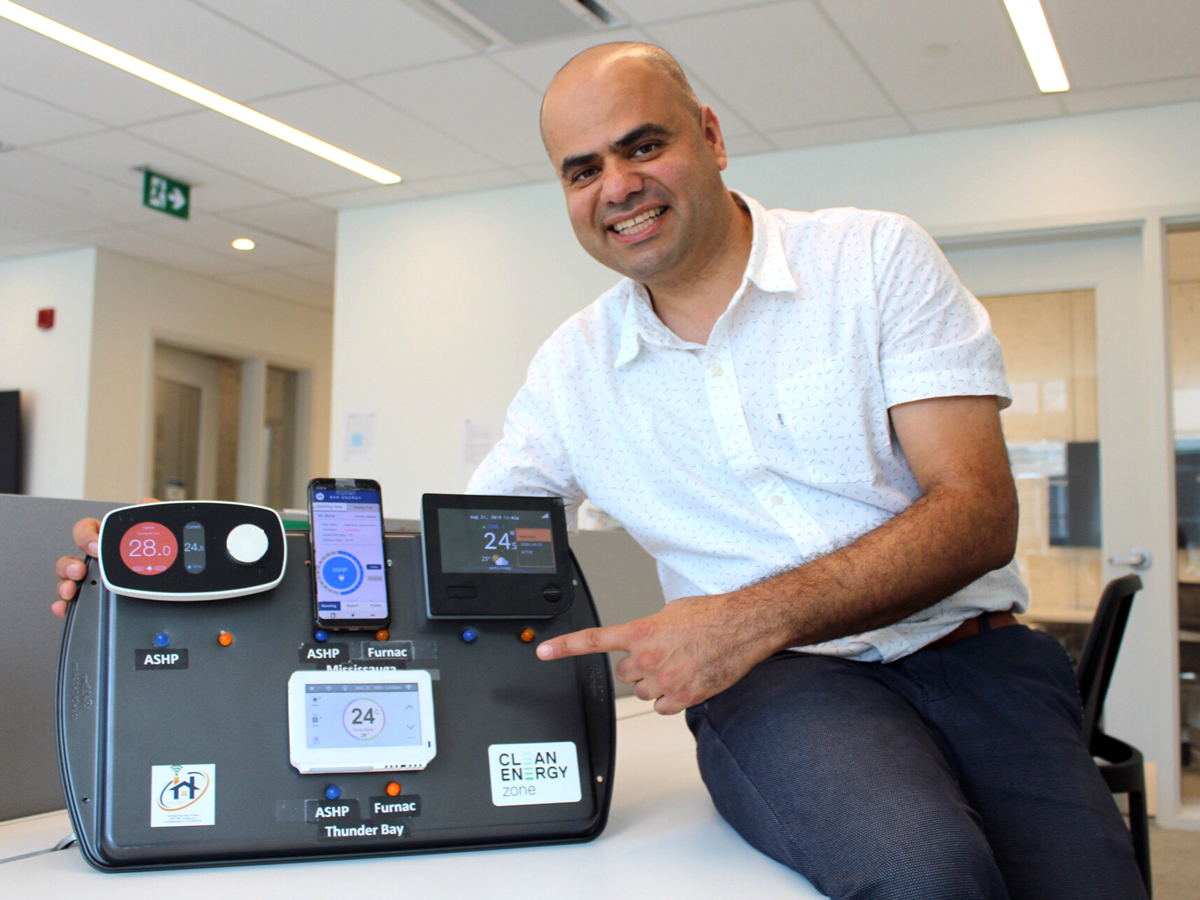
Nima Alibabaei, founder of Clean Energy Zone company BKR Energy. Photo: Madi Wong.
According to the Canada Green Building Council (external link, opens in new window) , buildings generate over 30 per cent of Canada's greenhouse gas (GHG) emissions.
Most Canadian homes have a typical HVAC (heating, ventilation and air conditioning) set-up: a furnace that runs on natural gas controlled by a thermostat.
Nima Alibabaei, founder of Clean Energy Zone Company BKR Energy (external link, opens in new window) , spotted huge potential in tackling the problem of greenhouse gas emissions by optimizing these HVAC systems. The company has been working on a technology that will help houses to switch from furnaces to heat pumps in an optimal manner. By using heat pumps, residents will consume electricity as opposed to natural gas.
When we last spoke to Alibabaei in 2018, his company had met with Natural Resources Canada (NRCan) to discuss installing their system in pilot homes. Since then, BKR Energy has made steady progress and added a host of additional partners, so we thought it was about time for another catch-up. Alibabaei’s responses have been edited for length and clarity.
Q: Can you tell us a bit about the HVAC product that you have been developing?
A: Using this technology, we are trying to demonstrate maximum GHG reductions at zero additional cost to the homeowner. Our pilot project results showed [that we were] very close to achieving it. What we are doing is cloud computing. We have smart algorithms that optimize the switch between furnaces and heat pumps in residential homes. All of the calculations are done on a cloud server and its results are sent via Wi-Fi to thermostats. Through the server, we can communicate to each thermostat, send results and it will read the command and implement it on the HVAC system.
Q: What projects has BKR Energy been working on in the past year?
A: We just finalized two pilot projects with Enbridge and NCan and are now working on the reports and reflections. We were testing our system in different pilot home locations. Some in Thunder Bay where there are colder outdoor temperatures, and other homes in Chatham, Ottawa and Toronto. We are targeting different homes in different climates to see how outdoor temperature and energy prices will impact the efficiency of our smart switching system.
Q: Have there been any challenges along the way?
A: I think most startups have to overcome a million challenges during their [journey]. Our first one was retrofitting and upgrading the existing HVAC system. To implement the technology, we needed to replace the existing [old] furnaces with new and high energy-efficient furnaces and coupled them with air source heat pumps. We needed to hire contractors to do the job for us and sometimes they worked well, and other times they had challenges with the homeowners themselves. In terms of cloud [server] development, sometimes things don't work the way they should but right now we have commercialized technology and have passed those hard days.
Q: What has the company gotten out of working in the Clean Energy Zone?
A: Two to three years ago, I was just a student. I was very new to running my startup. I had some desires for the future but didn’t know how I was going to move forward with them. But now we have some projects and collaborations with large companies like Enbridge and NRCan. I was introduced to excellent resources and an office space. I cannot thank them enough because I received very good and useful resources during my startup’s projects and company development.
Q: What does the future have in store?
A: We just started a new project targeting net-zero emission buildings. Based on Ontario's new building codes, the building will have minimal GHG emissions. Many of these buildings are equipped with both mechanical and electrical equipment. On the electric side, they have battery storage banks and electrical vehicles supporting GHG emission reduction. However, on the other hand they have furnaces that contributing to GHG emissions. In this project we are working on a controlled feature to manage all mechanical and electrical equipment together to minimize GHG emissions from buildings. Our smart switching technology is a portion of this project.
We are working with Alectra, Enbridge, and Sunverge Energy, a company coming from the United States. It’s a big team effort, we are working on software and cloud development to promote our current switching technology.
Madi Wong is a third-year journalism student at Ryerson University
"Two to three years ago, I was just a student. I was very new to running my startup. I had some desires for the future but didn’t know how I was going to move forward with them."